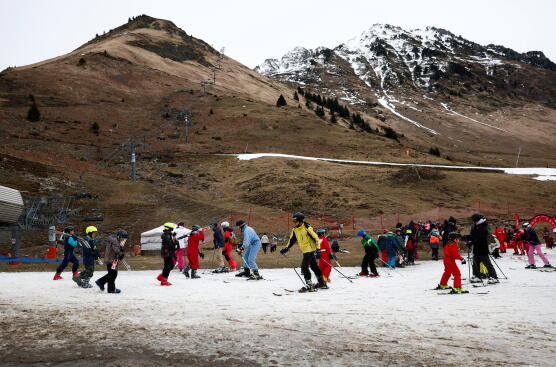
Written on 5 November 2023, updated on 11 May 2024. Above: a slope with artificial snow in France on 21 February 2024
Introduction: Below you will find the follow-up to ‘The Meloni government couldn’t care less about climate change and the environment’. But it is not the only one, unfortunately.
At the bottom, there is a short round-up of articles on the subject.
What was reported a few months ago has been further confirmed: Climate: why France and Europe are warming faster than average.
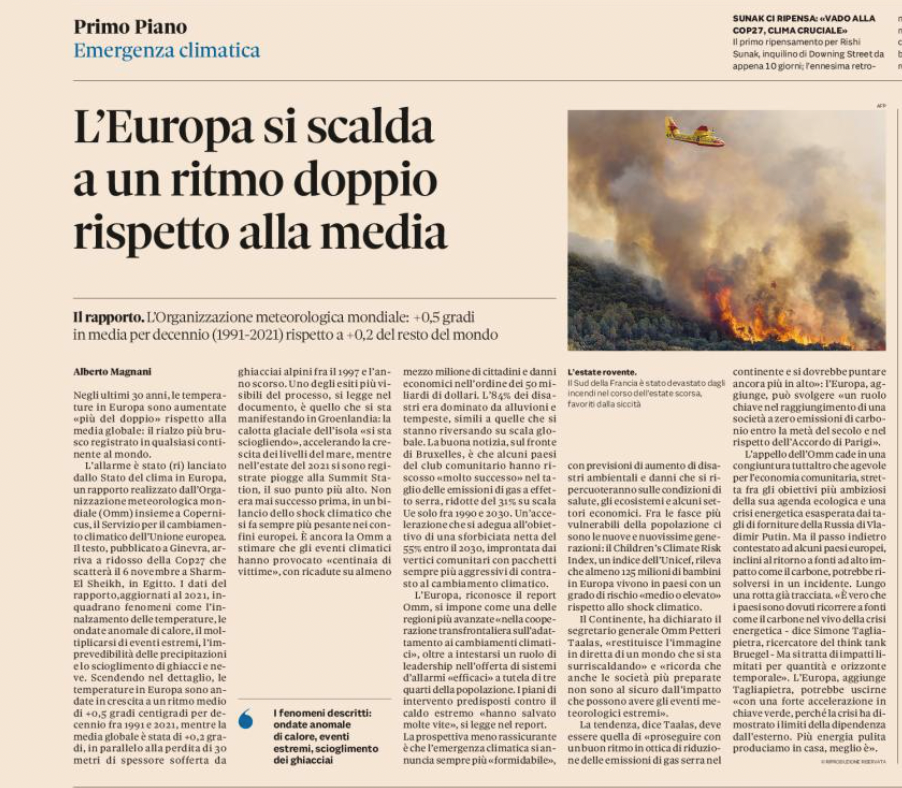
Europe is warming at twice the average rate
The report. The World Meteorological Organisation: 0.5 degrees on average per decade (1991–2021) compared with 0.2 for the rest of the world
Alberto Magnani
The south of France was devastated by wildfires last summer, fuelled by drought
Over the last 30 years, temperatures in Europe have risen ‘more than twice’ as much as the global average: the sharpest rise recorded on any continent in the world.
The warning has been (re)issued by *The State of the Climate in Europe*, a report produced by the World Meteorological Organisation (WMO) in collaboration with Copernicus, the European Union’s Climate Change Service. The report, published in Geneva, comes in the run-up to COP27, which is due to begin on 6 November in Sharm El-Sheikh, Egypt. The report’s data, updated to 2021, highlights phenomena such as rising temperatures, abnormal heatwaves, an increase in extreme weather events, unpredictable rainfall and the melting of ice and snow. Looking at the details, temperatures in Europe rose at an average rate of 0.5 degrees Celsius per decade between 1991 and 2021, whilst the global average was 0.2 degrees, alongside a loss of 30 metres in thickness suffered by Alpine glaciers between 1997 and last year. One of the most visible consequences of this process, the document states, is what is currently unfolding in Greenland: the island’s ice sheet ‘is melting’, accelerating the rise in sea levels, whilst in the summer of 2021 rainfall was recorded at Summit Station, its highest point. This had never happened before, as part of a climate crisis that is taking an increasingly heavy toll within Europe’s borders. The WMO also estimates that these weather events have caused ‘hundreds of fatalities’, affecting at least half a million citizens and resulting in economic damage amounting to around 50 billion dollars. Floods and storms accounted for 84 per cent of the disasters, similar to those currently occurring on a global scale. The good news, from Brussels’ perspective, is that some EU member states have achieved ‘great success’ in cutting greenhouse gas emissions, which fell by 31 per cent across the EU between 1990 and 2030 alone. This acceleration is in line with the target of a net reduction of 55 per cent by 2030, set by EU leaders through increasingly ambitious packages to combat climate change.
The UN report acknowledges that Europe stands out as one of the most advanced regions ‘in cross-border cooperation on climate change adaptation’, as well as taking a leading role in providing ‘effective’ warning systems to protect three-quarters of the population. The action plans drawn up to tackle extreme heat ‘have saved many lives’, the report states.
The less reassuring outlook is that the climate emergency is set to become increasingly ‘formidable’, with forecasts of a rise in environmental disasters and damage that will affect health, ecosystems and certain economic sectors. Among the most vulnerable sections of the population are the younger and youngest generations: the Children’s Climate Risk Index, a UNICEF index, finds that at least 125 million children in Europe live in countries with a ‘medium or high’ risk of climate shock.
The continent, said WMO Secretary-General Petteri Taalas, ‘provides a live snapshot of a warming world’ and ‘serves as a reminder that even the best-prepared societies are not safe from the impact of extreme weather events’.
The trend, says Taalas, must be to ‘press ahead at a steady pace with reducing greenhouse gas emissions across the continent, and we should aim even higher’: Europe, he adds, can play “a key role in achieving a carbon-neutral society by mid-century and in complying with the Paris Agreement”.
The WMO’s appeal comes at a time that is far from easy for the EU economy, caught between the most ambitious targets of its green agenda and an energy crisis exacerbated by cuts in supplies from Vladimir Putin’s Russia. But the controversial backtracking by some European countries, which are inclined to revert to high-impact sources such as coal, could prove to be a blip. Along a path already mapped out. “It is true that countries have had to resort to sources such as coal in the midst of the energy crisis,” says Simone Tagliapietra, a researcher at the Bruegel think tank, “but the impact is limited in terms of both quantity and duration.” Europe, adds Tagliapietra, could emerge from this “with a significant acceleration towards green energy, because the crisis has demonstrated the limits of external dependence. The more clean energy we produce at home, the better.”
The explanation for this difference compared with the rest of the world? Heatwaves are becoming more common in all parts of the world, but Europe is warming faster than the global average due to its high proportion of land mass and its location on the Earth’s surface.
How desertification is changing Italian tourism
Drought is severely undermining Italy’s agricultural GDP: why Coldiretti’s warning is realistic.
Commodity prices will not stabilise in 2022, partly due to the climate.