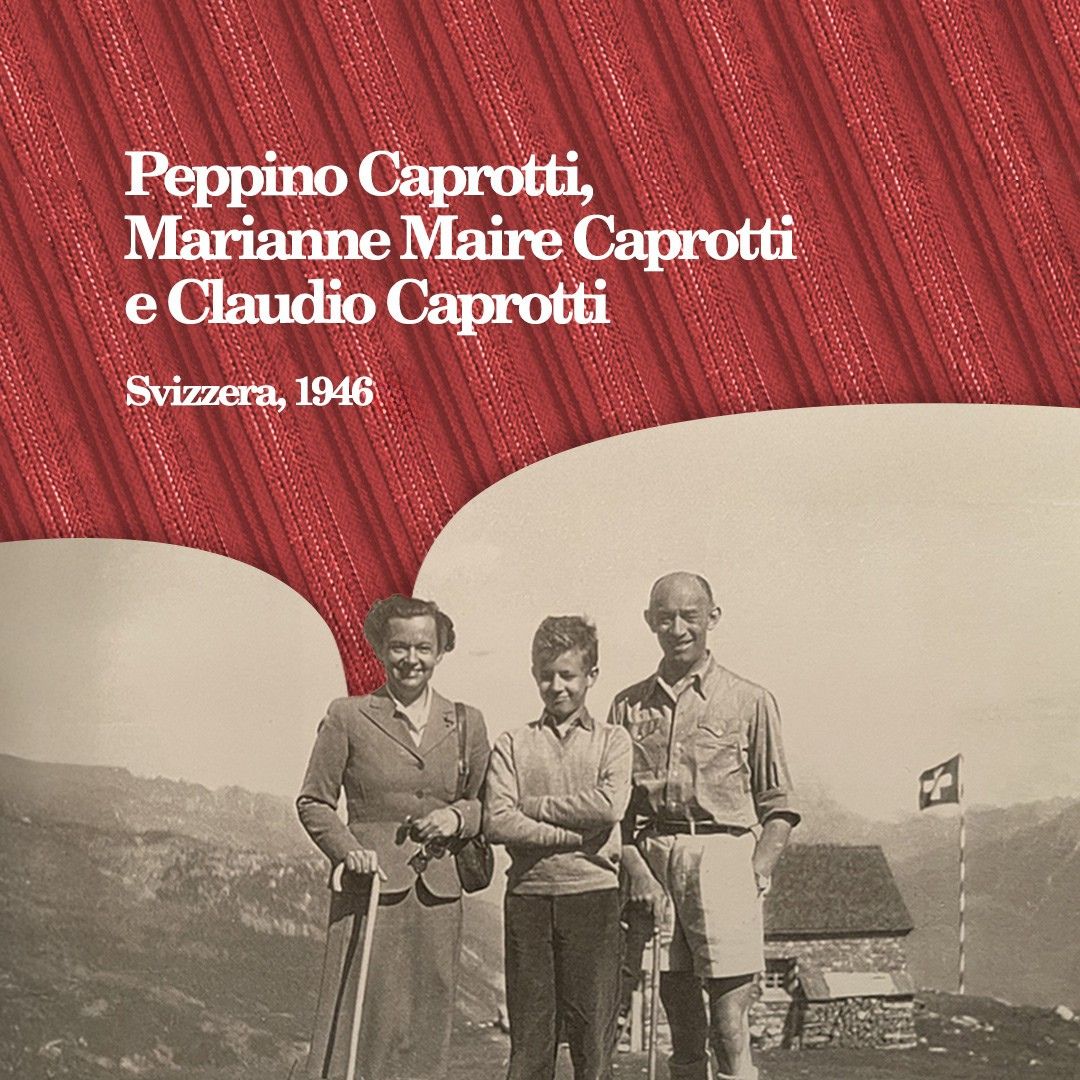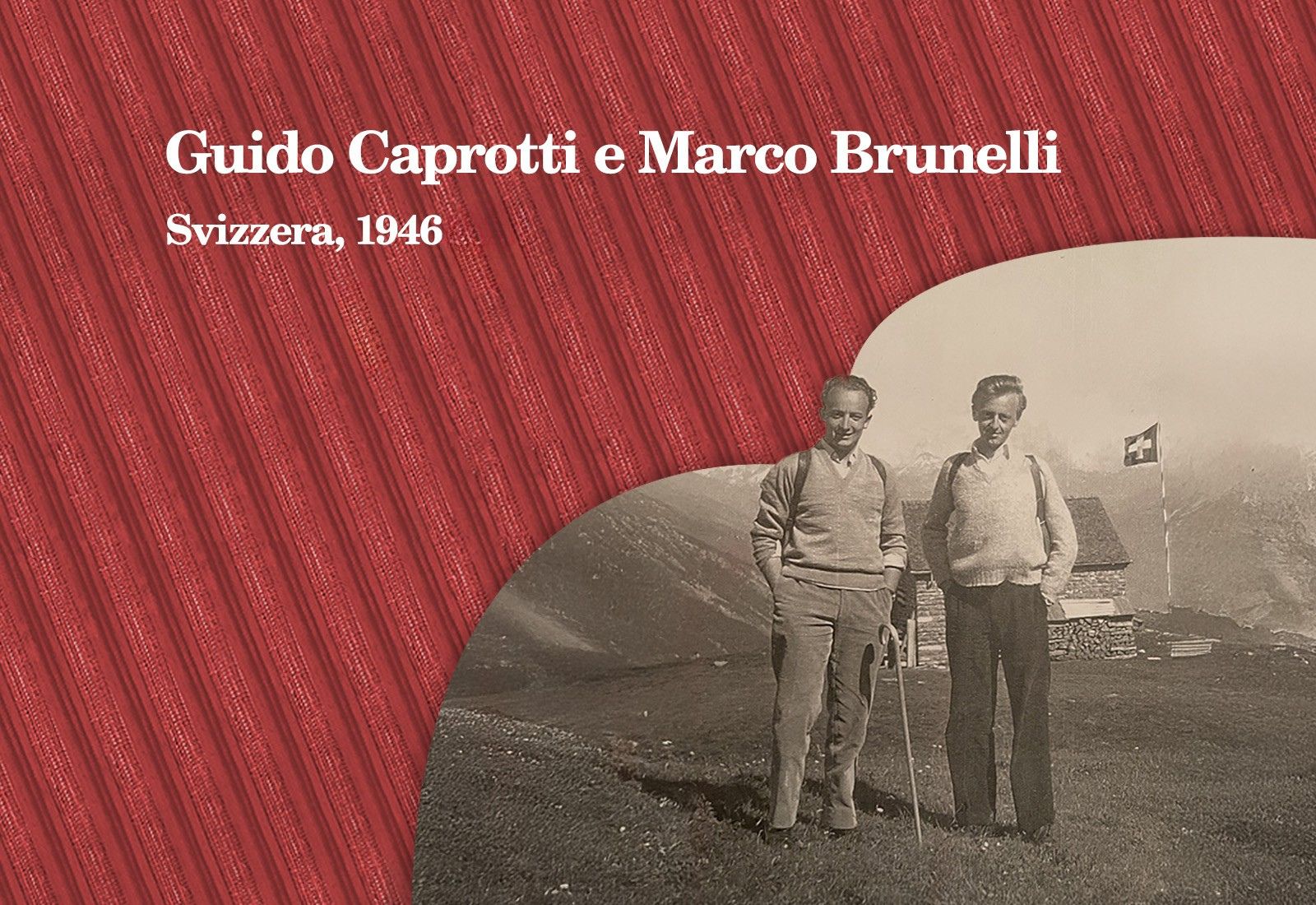
A family outing to Switzerland after the First World War, parents, children and a friend of a son, now also family. In the same spot, two photographs: one of Guido Caprotti, on the left, and his lifelong friend Marco Brunelli, on the right, both very young, both relaxed under the lens, almost certainly, of Guido’s older brother Bernardo, my future father. The rest of the excursionists are also photographed, Guido’s parents, Marianne Maire and Peppino Caprotti, and among them Claudio Caprotti, the last of the siblings, who couldn’t have been more than a dozen years old. We should therefore be in the early post-war period, around 1946: Uncle Guido was 17, Marco Brunelli, 19. A close, complicit friendship, rich in interests and fellowship, and very young, born when both are still at school. It is one of those friendships that creates fraternal bonds, so much so that the family welcomes the young friend as another member of their circle, of their everyday life, going so far as to make him participate in family outings as a matter of course.
Thistrue friendship, this familiarity that leads to the ‘best friend’, a fundamental figure in the growth path of most adolescents, will not many years later result in a fundamental step not only for Uncle Guido and Marco Brunelli, but for the whole of Italy, which is rapidly moving towards the contemporary economy.
As I recounted at length in my book ‘Le Ossa dei Caprotti’, if the Caprotti brothers entered the supermarket adventure, the first in the Peninsula, it was thanks to Marco Brunelli. The latter, first contacted by Nelson Rockefeller ‘s emissaries (the US tycoon who programmatically exported the American system to the western world, including supermarkets), thought it best to involve his friend Guido and, in concert, his elder brother Bernardo (Claudio, still a minor, would arrive later).
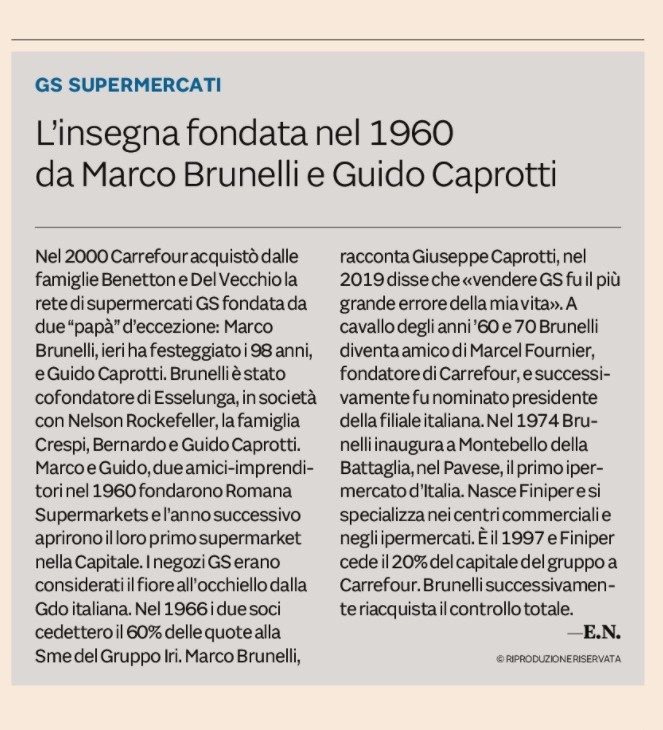
The story is long, adventurous, sometimes robbery, and will lead to the birth of the Esselunga supermarkets. Another story, which is also exciting, features just the two friends, Guido and Marco: “In May [1960] (…), Brunelli and my uncle Guido founded a chain of supermarkets together with the aim of focusing on Rome, the city that the IBEC [Rockefeller’s company that led to the founding of the future Esselunga, ed The first shop opened in a ‘splendid location because it was close to the Parioli district (…). The success was immediate and the company began to expand like wildfire, quickly involving other shareholders and in 1966 it entered the state orbit: 60 per cent of the capital was in fact taken over by the public finance company SME, which (…) changed its name to GS (Società Generale Supermercati) and decided to land in the Milan market (…). In short, Brunelli and Uncle Guido had seen it right, starting what would very quickly become one of the strongest large-scale distribution companies. The GS brand would live on for a long time and the network of supermarkets built over time still exists today (…)’. (Caprotti, ‘The Bones’, pp. 68-69).
Unfortunately, GS led to the end of the old friendship, and this was due to my father Bernardo who, ‘despite the success of the operation, became angry with his brother and called him back to Milan. Uncle Guido could not even attend the inauguration of the first shop, despite being an equal partner with Brunelli. He suddenly stopped giving news of him, leaving his friend bewildered‘.(Ibid.).
Marco Brunelli never forgave Bernardo for this; but even if he and Uncle Guido painfully went their separate ways, they would never forget each other.
That is what the smiles in that distant photo mean.
Sources:
Florence, Claudio Caprotti Archives, Photographic Archives.
Bibliography:
G. CAPROTTI, “Le Ossa dei Caprotti. Una storia italiana’, Milan 2024/3.
“Giuseppe Caprotti. Characters. Guido Caprotti (1929-2012)”.
“Giuseppe Caprotti. Characters. Marco Brunelli (1927-)”.
“Giuseppe Caprotti. Characters. Bernardo Caprotti (1929-2016)”.
“Giuseppe Caprotti. Personalities. Nelson Rockefeller (1908-1979)”.
“Giuseppe Caprotti. Characters. James H. Angleton (1889-1973)”.