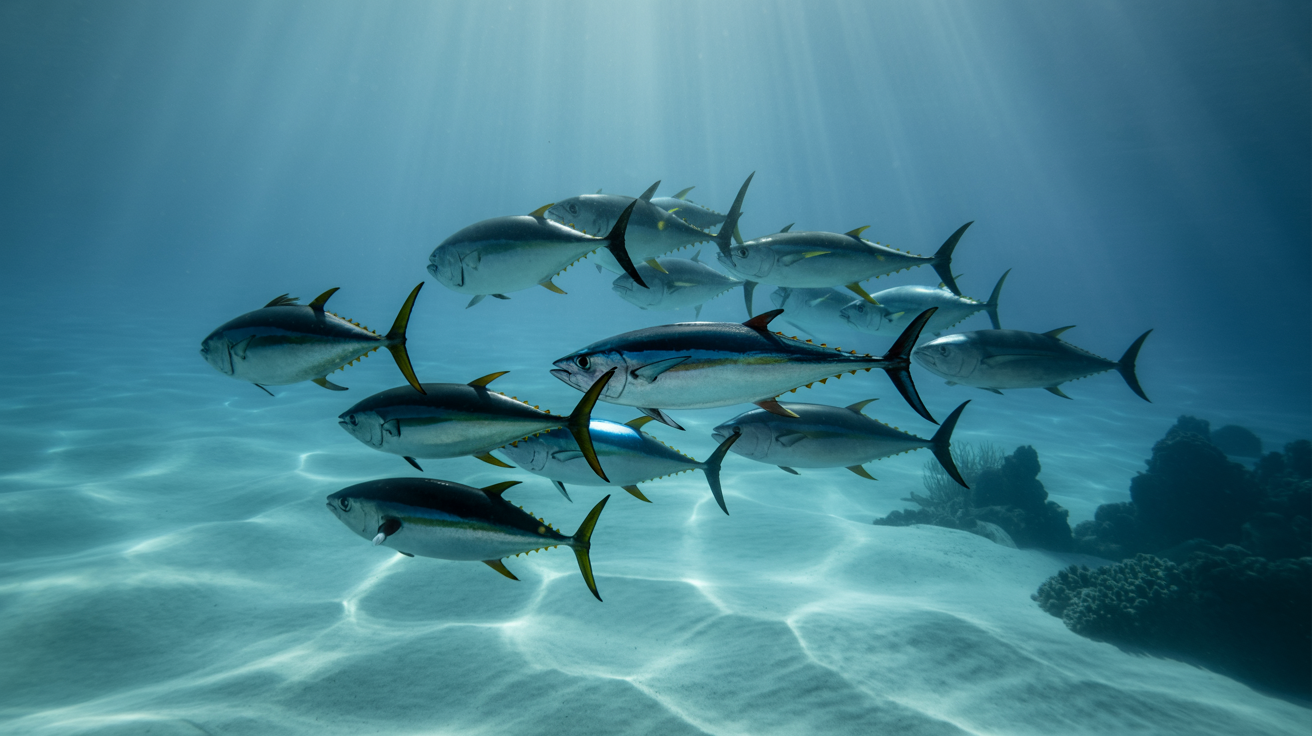
More than 10 years ago we wondered whether the bluefin tuna was protected , and the answer unfortunately is this:
The ecological tragedy of the bluefin tuna, a global affair between luxury and profit that has brought the species to the brink, with only a fragile recovery.
Once a symbol of abundance and nourishment for coastal civilisations, tuna has become the focus of an unsustainable trade
The Mediterranean, a millennial cradle of civilisation and biodiversity, is now the scene of an industrial revolution that is transforming one of its oldest symbols: bluefin tuna. What was once a mythical fish, the nourishment of coastal communities, has now become a luxury product, a ‘red gold’ contended by global markets and bred in huge floating cages that are gradually upsetting the marine balance.
A ruthless economic system
In a months-long investigation carried out by journalists from Le Temps, a leading Swiss online French-language newspaper, and reported in Internazionale, the reporters calculated the total unsustainability of the system, starting with a resounding fact. Behind every kilo of bluefin tuna exported lies an economic mechanism that could be described as predatory.
Suffice it to say that to produce one tonne of fattened tuna, around 15 tonnes of blue fish – sardines, anchovies, mackerel – are sacrificed in a conversion ratio that far exceeds any logic of sustainability. In 2024, between 45 and 50 thousand tonnes of tuna were exported from the Mediterranean, consuming the equivalent of more than a third of the entire stock of small fish caught in the area.
Malta: the epicentre of business
The small Mediterranean island has become the world’s hub of intensive tuna farming. With only 26 fattening cages, Malta runs an industry worth hundreds of millions of euros. Every day, five hundred tonnes of frozen fish leave the port of Marsaxlokk to feed these ‘marine farms’, in an operation that is more reminiscent of a factory than a natural ecosystem.
The global luxury chain
The tuna’s journey is, in short, a tale of global inequalities. Caught in the Mediterranean, artificially fattened, exported to Japan, Korea and the United States, where it can reach staggering prices. It can apparently cost up to nine thousand euros per kilo at an auction in Tokyo. A folly for a fish that travels thousands of kilometres, consumes resources and generates a devastating carbon footprint, to satisfy a niche market.
A story that has something incomprehensible about it, especially for scientists and biologists who are raising ever more pressing alarms: bluefin tuna, in fact, are extraordinary creatures and play a crucial role in the marine ecosystem in terms of nutrient turnover and oxygenation. The current farming system, however, which catches them before they reach maturity, interrupts biological cycles that are thousands of years old.
Emanuela Fanelli, a biologist at the University of Marche and marine ecology expert, interviewed by journalists, speaks of ‘apex predator aquaculture’ as a totally unsustainable model. While Marcel Kroese, renowned South African biologist and marine policy advisor to governments and NGOs, compares this system to ‘an aberration like breeding lions for meat, sacrificing thousands of gazelles’.
A global justice issue
The whole industry is an example of colonial exploitation of marine resources. The demand for sushi and sashimi in luxury markets, as well as for cocoa in Africa, has created an unsustainable system that impoverishes local communities and traditional fishermen who are progressively dispossessed of their seas, while about six companies, traceable to a dozen families, run a billion-dollar business.
Change is needed, the bluefin tuna industry is at a crossroads: experts warn that continuing along this path means condemning an entire marine ecosystem to collapse. This is a story that goes beyond fish, but becomes a sad metaphor for a global economic system that is increasingly moving away from environmental and social sustainability.
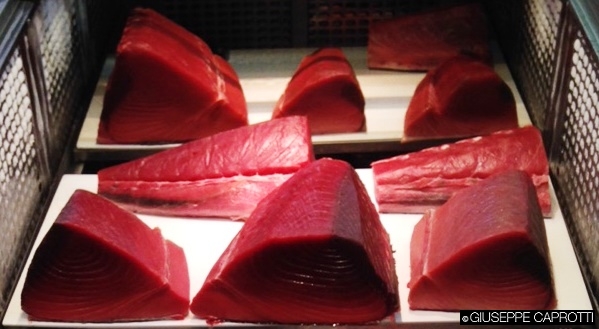
Below: tuna at the fish market in Tokyo
The bluefin tuna has been exploited for centuries. In the last 100 years it has been increasingly intensively exploited, to the extent that it has caused not only a decline in population, but even genetic erosion of the precious fish in the Mediterranean Sea. What does this mean? The loss of genetic diversity within bluefin tuna populations, which can have important consequences. One of these is a reduced ability to adapt to climatic and environmental changes, such as ocean warming or new diseases. In short, genetic impoverishment exposes the species to greater risk factors, even toextinction. These two important discoveries are the result of an international collaboration in which the University of Bologna took part, publishing the results in the scientific journal PNAS. A collaboration involving marine biologists, geneticists and archaeozoologists, scientists from different disciplines and different historical periods. Those who study the present and those who study the past
è … a clear example of how human intervention first brought the species to the brink of collapse, only to abruptly backtrack to an astonishing recovery and stabilisation.
In recent decades in particular, bluefin tuna fishing in the Mediterranean and eastern Atlantic has been characterised by an increasingly unsustainable intensity. Driven by growing global demand, fishing fleets have become larger and more specialised, using increasingly efficient technologies. Between the 1990s and the early 2000s, catch estimates far exceeded the quotas recommended by international bodies monitoring the species, driving the stock to dramatically low levels. With theInternational Union for Conservation of Nature (IUCN ) – the largest and oldest global organisation dedicated to the conservation of the environment – sounding the alarm of danger, there were also fears for the survival of the species.
Fortunately, in the first decade of the new millennium, extremely strict multi-annual management plans were introduced to prevent the depletion of bluefin tuna, resulting in annual quotas set for the fishery, with extensive combating of illegality, prohibition of seasonal fishing, and protection of juvenile fish to allow reproduction. As of 2015, the International Union for Conservation of Nature downgraded the status of bluefin tuna from ‘endangered’ to ‘near threatened’. And annual quotas have risen again: for Italy, for example, quotas have significantly increased from over 4,300 tonnes in 2019 to over 5,200 in 2023. In short, a positive story of how human effort can solve the problems it has caused. A similar story to what is happening with pollutant emissions and climate change.
But let us return to the study by the University of Bologna, in which researchers conducted a series of genomic analyses, drawing a picture that changes our knowledge of the impact that exploitation has had on bluefin tuna and marine ecosystems. The investigation was conducted on modern and ancient samples, totalling 90 samples: 49 obtained between 2013 and 2020 and 41 dating back up to 5,000 years ago. All came from different areas of the Mediterranean and Atlantic.
Considering that fishing began in the second half of the 20th century, becoming truly intensive since the 1980s, according to the study, bluefin tuna began to suffer population decline and genetic erosion around 1800, when for millennia it remained essentially unchanged. “Our research shows how anthropogenic pressure related to historical overfishing has profoundly affected not only the abundance of bluefin tuna, but also its genetic structure, which until the 19th century had remained surprisingly stable,” said Adam Andrews, lead author of the study…
“Reconstructing the ancient and historical genetic dynamics allows us to quantify the human impact and more accurately establish recovery margins. Ancient DNA is a window to the past that helps us look to the future with greater awareness,’ commented Elisabetta Cilli, palaeogenomics expert and senior author of the paper.
Conclusion: fish consumption is good for you but tuna is – after swordfish – the most polluted species of all (read more on page 16 of this important study).
This information is not new: canned tuna: too much mercury. In a study published on Tuesday, Bloom warns of mercury levels in canned tuna consumed in France and Europe. A ‘health scandal’, according to the NGO, which assures that 100 per cent of the products tested contain the dangerous substance.In high doses, mercury is toxic to the human central nervous system. The subject was already covered here.
Bluefin tuna, also for the reasons stated above – pollution and possible extinction – should therefore be consumed ‘in moderation’.
Below: swords for cutting fish at the Tokyo market.