
Compiled 25 August 2023, updated 19 April 2025
At the bottom of this article you will find various updates, the latest, which gives much hope, is that a decree to limit Pfas pollution of drinking water in Italy is on the way
- I had written: Europe launches a plan for PFAS, what they are and why it concerns us closely: Veneto aquifer polluted
Phthalates, bisphenols, PVC, parabens, glycol ethers, brominated flame retardants, perfluorinated compounds (PFAS)..
These so-called ‘everyday’ pollutants are everywhere: toys, baby bottles, dummies, food packaging, clothing, furniture, electronic devices, cosmetics, paints, cleaning products. In total, several thousand toxic products will be banned in the coming years.
I anticipate some of my considerations:
PFAS are everywhere, even in toilet paper.
In the first attachment below, which talks about tobacco and sugar, the oil industry is definitely missing, which, for decades, knew that it was behind climate change and not only denied the evidence, but also made counter-information. Now, after the energy crisis generated by the war in Ukraine, it is reinvesting heavily in oil and gas.
Europe, despite the dangers of PFAS, seems to be backtracking: you can read the whole story in the third appendix, at the bottom of the article.
In Veneto: the epidemiological study on the impact of Pfas contamination was ready to start, in 2018, but was blocked by political decision. The agreement between Iss and the Veneto Region also indicated a forecast of co-financing, approved by Iss while the Veneto Region never signed it.
According to a Danish study, PFAS would contribute to the obesity pandemic, and thus also to cancer.
PFAS are present in the majority of drinking water samples in Italy and France and the fundamental question therefore arises: Bottled water or tap water? – Guido Venosta Foundation
More worrying is the European situation where the chemical lobby slows down new regulations, no longer ‘fashionable’ (but let us remember that Pfas are carcinogenic).

Like tobacco and sugar, the production of perfluoroalkyl substances, the notorious Pfas, has also been the subject of repeated fraudulent behaviour on the part of manufacturing companies.
These companies, like those that sell cigarettes and sugary drinks, willing to do anything to continue to increase sales, have consolidated habits that would later be difficult to break, and have continued to conceal very worrying data, while denying that these 15,000 substances, considered perennial, could represent a risk to human health.
But, as with the other two areas, the moment of truth has arrived for Pfas, after years of heated controversy, lawsuits, books and even films all pointing in the same, unequivocal direction: that of harmful effects that are increasingly difficult to hide and deny.
Researchers at the University of California at San Francisco have in fact just published, in the Annals of Global Health, an analysis of documents that have remained secret, almost always internal and confidential, from two of the main Pfas-producing companies, the giants DuPont and 3M, covering the period from 1961 to 2006, donated to the university by one of the key protagonists of the whole affair, lawyer Robert Bilott, the first to file a lawsuit against the chemical giants and win it. Bilott, on whose affair the film Bad Waters was also made, gave all the documentation he had collected to the producers of a documentary, who in turn gave it to experts to analyse in depth, and the result is a report with the explicit title: The Devil They Knew: Analysis of the chemical documentation on the influence of industry on Pfas science.
The study shows very clearly how the two companies were in possession of both epidemiological data, on employees working on Pfas production lines, and results obtained internally on animal models, the conclusions of which were very clear.
Lawyer Robert Bilott put the spotlight on Pfas pollution of the water surrounding a production plant
Among the many elements that emerged, here are a few:
- As early as 1961, the head of DuPont’s toxicology department reported that Teflon caused the liver of animal models to swell at low doses and urged that the substance be handled with extreme caution, absolutely avoiding any contact with the skin;
- In 1970, a report commissioned by DuPont from an external laboratory concluded that C8, one of the most commonly used Pfas, was toxic if inhaled or ingested in very low doses, and in another, from 1979, the same laboratory stated that some dogs had died two days after ingesting a single dose of another of the most common Pfas, Pfoa;
- In 1980, DuPont and 3M had learned that two of the eight pregnant employees working at C8 had given birth to children with malformations, but they had not told anyone, including the women, nor had they advanced any hypothesis of a connection; on the contrary, a few months later they declared that there was no evidence that C8 was dangerous to the foetus. According to DuPont, C8 was as stable and safe as table salt, while in the face of environmental contamination, in 1991, the company still maintained that there was no danger at the doses detected.
Shortly afterwards, following a series of lawsuits filed between 1998 and 2002, DuPont itself had urged the US Environmental Protection Agency (EPA) to declare Teflon safe (within 24 hours), because the Pfoa (perfluoro-octanoic acid) it contained was a precisely safe substance and any fears on the part of consumers had to be dispelled.
Then, in 2004, came the first setback: the EPA condemned DuPont to a $16.4 million fine for failing to disclose data on the hazardousness of Pfoa: trifles, if you think that the company had earned a billion dollars from Pfas that year. But something changed then (and other lawsuits have since been lost), to the point that today many countries are questioning how to put limits on the use of Pfas and how to try to eliminate them from the environment.
The EPA, for its part, seems to be an exception: its top management, all appointed by Donald Trump and known to be, like the former president, much more interested in business than in the health of citizens, has just made a decision that sets the agency back decades. As reported by the Guardian, which has been following the Pfas affair with investigations and reports for years, the agency is allowing the company Inhance Technologies, which has followed in the footsteps of DuPont and 3M by lying repeatedly and is still involved in numerous lawsuits and class actions, to continue to produce plastic containers – mainly for foodstuffs – full of Pfas. Inhance produces about 200 million pieces per year and, according to various environmental and consumer associations, does so by treating plastics with a vaporisation of fluorine derivatives that generates at least nine different Pfas over time, directly in the plastic, releasing them into the contents: for example, very high concentrations have been found in pesticide containers and are generally found in plastic bottles, to the point that the EPA itself has called for more controlled procedures. In 2022, Inhance claimed to have modified the process to the point where plastics release negligible amounts of Pfas, which was promptly denied by a Notre Dame University study. But the agency seems to have no difficulty in allowing the same company to continue producing plastics that release Pfas.
Meanwhile, as the list of widely used products in which very high concentrations of Pfas can be found grows (among the latest: daily contact lenses and tampons), so do the studies associating them with negative health effects, such as on female fertility.
Below: DuPont and 3M have known for decades that Pfas, used for example in the production of Teflon, are dangerous to health

Pfas, compensation of almost $1.2 billion from three chemical companies
Ansa
Per and polyfluoroalkyl substances, known as Pfas, are believed to cause cancer and other health problems and take a very long time to break down
Three major US chemical groups will pay nearly $1.2 billion to settle claims following allegations that they contaminated water sources across the US with the harmful chemicals known as Pfas.
Chemours, DuPont, and Corteva said in a joint press release that they had “reached an agreement in principle to resolve all claims related to Pfas in drinking water” for areas serving “the vast majority of the population of the United States.” A total of $1.185 billion will go into a settlement fund, with Chemours contributing $592 million, DuPont paying $400 million, and another $193 million added by Corteva.
Per and polyfluoroalkyl substances, known as Pfas, are believed to cause cancer and other health problems and take a very long time to break down. Since the 1940s, they have been used in a wide range of industrial and consumer products, such as non-stick pans, carpets, waterproof clothing, food packaging, cosmetics and cleaning items. In addition to the settlement reached by the trio of companies, Bloomberg reported that industrial giant 3M signed an agreement in principle worth at least $10 billion to settle other Pfas-related lawsuits filed by several US cities. Earlier this year, the US Environmental Protection Agency (EPA) proposed new standards to limit Pfas in public drinking water, requiring companies to monitor six chemicals and reduce their levels. The EPA proposal, which will be finalised by the end of the year, will set national standards for Pfas in drinking water.
3M has also been the subject of Pfas lawsuits in Europe. In 2022, the company agreed to a €571 million settlement with the Belgian region of Flanders over Pfas chemical discharges around its plant in Zwijndrecht, near the Belgian city of Antwerp. Last week, the Dutch government also said it would seek compensation from 3M for damage caused by its chemicals in the Western Scheldt River, which flows into the North Sea. Last year, Dutch authorities warned against consuming fish, prawns, mussels and other products from the Western Scheldt because of high Pfas levels. In December, 3M declared that it would stop producing these substances by the end of 2025, in light of stricter regulation.
In reality, 3M’s situation in the US (read the Wall Street Journal of 30 August 2023, below) is much more complicated: it will probably have to pay a sum of $10 billion and face lawsuits from several US states over water quality altered by its discharges. It is expected to be one of the largest litigations in history, perhaps larger than the one against Bayer over glyphosate.
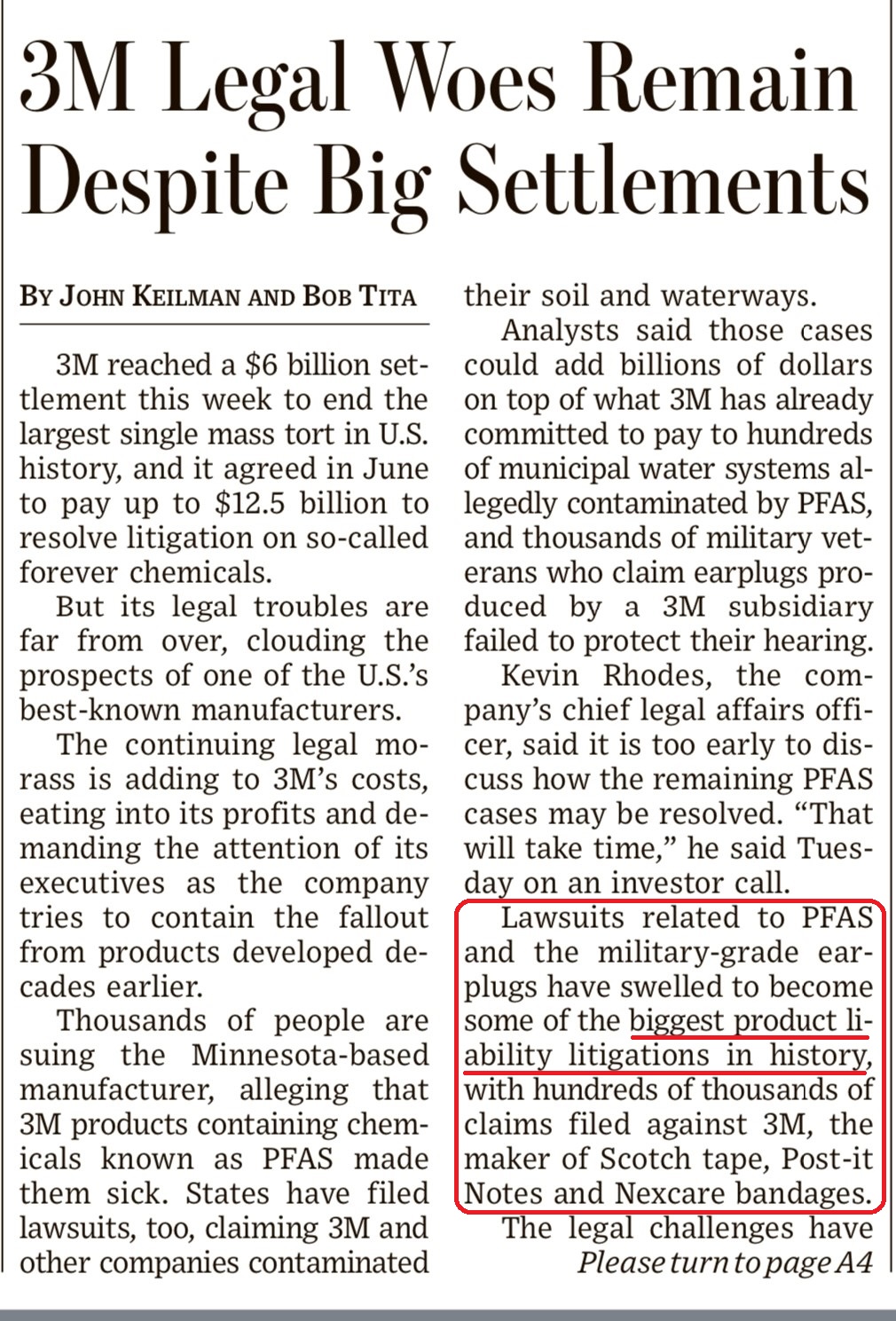
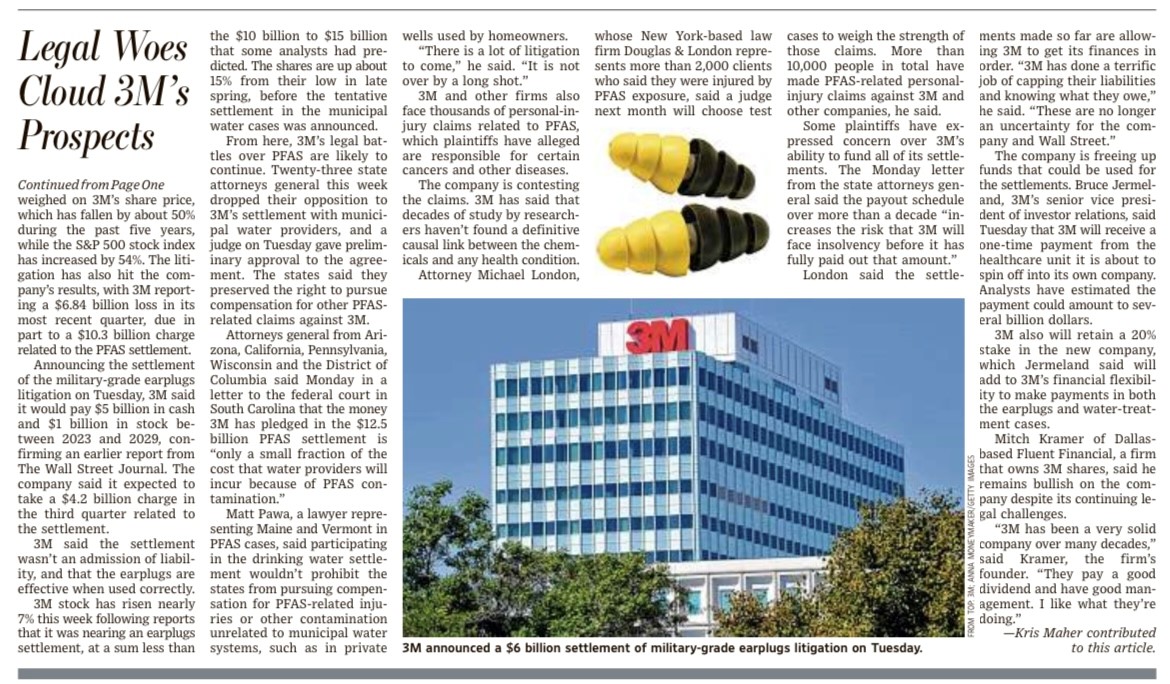
Above: 3M was our supplier of Esselunga-branded photographic film, as well as supplier of videotapes and stationery (post-it, etc.).
But Europe takes back the enforcement of Pfas bans:
the update of the Reach regulation has slipped because of a clash between two departments of the European Commission that were working on the text: the one dealing with the environment, in favour of more restrictive measures, and the one deputed to the internal market, which opposed it. A legislative document seen by the Guardian reveals that the Commission is considering three possible options, respectively a 50%, 10% or 1% restriction of hazardous chemicals currently available on the market.
A source inside the European institutions told the British newspaper that in Brussels there has been ‘a complete change in the wave of support for consumers and the environment‘, from which the ‘Green Deal’ and the ‘Farm to Fork’ strategy were born in 2020, two initiatives that have been losing ground in recent months due to pressure from various industrial sectors (including agribusiness), with the support of some political parties, especially from the right and centre-right.
In fact, the aforementioned European People’s Party has proposed a ‘regulatory moratorium to postpone those acts that would unnecessarily increase costs for companies … such as the Reach regulation‘. These were joined by interference from some heads of state, such as French President Emmanuel Macron and Belgian Prime Minister Alexander De Croo.
The heaviest pressure, however, probably came from Germany. The German Chemical Industry Association (Vci) had called for the ban to be postponed until as early as March 2022 and last June declared, through its director Wolfgang Grosse Entrup, that the proposal to ban Pfas would have ‘fatal’ effects for German industry. According to data from the association Corporate Europe Observatory, 11 German Pfas operators employed 94 lobbyists, spending a total of EUR 9 million. In Brussels, 12 members of the Pfas industry have 72 active lobbyists, spending between EUR 18 and 21 million annually.
The reform of the Reach regulation was one of the priorities of Commission Vice-President Frans Timmermans, who declared in 2020: ‘It is particularly important to stop using the most harmful chemicals in consumer products, from toys and baby products to textiles and materials that come into contact with our food’. Now, however, it seems that the Commission’s promises have to bow to the will of industry, along with the interests and health of people
Note:Reach is the European Union Regulation of 18 December 2006 on the Registration, Evaluation, Authorisation and Restriction of Chemicals.
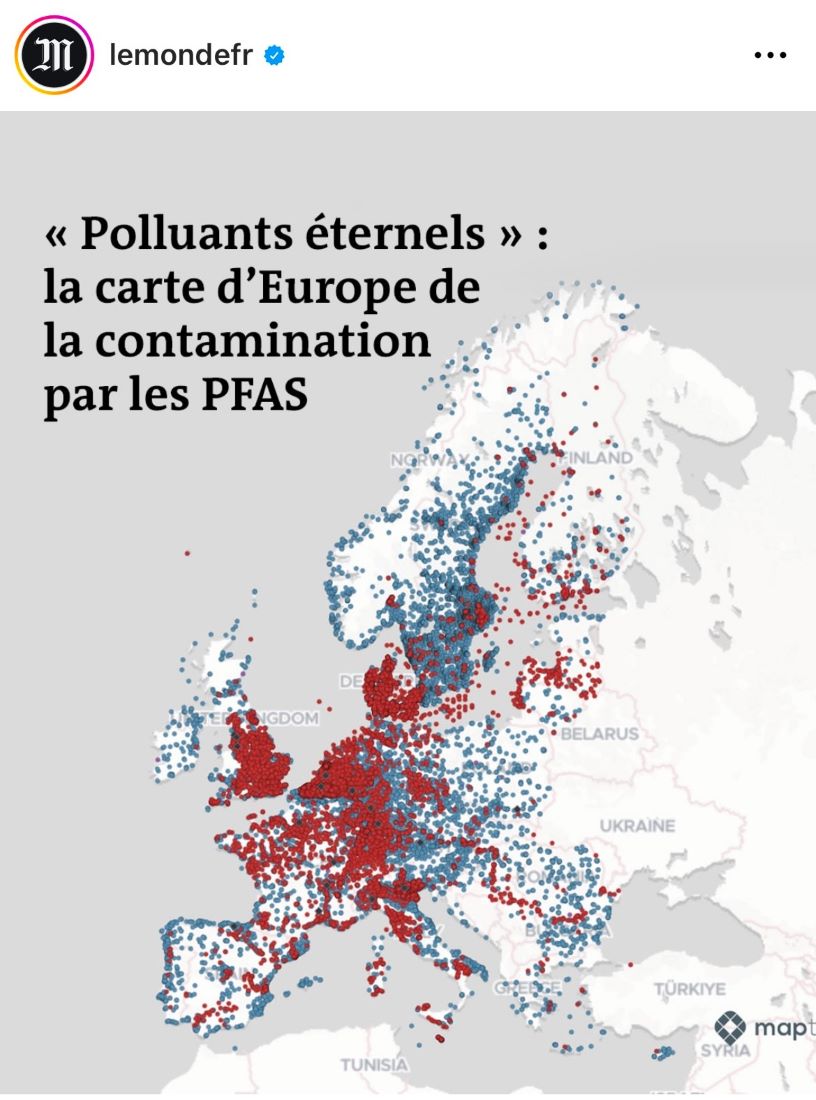
Below : on the map of Europe you can see the level of contamination (red : strongest).
Updates:
- Pollution. From jackets to pizza boxes, even Europe now limits Pfas (November 2024)
- but the battle over pfas in Europe has only just begun Le Monde reports: The plastic lobby’s disinformation campaign to defend PFAS (January 2025)
- and rid Europe of Pfas will cost €100 billion a year, for 20 years.
- on Teflon, read Cooking utensils – Teflon, plastic, silicone, melamine… Which materials should be preferred?– Tips – UFC-Que).
- On water you can read this article updated to December 2024.
- On microplastics read here.
- Bisphenol A banned from food containers in Europe after a long battle(Bisphenol, Pfas and more: from pushchairs to make-up, still too many dangerous substances on sale in the EU)
Below: Pfas-free frying pan