Compiled 6 July, updated 13 September 2024
The US and China are fighting an all-out trade war.
Online.
Now Amazon counterattacks, against Temu and Shein
with the new section of its website, the e-commerce giant is trying to counter the business model of rivals selling at reduced prices, directly from China
Amazon plans to deliver ultra-cheap goods directly from China in nine to eleven days .
…
In a recent meeting with leading Chinese sellers, the US group outlined the new channel, which aims to ship goods to US buyers from warehouses in China, according to a presentation seen by the Financial Times. Amazon plans to include the new section on the home page of its app and deliver the goods cheaply in a nine- to 11-day timeframe, the presentation said. The offer would target US consumers willing to wait longer than Amazon’s typical one- or two-day delivery schedules.
The US group’s rush to offer cheap goods direct from China comes as it faces growing competition from Temu and Shein, which have grown rapidly by covering the Internet with advertisements for their low-priced toys and clothes.
Temu, owned by PDD Holdings, and Shein have perfected business models that rely on Chinese merchants shipping goods to warehouses in southern China that are then shipped via cargo planes to foreign countries. Individual consumer packages benefit from the de minimis rule, which many countries have in place to allow citizens to receive packages from abroad below a certain value without paying import tariffs. In the US, the threshold is set at $800 per parcel. Temu and Shein’s use of the loophole has allowed a flood of Chinese goods to reach the doorstep of American shoppers while skipping tariffs on Chinese imports that have increased during the Trump administration.
Both companies have been criticised by US politicians for the practice, and lawmakers in Washington have introduced bills to limit the use of the de minimis loophole.
Amazon, whose market value on Wednesday surpassed the $2 trillion mark for the first time, said, “We’re always exploring new ways to work with our retail partners to delight our customers with more selection, lower prices and greater convenience.”
Chinese sellers adopted in the new programme would ship their goods to a warehouse operated by Amazon in China, with the US group then shipping them to its warehouses in the US, according to a person familiar with the matter. The China-directed section being tested would include goods that sell for less than $20 per item, weigh less than a pound [about half a kilogram] and are not edible or liquid.
Amazon will begin signing contracts with sellers this summer and will offer the offering in the autumn, the presentation said. The US group’s move would pose a risk to Shein’s prospects as it plans to make an initial public offering to investors in London (*).
(*) after trying, in vain, to present themselves in New York. Now, as an alternative to London, it is considering listing in Hong Kong.
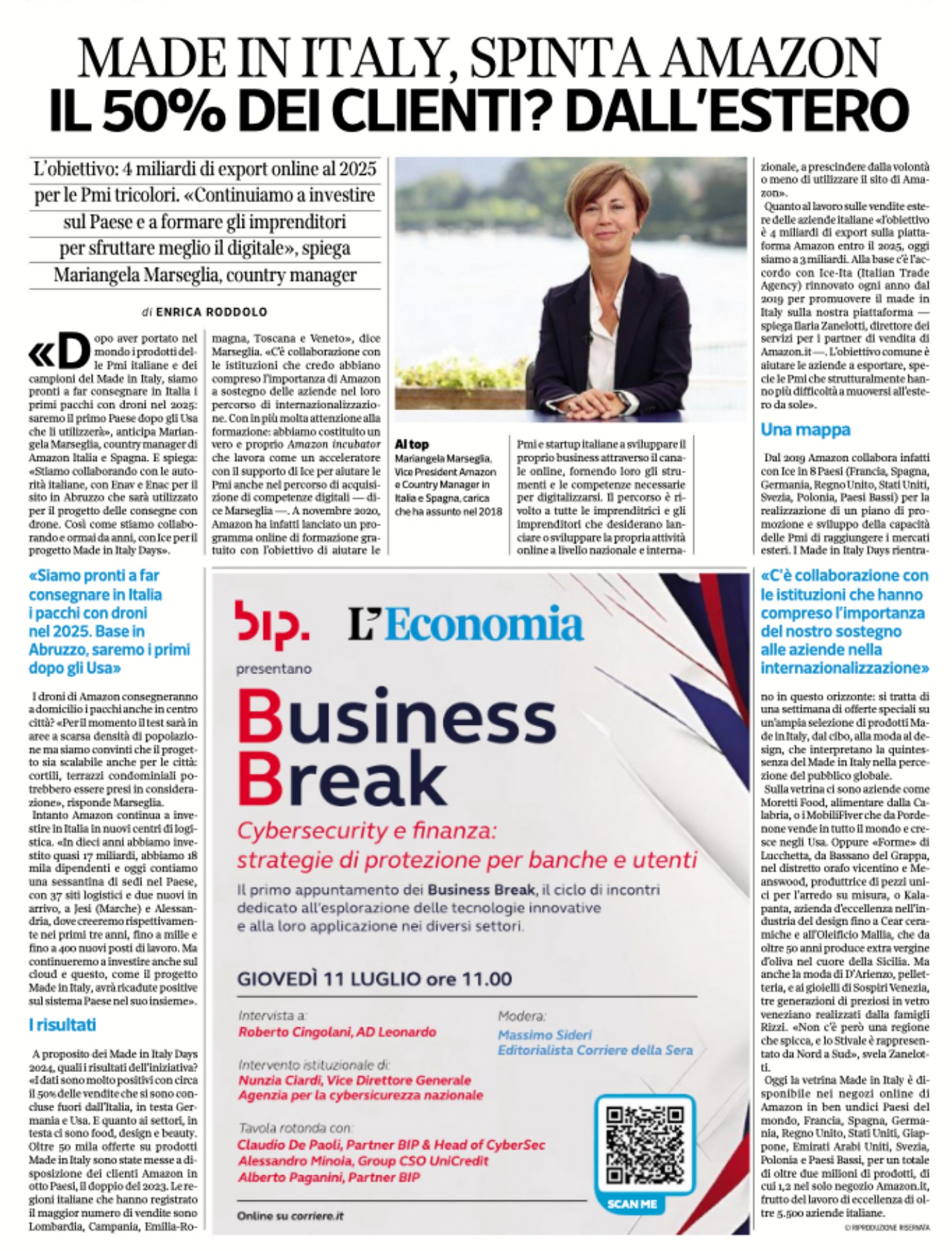
In this situation, the European operators – Zalando, Auchan, Decathlon, Zara and a few others – are in great difficulty.
As you can see from the article below, it is a commercial space that we in Italy have not really been able to approach. A world where we have abdicated … to Amazon and the Chinese. Just look, for example, at the sponsorships of Aliexpress – which belongs to the Chinese – Alibaba, during the European football championships. The Chinese sign is everywhere (**) like Temu’s television advertisements.
And in the US ‘TikTok is another retail competitor’. Also in groceries.
P.S.: Amazon has 40.4 per cent of the US e-commerce market share, Walmart 7.8 per cent, Shein and Temu each have just 1 per cent. And Temu would have lost $4.6 billion (out of a total worldwide turnover of $17 billion).
(**) Five of the 13 official sponsors of the tournament are Chinese companies, according to UEFA, which organised the event and governs the game in Europe, below: Harry Kane, England captain with Alipay (Alibaba) advertising background.
For an update read : White House : trade war against Chinese e-commerce giants, Temu and Shein