Written on 4 January 2025, updated on 10 August 2026
Introduction:
- Altroconsumo is not “the Bible”, as Alberto Grimelli also points out.
- When I was working at Esselunga, I always raised questions and objections regarding this magazine’s price surveys, but unfortunately there were no alternative publications on the market.
- It is strange that so many major retailers, such as Aldi, Carrefour or Esselunga (Coop is in the ranking but is not mentioned in the article), are missing from this survey, but be that as it may, this article – like the one on pasta – is only intended to provide a general guide to the best brands of olive oil.
- It would be interesting to know who produces for whom (e.g. De Cecco has its own olive oil, but as far as I know, it doesn’t produce it itself).
- The origin of the oil is crucial (read more on this: Food fraud involving olive oil in Spain. The world’s leading olive oil producer, the Andalusian cooperative Dcoop, has denounced widespread fraud involving refined olive oils in Spain. According to the stark accusation, these are in some cases mixed with lower-quality oils such as pomace oil and sunflower oil. ‘We have remained silent for 40 years, but we will not allow this any longer,’ said Dcoop’s president, Antonio Luque, at a press conference. He called on national and regional authorities to investigate traceability, in light of ‘very solid evidence’.Dcoop’s Director-General, Rafael Sánchez, in turn, reiterated that ‘it is time to put an end’ to this situation and ‘restore the image of this product so that Spain can exercise the leadership it deserves’ in the olive oil sector.
- To get a clearer picture of the sector, I recommend reading this article–or eventhis one – because the oil we put on our tables is often of very poor quality.
The best olive oil on the supermarket shelf is 100% Italian
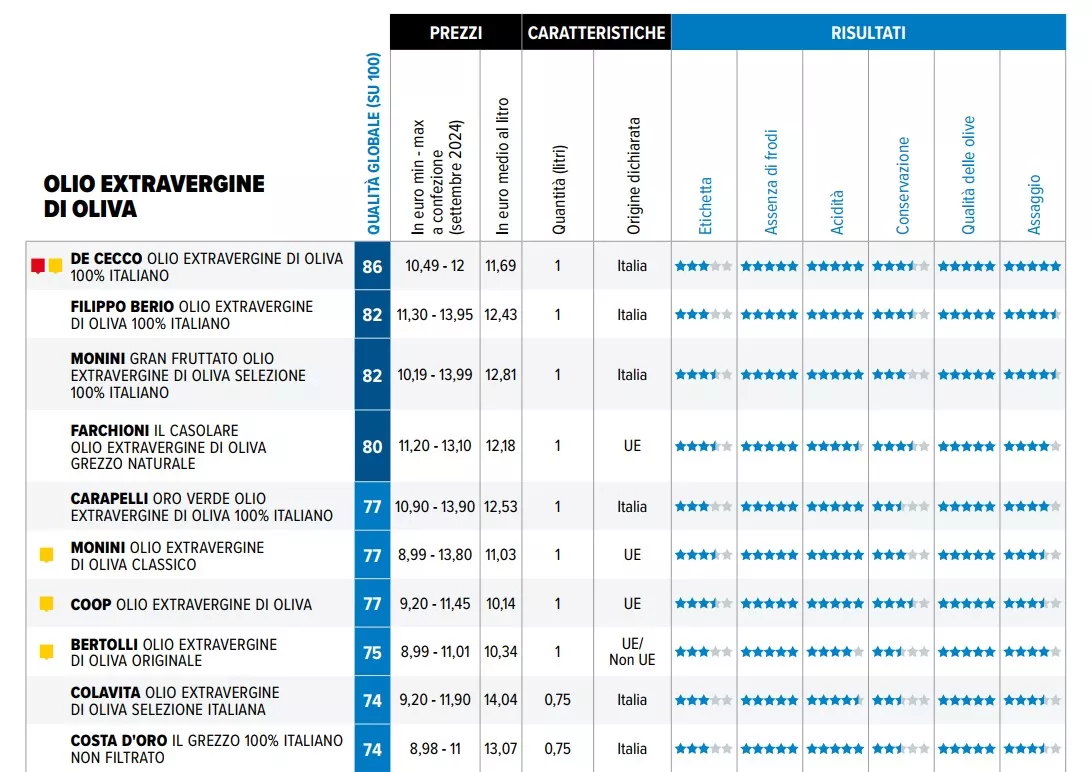
Altroconsumo’s analysis of 20 olive oils taken from the shelves found no non-compliance: all were extra virgin. Only 100% Italian oils made it onto the podium of the best. The three worst, on the other hand, are all own-brand products
23 December 2024 | 11:00 | Alberto Grimelli
The consumer magazine Altroconsumo reports that, out of 20 olive oils taken from the shelves between May and June 2024 and subsequently analysed in July, none were found to be non-compliant.
All were extra virgin olive oils according to Altroconsumo’s panel. According to the statement, the ‘tasting test’ was ‘carried out in accordance with the methodology defined by law by a panel of experts recognised by the COI (International Olive Council)’.
However, it is not clear whether the panel used by Altroconsumo is recognised by the Ministry of Agricultural Policies, nor whether it is a professional or an official panel. These differences are substantial for the purposes of a correct assessment of the test, as an unrecognised panel (i.e. a group of eight tasters, led by a panel leader, but which has not carried out the harmonisation tests required by MASAF) has relative validity and reliability, whereas this becomes absolute in the case of an official panel (ICQRF or Customs).
Given that the Altroconsumo panel’s assessment accounts for 36 per cent of the overall rating, delving into assessments of individual oils seems rather risky.
However, it is worth pausing for a moment to consider the analysis of the market landscape, as this does provide an overview of the range available in supermarkets.
The three best oils tested by Altroconsumo are all 100% Italian, in the order De Cecco, Filippo Berio and Monini.
The three worst oils tested by Altroconsumo are all from the EU and all private-label brands, in the order: La Badia (Eurospin), Conad and Primadonna (Lidl).
This picture therefore suggests that, during the last olive oil season, Italian olive oil came out on top in terms of quality (six of the top ten oils are all 100 per cent Italian). Meanwhile, EU-produced oils are almost all at the bottom of the rankings.
It also suggests that large retail chains no longer have much hesitation in using their own private-label brands to offer products of dubious value for money. This is an interesting development in the market, as, in the past, it was the bottling companies that found themselves forced to supply borderline oils, particularly for promotions and below-cost sales, but also for very low-end positioning. Today, it is the large retail chains that are positioning themselves as leaders in value for money, albeit at the expense of quality. Just how beneficial this policy will be for the retailers’ image remains to be seen once in-depth and detailed shelf monitoring programmes begin, perhaps carried out by the official regulatory authorities.
Given the problematic harvest year – particularly in terms of quality in Spain, Portugal and Tunisia – the range on the shelves from early 2025 onwards will certainly be affected by this trend, and it will be very interesting to assess the care and attention with which buyers have selected their product range.
The real problem is thatonly 45.9 per cent of the extra virgin olive oil (EVO) available in Italy is produced domestically; when exports are factored in,the percentage falls even further:Italian olive oil accounts for approximately 27 per cent of total demand (domestic consumption and exports).
Fortunately, however, the signs for the new season currently underway – running until autumn 2025 – are positive: Italy has regained second place amongst the world’s olive oil producers. Even so , it is behaving like a commodity in the face of ongoing speculation, which has recently caused the price of Italian olive oil to plummet.
Unfortunately, the share of our production is steadily declining: Italy’s share of the global olive oil market has halved since 2023, and the area of land under cultivation is falling (-7.1%), which means that, even in our own country, it will become increasingly difficult to find genuinely Italian olive oil in blended products.
And 100% Italian products will become increasingly niche and more expensive: producing a litre of genuine extra virgin olive oil in Italy for less than 9 euros per kilo is very difficult.
Read also:
Extra virgin oliveoil: the new labelling contradicts European standards
The Financial Times: “Spanish olive oil is superior to Italian olive oil” but it is not clear why
The global olive oil market continues to show strong prospects for growth