Compiled 21 June 2023, updated 28 October 2025
Europe has fallen behind America and the gap is growing
From technology to energy, from capital markets to universities, the EU cannot compete with the US
GIDEON RACHMAN 19. JUNE 2023
The war in Ukraine has revived the transatlantic alliance. But the relationship between the US and its European allies is increasingly unbalanced. The US economy is now considerably richer and more dynamic than the EU or Britain – and the gap is growing.
This will have an impact far beyond relative living standards. Europe’s dependence on the US for technology, energy, capital and military protection is steadily undermining any aspirations the EU might have for ‘strategic autonomy’.
In 2008, the EU and US economies were roughly the same size. But since the global financial crisis, their economic fortunes have dramatically diverged. As Jeremy Shapiro and Jana Puglierin of the European Council on Foreign Relations .
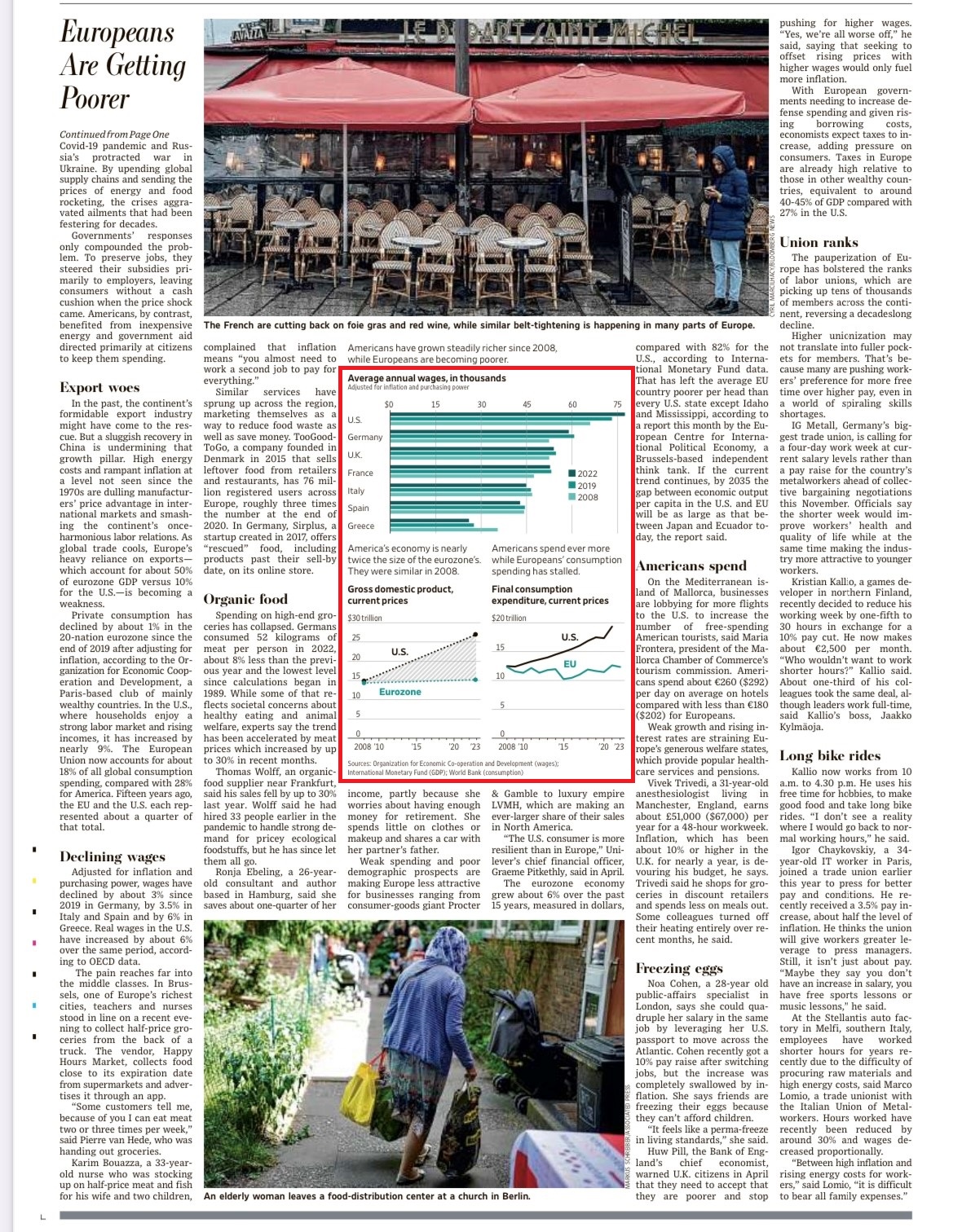
In 2008, the EU economy was slightly larger than the US economy: $16.2 trillion versus $14.7 trillion. By 2022, the US economy had grown to $25 trillion, while the EU and the UK together had only reached $19.8 trillion.
The US economy is now almost a third larger. It is more than 50 per cent bigger than the EU without the UK’. The aggregate figures are shocking. Underlying them is a picture of a Europe that has fallen behind, sector by sector.
The European technology landscape is dominated by US companies such as Amazon, Microsoft and Apple. The seven largest technology companies in the world, by market capitalisation, are all American.
There are only two European companies in the top 20: ASML and SAP. While China has developed domestic technology giants of its own, European champions are often acquired by American companies. Skype was bought by Microsoft in 2011; DeepMind was bought by Google in 2014. AI development is also likely to be dominated by American and Chinese companies.
Major universities feeding the pipeline of tech start-ups in the US are missing in the EU. The Shanghai and LE rankings of the world’s best universities both have only one EU institution in the top 30. (Britain does better – courtesy of Cambridge, Oxford, Imperial and others.)
In 1990, Europe produced 44% of the world’s semiconductors. This figure is now 9%; compared to America’s 12%. Both the EU and the US are rushing to develop their capacities.
But while the US is expected to see 14 new semiconductor plants come on stream by 2025, Europe and the Middle East will only add 10, compared to 43 new plants in China and Taiwan.
Both the US and the EU are trying to turn this around with ambitious industrial policies that provide public funding and incentives for chipmakers and electric vehicle manufacturers. But the dollar’s status as the world’s reserve currency gives the Americans the ability to finance their ambitions without scaring the markets. As one European industrialist put it: ‘They can simply swipe their credit card’.
The EU, on the other hand, has a much smaller budget and has just started to issue common debt.
Private capital is also much more readily available in the US.
Paul Achleitner, chairman of Deutsche Bank’s global advisory board, says that Europe is now ‘almost totally dependent on the US capital markets’. He tells me that Europe has very few of the large pension funds that give depth to the US capital markets, adding that: “If you want to do something sizeable – whether it’s an acquisition or an IPO – you always go back to US investors.”
The EU has talked a lot about creating a ‘capital markets union’ to give Europe some of the scale of the US. But progress has been weak.
Unlike Europe, the US also has abundant and cheap domestic energy supplies. The shale revolution means that America is now the world’s largest producer of oil and gas. Meanwhile, energy prices in Europe have skyrocketed. The war in Ukraine and the loss of cheap Russian gas mean that European industry typically pays three to four times more for energy than their American competitors.
Gloomy European leaders say this is already leading to factory closures in Europe.
Some in Britain might be tempted to see this as proof that, within the EU, Britain has been ‘chained to a corpse’ and that Brexit was a good move. But outside the EU single market, Britain suffers from an exaggerated version of the problems of scale that are hampering the EU itself. As a result, British industry is already lagging behind.
Are there really no areas where Europe is a world leader? Some proudly point to the fact that the size of the EU single market means that companies around the world have had to adopt European regulations – the so-called ‘Brussels effect’. But it would clearly be better to lead the world in wealth creation than to regulate it.
Europe outperforms in ‘lifestyle’ sectors. Almost two thirds of the world’s tourist arrivals are in Europe. The luxury goods market is dominated by European companies. Football, the world’s most popular sport, is dominated by European teams, although many of the biggest clubs are now owned by Middle Eastern, American or Asian investors. Europe’s dominance in lifestyle industries underlines that life on the old continent is still attractive to many. But perhaps that is part of the problem. Without a greater sense of threat, Europe may never summon the will to reverse its inexorable decline in power, influence and wealth.
Read also :
Walmart raises its sales forecast thanks to strong revenue and e-commerce growth
Stuck in the 1980s: why European retail giants can’t keep up with Walmart’s digital revolution
How Walmart built the biggest threat Amazon has ever faced
Retail: a good look at the widening gap between the US and Europe
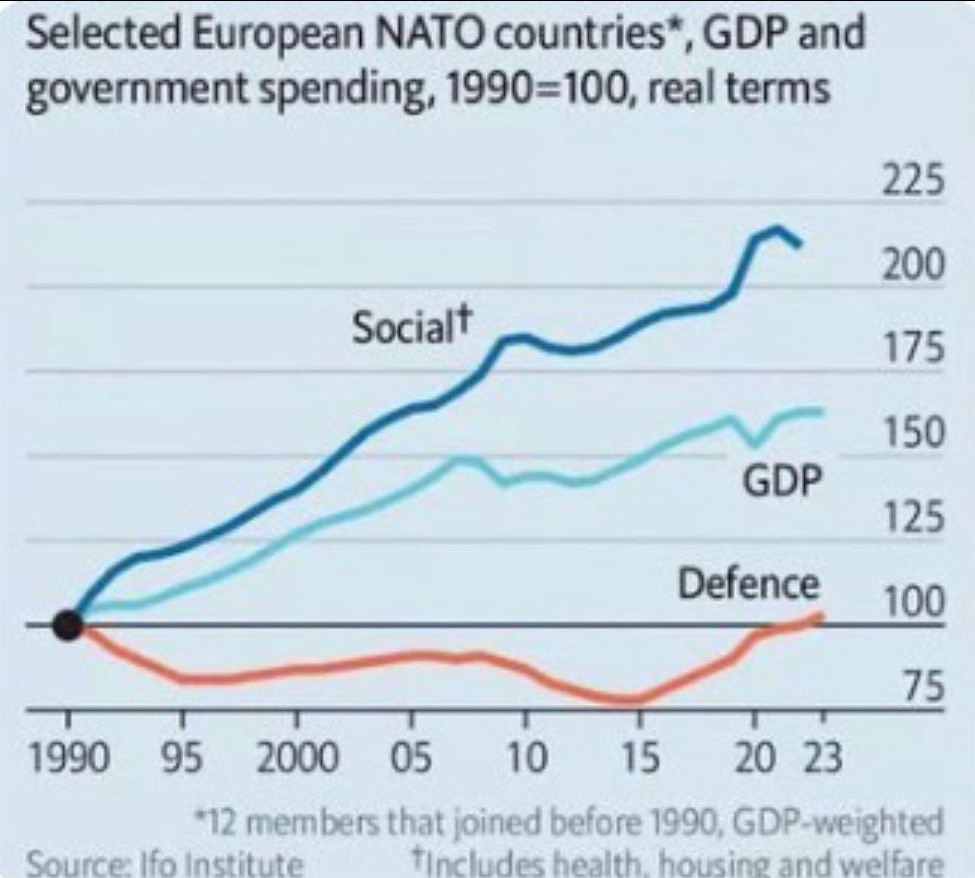
Below: the growth of social spending, GDP (GDP) and defence in 12 European NATO countries (The Economist October 2025), where it is clear that the policy of these countries has not been aimed at economic growth but rather at meeting needs in terms of health care, rent-controlled housing, social security, pensions, education through scholarships, etc.
p.s. : some initiatives, such as the one below, seem to confirm the Italian and European tendency to say ‘no’ to everything, a priori (*).
Health: the alliance against synthetic food is born
An unprecedented, wide-ranging and composite alliance has been set up to call for the defence of the culture of quality food and to push against artificial and synthetic food, which includes Acli, AcliTerra, Adusbef, Anpit, Asi, AssoBio, Centro Consumatori Italia, Cia, Cna, Città del Vino, Città dell’Olio, Codacons, Codici, Consulta Distretto del Cibo, Ctg, Coldiretti, Demeter, Ecofuturo, Ewa, Federbio, Federparchi, Fipe, Fondazione Qualivita, Fondazione Una, Fondazione UniVerde, Globe, Greenaccord, Gre, Italia Nostra, Kyoto Club, Lega Consumatori, Masci, Movimento Consumatori, Naturasi, Salesiani per il sociale, Slow food Italia, Unpli, Wilderness.
The initiative was launched by the representatives of the various Organisations during a meeting in the Coldiretti Headquarters Boardroom and has as its first objective the signing of a Manifesto to set out the reasons for the alliance and open a debate with institutions, associations, the scientific world, businesses and citizens to start a battle – the one against synthetic and artificial food – that can be won – the Organisations claim – also in a European projection, in the certainty of acting for the common good.
An assumption of responsibility,’ the Organisations conclude, ‘in the search for technical and value-based reasons to counter real risks of desertification of the countryside, financial speculation and patent monopolies, together with health concerns for consumers.
(*) Coldiretti, however, is pro-GMO ( and is succeeding brilliantly in that field ). On synthetic meat read here.
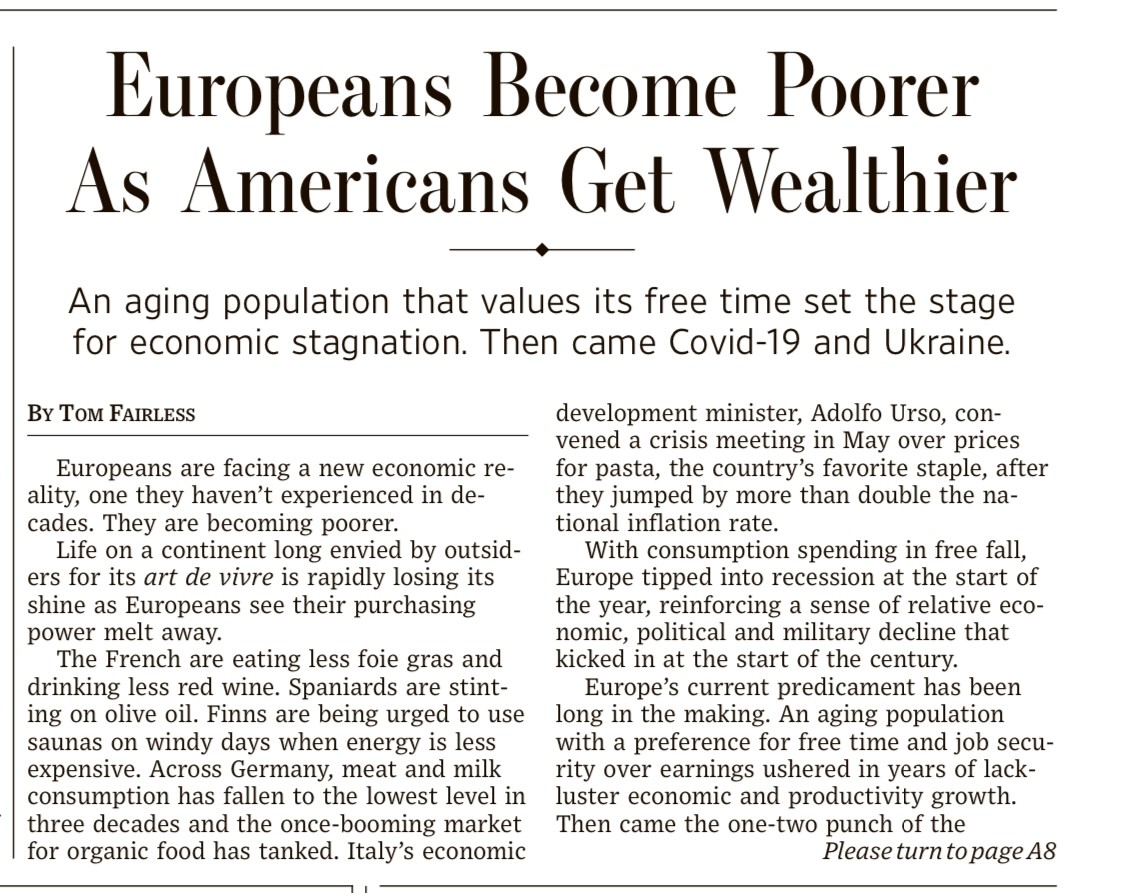
Below: an article in the Wall Street Journal that, on 18 July 2023, confirms what the Financial Times says, adding, on the second page, the economic indicators that I have highlighted.
The headline is: ‘Europeans get poorer, Americans richer’ . Interestingly, the subtitle refers to the responsibility of Europeans: ‘an ageing population that values its leisure time has set the stage for economic stagnation. Then came Covid-19 and Ukraine.”
To this picture is added:
The great collapse of European industry (Le Monde, 24 September 2024)
Industrial production is in decline in most EU countries. The reason for this is the lack of competitiveness vis-à-vis China and the US, while the Draghi report recently called for massive investments to avoid a ‘stalemate’.
.. Between July 2023 and July 2024, industrial production decreased by 2.2 % in the euro area and 1.7 % in the European Union (EU). However, during this period, the largest decreases recorded by Eurostat were in Hungary (-6.4 %), Germany (-5.5 %), Italy (-3.3 %) and France (-2.3 %) …
Among the key factors in the gap: the cost of energy, which is twice as expensive in Europe as in the US.
It should be noted that in Italy, thanks to a short-sighted policy, the cost is still higher, for example, than in Spain, one of the few European weights that is growing consistently.
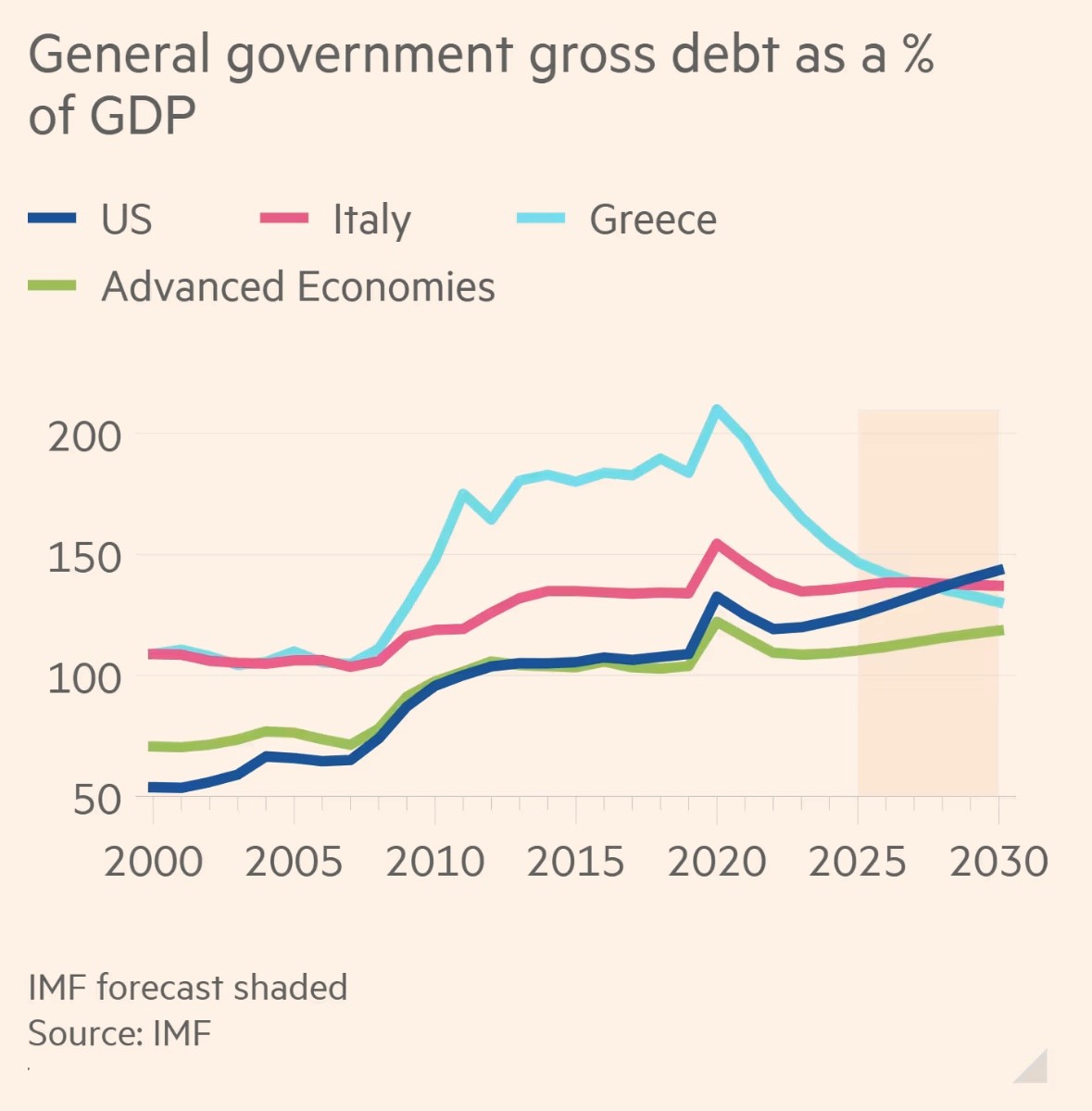
The only real weakness of the US is its debt (October 2025) :
The US government debt burden is on track to exceed levels in both Italy and Greece for the first time this century, according to IMF forecasts, underscoring the precarious state of US public finances. Gross general government debt in the US will increase by more than 20 percentage points between now and then to reach 143.4 per cent of the country’s GDP by the last year of the decade, according to IMF forecasts, surpassing previous records set after the pandemic.
This comes as the IMF estimates that the US budget deficit will hover above 7% of GDP every year until 2030 – the highest of any wealthy nation monitored by the fund for this year and the rest of the decade. Italy and Greece have long been highlighted by economists for their fragile public finances. Both countries were at the centre of the eurozone sovereign debt crisis of 2010-2012, with Greece requiring an IMF- and EU-supervised bailout and restructuring.
But public debt burdens in both European countries are expected to be on a downward trajectory at the end of the decade, as they maintain a tight grip on their budget deficits. In contrast, the US debt-to-GDP ratio will continue to rise in the 2030s, according to IMF data released this month, with the Congressional Budget Office forecasting an increase for the following decades…
Below : in blue the growth of US debt (compared to Greece and Italy) as % of GDP.