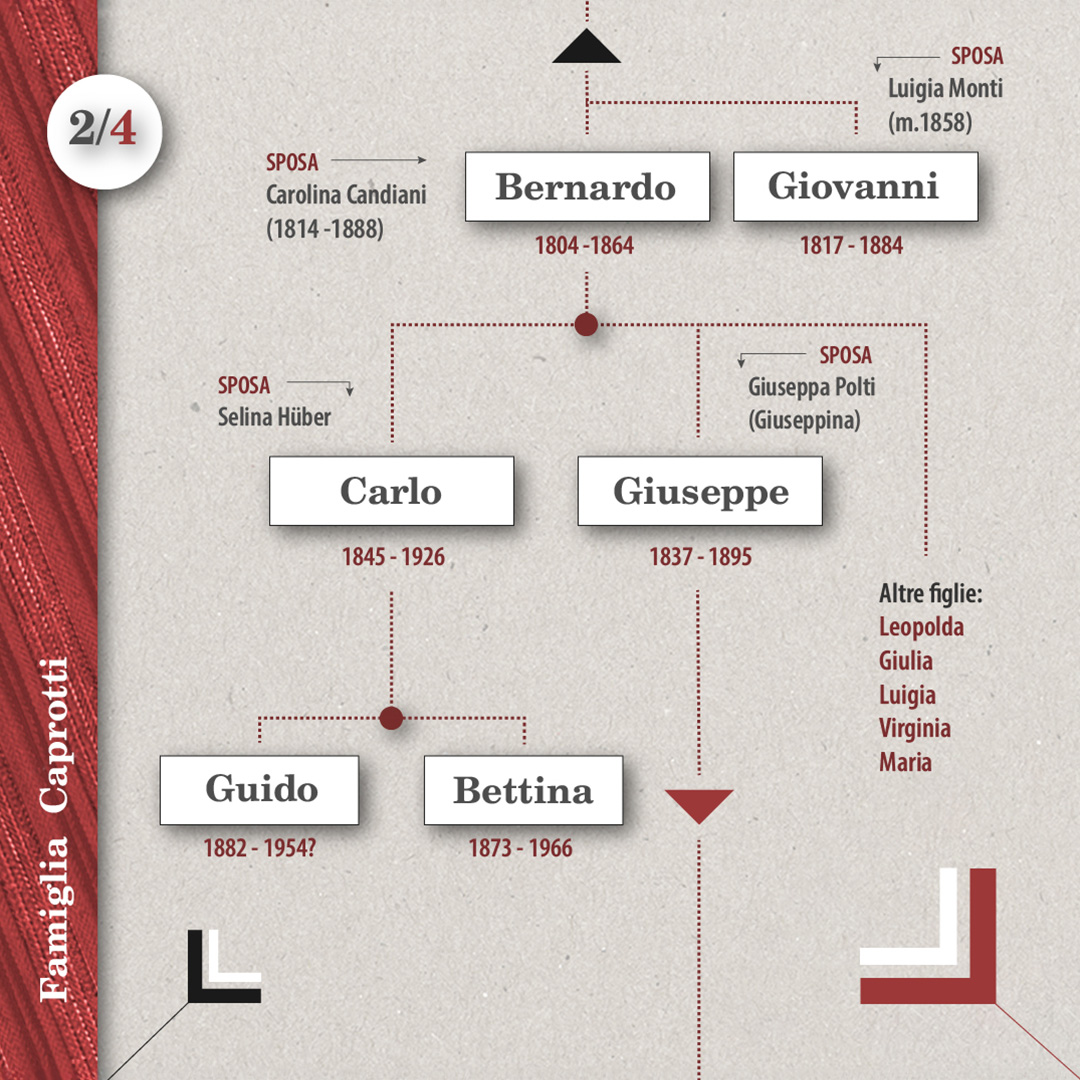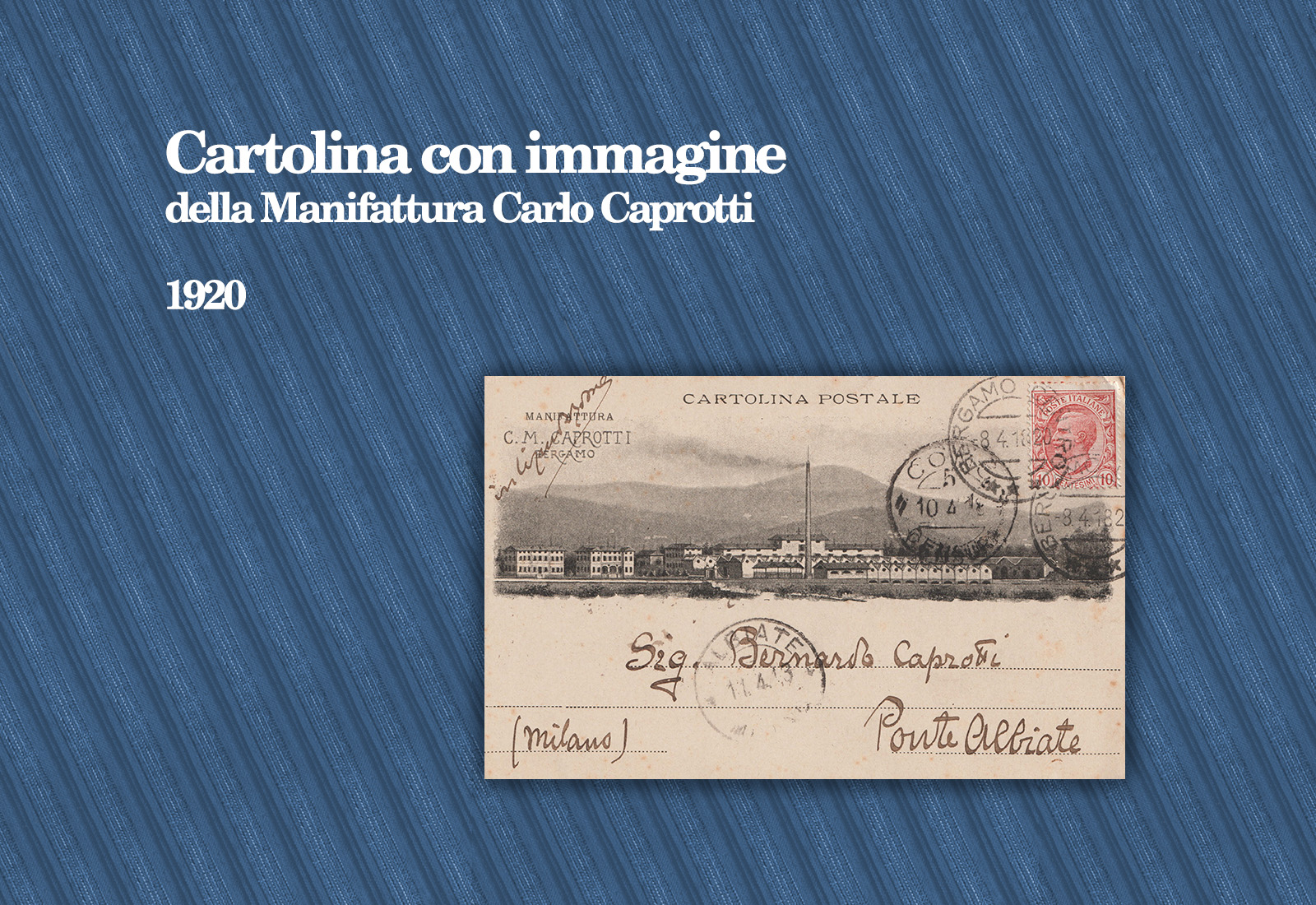
After separating in business from his elder brother Beppo Caprotti (1872), who remained alone at the helm of the family textile factory in Albiate, Carlo moved to Bergamo and here, in 1874, set up the ‘Caprotti & Guttinger Partnership’ with the Swiss Giulio Guttinger, operating a mechanical weaving business in Scanzo [today Scanzorosciate, ed.
It was not difficult for Caprotti to find a partner in such a short time: these were the years when many Swiss moved to the Bergamo area, and his marriage to a Zurich girl and his knowledge of the Swiss environment, where he lived and frequented, certainly helped him. Apparently, already a few months later the company must have established itself well on the market, since in March 1875 Beppo [my great-great-grandfather] himself wrote that in Veneto circulars from Caprotti and Guttinger were already circulating, ‘therefore another competitor, and morally more serious than any other‘.
Moreover, the company, ‘in addition to the experience of the two owners, could count on the experience of the specialised workers and some employees that it had managed to take from the Ponte d’Albiate [sic]factory (…)’.
A few years later, the company could count on a hundred looms, with a workforce made up mainly of women and children under 15 (GELFI, Capitali svizzeri, p. 13). And it was Caprotti and Guttinger who, around 1890, set up one of the first electrical workshops (GELMI, “History and Characters“, p. 177).
The business ceased in 1901, when Giulio Guttinger left the company to engage in another enterprise, and Carlo as well.
“The individual firm C. M. Caprotti began its activity of ‘mechanical cotton weaving’ in 1901, following the termination of the Caprotti and Guttinger general partnership (…). The registered office was in Bergamo, while the factory was that of Caprotti and Guttinger in Scanzo (today the municipality of Scanzorosciate). The sole owner was Carlo Caprotti fu Bernardo Caprotti. On 20 September 1905 Carlo Caprotti entrusted his son Guido Caprotti with the general power of attorney for the company’s commercial affairs, while on 28 August 1907 the Chamber of Commerce certified that he ‘was’ the sole owner: there is no way of knowing what happened during that time. The date of cessation of business is unknown‘. (TODESCHINI, C.M. Caprotti [Ditta individuale].
In Bergamo, Carlo found his place: in 1889, he was again among the founding partners of the spinning mill “Società in accomandita semplice Festi Rasini & C.”, again together with Giulio Guttinger; at the end of the 1890s he was part of the committee for the creation of a weaving section and a spinning school to be framed as a subsection of the Industrial Section of the Technical Institute(Ibid, p. 238); he was also a member of its first Supervisory Commission, with the aim of checking that the teachings provided met the real needs of the industrialists who would later employ the future graduates(Ibid., p. 358). Of course, Carlo was also a member of the Selection Committee that hired the school’s teachers by competition. To crown, one could say, his leading position among Bergamo’s textile industrialists, in 1907, at the constitutive assembly of the Federazione bergamasca industrie tessili, he was elected its first president.(Ibid., p. 368).
Sources:
Albiate (MB), Villa San Valerio, Villa San Valerio Archives, Giuseppe Caprotti Archives, Giuseppe Caprotti Archives (1837-1895).
O. GELMI, Storia e caratteri dell’istruzione tecnica industriale bergamasca, University of Bergamo, PhD in Scienze pedagogiche, Dipartimento Scienze della persona, Ciclo XXIII, a.a. 2009-2010. Supervisor ch.mo prof. Giuseppe Bertagna.
Bibliography:
G. CAPROTTI, “Le Ossa dei Caprotti. Una storia italiana’, Milan, 2024/3.
R. ROMANO, “I Caprotti. L’avventura economica e umana di una dinastia industriale della Brianza”, Milan, 1980.
G. CAPROTTI, “Mostra: la meccanica della Manifattura Caprotti“, 09/10/2024.
ID., “La famiglia Caprotti, innovazione e tradizione in una manifattura italiana: Albiate e la Svizzera“, 09/10/2024.
ID., ‘La famiglia Caprotti, innovazione e tradizione in una manifattura italiana: operai dal prigione di San Vittore‘, 13/10/2024.
Per filo e per segni. Innovazione e creatività dell’ industria tessile a Bergamo tra XIX e XXI secolo, multimedia and interactive exhibition, Bergamo, 2008 (ref. ‘Rivista di Bergamo’, January-March 2008, monographic issue dedicated to the exhibition).
M. GELFI, Capitali svizzeri e nascita dell’industria cotoniera a Bergamo, in “Archivio storico bergamasco”, n.s., n. 3, September-December 1995, pp. 4-41.
G. TODESCHINI, Caprotti e Guttinger [Società in nome collettivo], ( 1875 – 1901 January 1 ), in ArchiVista, 1 December 2017.
EAD., C.M. Caprotti [General partnership], (1901 Jan. 1 – No date of termination known.), in ArchiVista, 4 December 2017.
E. SÀITA, ‘I Caprotti : private aspects, from the Risorgimento to the Second World War‘, 08/11/2022.