

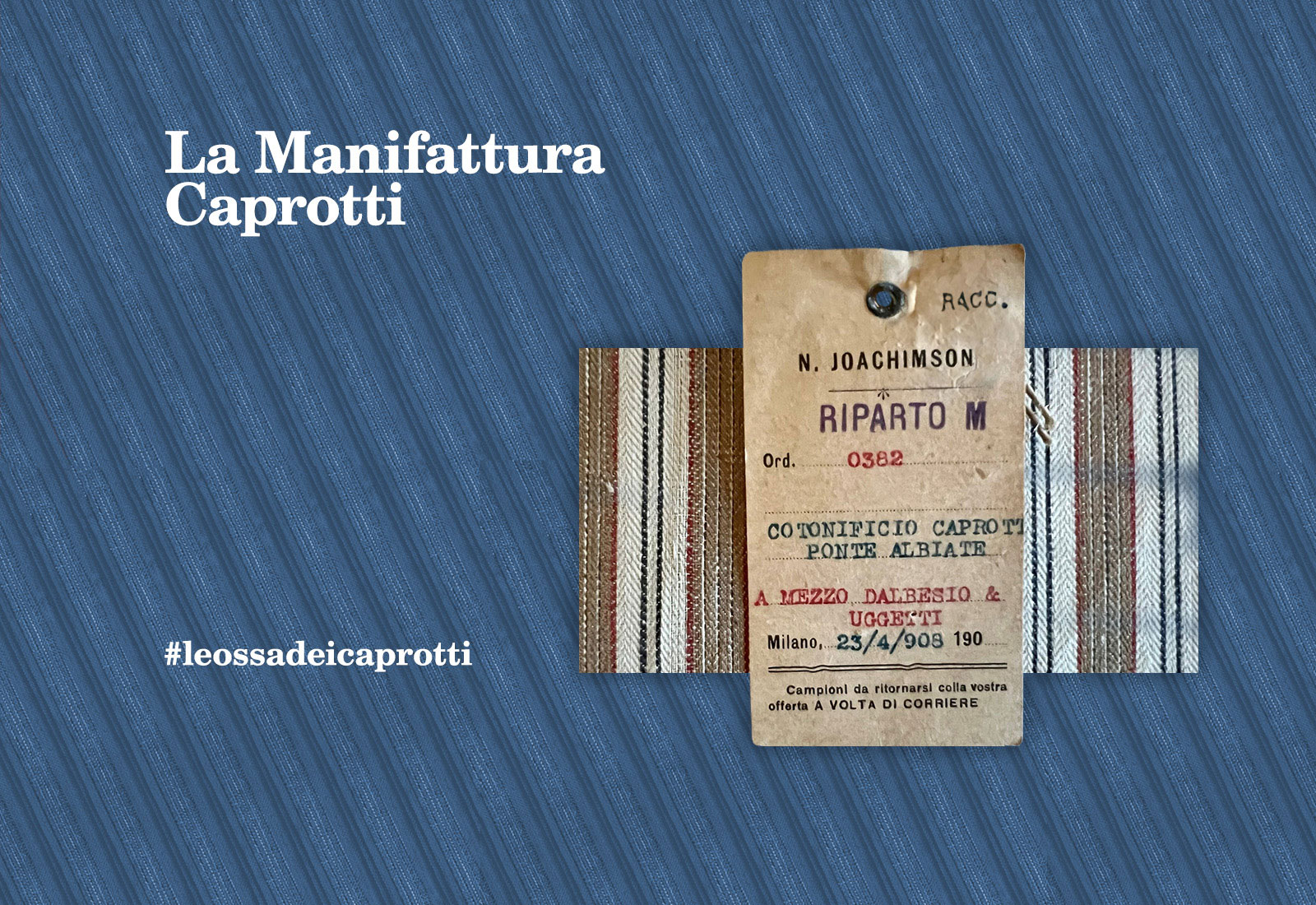
In the second half of the 19th century, Giuseppe and Carlo Caprotti took the company to truly competitive levels thanks to a massive mechanisation and modernisation project that allowed Caprotti to expand its business, after the Unification of Italy, on markets throughout the peninsula and even abroad.
ALBIATESE INDUSTRY, SWISS INDUSTRY
Caprotti
Honegger/Rüti
Sulzer
There are numerous documents on the period that saw Caprotti’s transformation into a centralised mechanical processing company, which took place amidst a thousand difficulties due above all to the inexperience of the personnel employed, the lack of technical knowledge and the environment that was still profoundly agricultural and therefore substantially refractory to innovation. In the early days, gross errors and inexperience caused serious damage and considerable delays, and the Caprottis would probably have failed in their attempt if that curious effect of the industrialisation process that pushes the most advanced countries to export technology to backward areas of the world had not also occurred for them. In the Caprotti’s case, the ‘mentor’ is above all the Swiss company Caspar Honegger. It was Caspar Honegger who prepared the plant project for everything concerning the starting point of the production cycle (from the number and quality of the looms to the design of the dyeing plant), and it was Caspar Honegger who negotiated for Caprotti the purchase of a boiler and a tractor from the Sulzer brothers in Winterthur, and he also assisted them in what was one of their greatest difficulties, the assembly of the machinery, by sending assembly workers and foremen. Not least, it was Honegger who welcomed Carlo Caprotti from February to May 1869 on a real educational trip, during which he followed the company’s mechanisation project and learnt about machine technology and the management system of a modern industry.
While Carlo is in Switzerland, the situation in Ponte Albiate is even humorous: mysterious poorly assembled machines that do not work, surrounded by onlookers and the usual ‘experts’ who do not let the foreign technician on duty work, workers who wander around the halls without knowing exactly what to do, technicians who try to make a very modern coke boiler work with wood sawdust. Production drops tremendously because no one is used to the new work rhythms, and the employees fill out the books according to brain-dead criteria, since the new production processes require very complex accounting of which they know nothing.
In reality, beyond the comic implications inevitably associated with all that is clumsy and awkward, what was taking place in the small company on the banks of the Lambro was a piece of the industrial revolution, with all the traumas, contradictions and difficulties that this could present.
Of course, it is not that, having finally completed the ‘mechanical’ factory – which would always be implemented with new and more modern machinery, despite the constant quarrels between brothers – the difficulties were over. An example of this is the lighting system, as you can well understand, which is very important in a manufacturing business. As early as 1876, the Caprottis opted for a modern gas-fired system (produced from petroleum) to light the factories, powering 250 flames, entrusting its design and execution to engineer A. Redaelli of Milan: the failure is resounding. On a single day, 16 November 1878, Caprotti’s administrator, Mauro Rho, wrote Redaelli two letters. In the morning he complains that the machine won‘t start, and the worker blames this on not having the mass or whatever./ Today, however, I haven’t seen them in the factory for most of the day and I believe they are at the hotel having gas./ Sorry if I have to repeat myself, I’m beginning to get annoyed. In the afternoon, Rho continues, between the furious and the ironic: I continue mine today./The lighting in the factory this evening is pitiful; with primitive oil lamps it would be richer./The rooms stink, your workers are drunk./I am tired and annoyed; tomorrow go here to fetch your workers and the day after tomorrow I will start lighting with lucilina [oil, processed and lightened for use in the lamps]. The affair, always with comic and grotesque overtones, dragged on until 1880, when the Caprottis decided to finally drive Redaelli out, dragging him, moreover, uselessly, into court to try to obtain compensation for the damage suffered.
Follow Le Ossa dei Caprotti
on Instagram
on Facebook
on YouTube
on LinkedIn
on X
Sources and reference Bibliography:
Albiate, Villa San Valerio, Villa San Valerio Archives, Manifattura Caprotti Archives
R. ROMANO, I Caprotti; l’avventura economica e umana di una dinastia industriale della Brianza, Milano, 20082 (especially pp. 86-109)
Sulzer, Sustainably successful since 1834(https://www.sulzer.com/en/about-us/our-company/history ).
M. LEONHARD: ‘Maschinenfabrik Rüti’, in: Historisches Lexikon der Schweiz (HLS), Version vom 29.10.2009. Online: https://hls-dhs-dss.ch/de/articles/041807/2009-10-29/, konsultiert am 08.10.2024.
G. CAPROTTI, Le Ossa dei Caprotti. Una storia italiana, Milan, 2023


