

Updated 9 October 2024
Manifattura Caprotti: and the History Continues…
In the spring of 2008, on the home straight of the reorganisation of the Manifattura Caprotti archives kept at Villa San Valerio, a large folder was examined that contained, according to its caption, ‘Old Drawings’.
Old, certainly, but so old as to be ancient, and to constitute a unique, continuous, very interesting and even beautiful cross-section of the technical drawings of all the innovations, especially from the mechanical point of view, that led to profound changes in the Caprotti company in its production methods and volumes: a series of large plates ranging from the years immediately following the Unification of Italy to the early 1950s, almost a whole century!
Giuseppe Caprotti was immediately aware of the importance of that fund of drawings, and in September of the same year, he called in one of the best photographers on the market, Alessandro Belgiojoso, and conducted a photographic campaign in the light of the Villa San Valerio garden to reproduce each of the over one hundred drawings, often very delicate and difficult to handle, in the best possible way, so that they could be used without jeopardising their conservation.
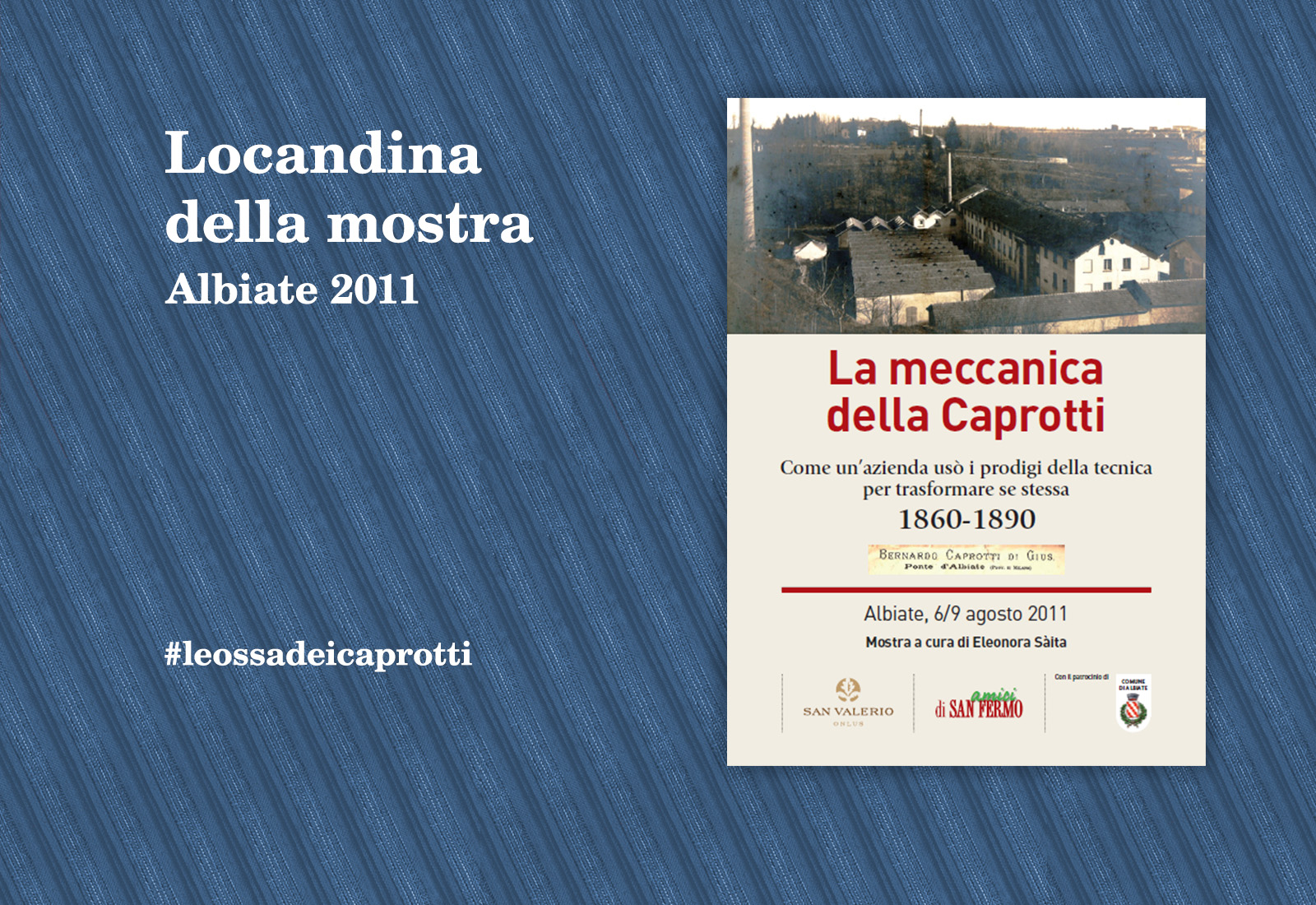
A selection of those same drawings, filed and commented on, is now presented as a further piece in the historical mosaic of Caprotti and Albiate, to which the company has been closely linked for centuries: from 6 to 9 August 2011, in fact, in conjunction with the Sagra di San Fermo, the exhibition La meccanica della Caprotti will be held.
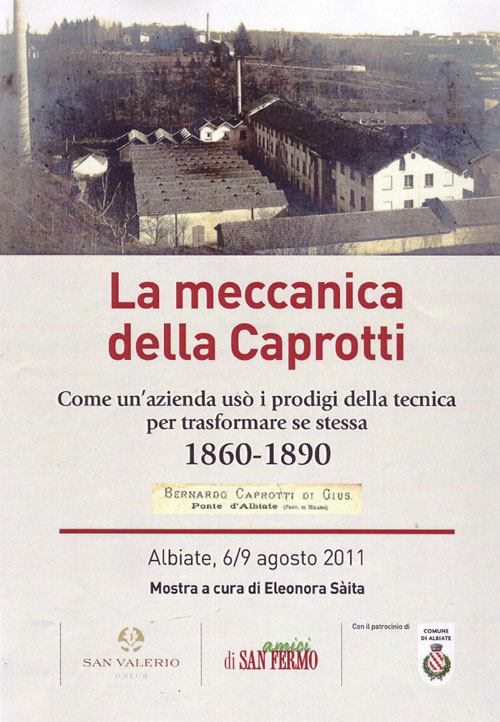
How a company used the prodigies of technology to transform itself, commissioned by the Associazione San Valerio Onlus, the Amici di San Valerio and sponsored by the municipality of Albiate.
15 large panels will illustrate some of the most beautiful drawings preserved in the Caprotti Archive, photographed by Alessandro Belgiojoso and commented on by the curator of the archive and exhibition, Eleonora Sàita.
The panels are interspersed with period documents that complete the overall picture, from information on the company’s Swiss suppliers, including the Sulzer brothers in whose factory engineer Rudolf Diesel worked in 1879 and whose licence they produced the world’s first diesel engine in 1898, to those on the long story of thelighting in the factories, at first conceived to be powered by a petroleum derivative, an experience so disastrous that the Caprottis decided to return to the use of oil lamps, adapted, however, to olive oil.
Fortunately, the idea soon waned in favour of the more logical, and at the same time more innovative, decision to use electricity, which, thanks to a huge financial investment, was installed and brought up to full capacity between 1884 and 1885.
The story therefore – of Caprotti, and through it of Albiate and its people – continues with a further important contribution, rich and at the same time simple, to allow everyone to read and enjoy, after the success of the 2007 exhibition, a second chapter of the fascinating book of time.
Eleonora Sàita
29 November 2018
Notes:
photographs by E. Sàita, Garden of Villa San Valerio, 16 September 2008;
photographs of drawings by Alessandro Belgiojoso.
bibliographic references to R. Romano, I Caprotti. L’avventura economica e umana di una dinastia industriale della Brianza, Milan 2008.


