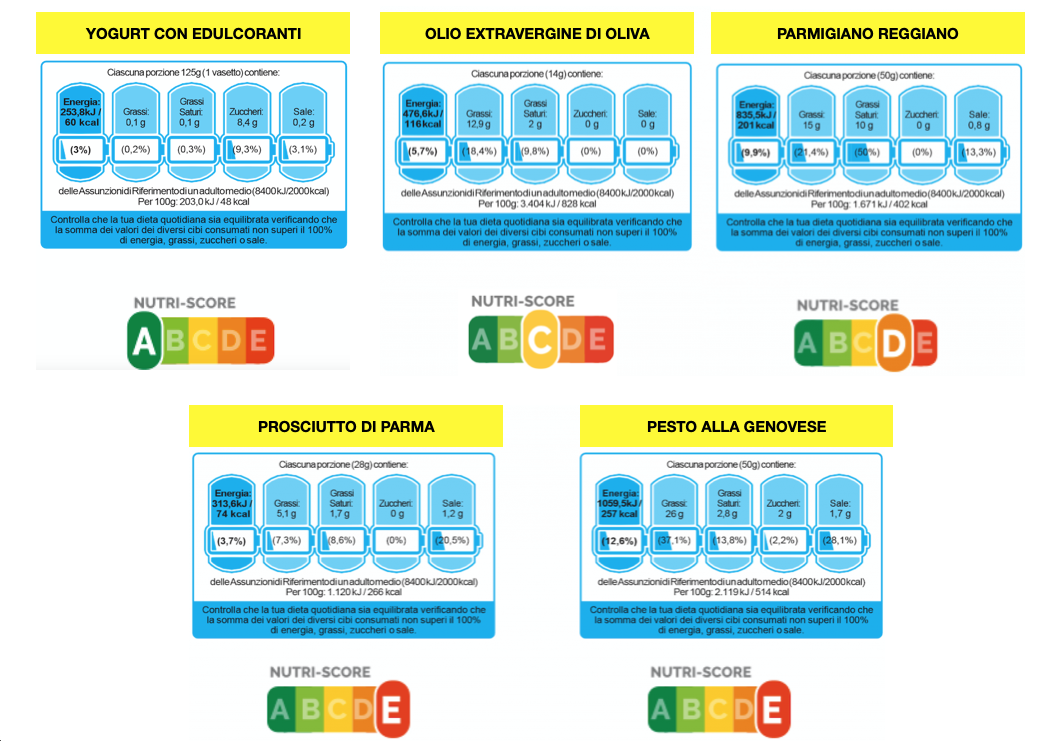
Cover: a comparison of two types of labelling. Written on 14 November 2024, updated on 4 March 2025
This article also appears in the ‘Social’ section of this website because it is the poorest section of the population that has the poorest diet, partly due to a lack of reliable information about food.
NutrInform Battery, Italy’s response to nutritional labelling
Roberto Pacifico, 15 February 2024
The NutrInform Battery app will be promoted in thousands of retail outlets across Italy. It helps consumers make informed and conscious choices
In the coming months, the European Commission is due to decide on a single nutritional labelling system that Member States could adopt. NutrInform Battery is Italy’s response to traffic-light labelling systems that classify foods as ‘good’ (green label) and ‘bad’ (red label), without taking into account useful information on recommended portion sizes and the actual nutritional content of foods. Federdistribuzione, Ancc-Coop and Ancd Conad – the three associations representing the modern retail sector – are promoting the Italian proposal for nutritional labelling, designed to help consumers make informed and conscious choices at the table, whilst following a healthy and balanced diet.
From 15 February 2024, thousands of retail outlets belonging to companies that are members of the three associations will promote the use of the dedicated Nutrinfom Battery app, through communication campaigns aimed at the millions of Italians who go shopping every day. The app can be downloaded free of charge and enables users to understand the nutritional impact of the food we consume throughout the day, suggesting appropriate portion sizes and the correct ways to combine different foods. The NutrInform Battery app is fully operational and already allows users to access nutritional information using the codes found on thousands of products on the market.
“We are facing a crucial challenge that requires the collective commitment of the entire agri-food sector and businesses, both at national and European level,” stated Adolfo Urso, Minister for Enterprise and Made in Italy. “It is essential to guarantee consumers’ right to information, whilst combating unfair competition practices. We appreciate the support and sense of responsibility shown by modern retail companies, who are joining us in this important initiative.”
“This is an important signal and contribution that the sector wishes to make in support of the Italian agri-food sector and consumers,” commented Federdistribuzione, Ancc-Coop and Ancd Conad, the three associations that have signed the Memorandum of Understanding with the Government. We are faced with the challenge of safeguarding our food excellence and ensuring that people have access to accurate information when making purchasing decisions. Our commitment will therefore be to promote, over the coming months, the use of an innovative, digital tool that operates on the basis of existing product coding standards and will help us all to consume food in an informed manner.
In reality
- , major multinationals such as Ferrero and Lactalis have taken a firm stand against Nutriscore
- others, such as Danone in France, have adopted an ambiguous stance
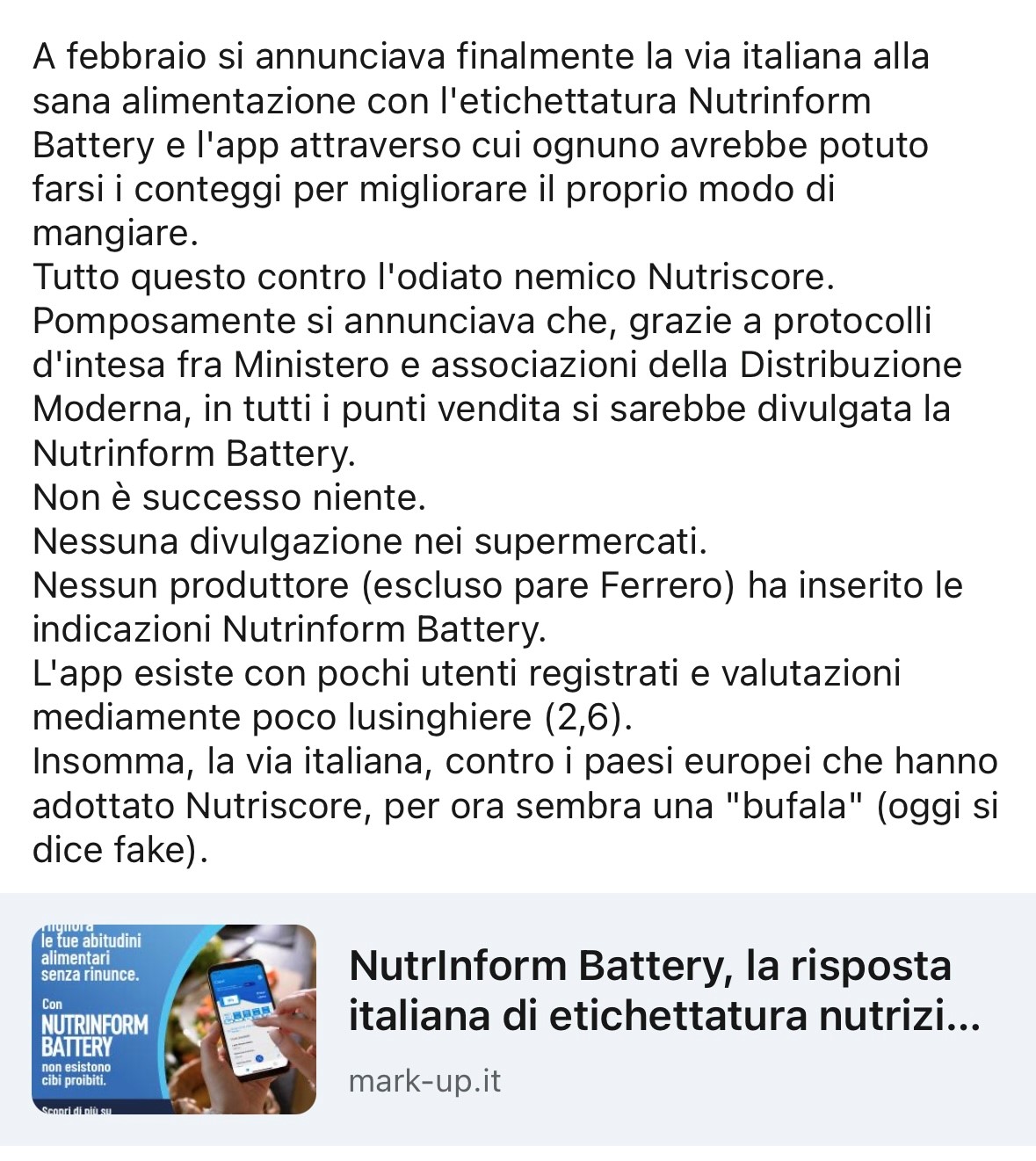
- but, above all, as one LinkedIn user points out, in Italy none of what was announced has actually happened.
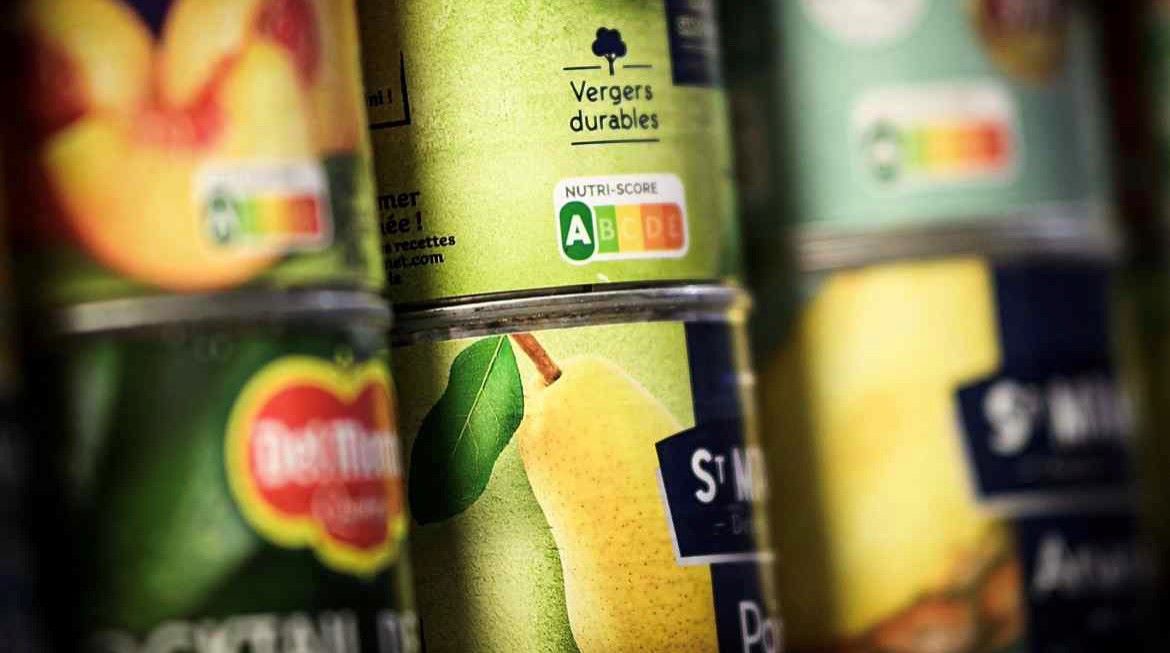
- A possible clash within the EU over food labelling: Carrefour France is imposing Nutri-Score on all suppliers, including major brands – such as Coca-Cola, Ferrero and Mondelez – which continue to conceal the nutritional profiles of their products.
- Nutri-Score arrives in Italy on 100products
- Nutri-Score: is Europe doing an about-turn? (*)
The bottom line is this: there is too much confusion on food labels,according to the European Court of Auditors; to this – extremely chaotic – situation, we should add the potential for labelling regarding ‘shrinkflation’ (for which Italy risks EU infringement proceedings).
The Italian government is reportedly already celebrating this U-turn, though it is unclear why, given that we are promoting a system – Nutrinform – that is useless, and there are no viable alternatives on the horizon. It is not enough simply to dismantle; we must also build: if there is to be a new labelling system, it will take years to implement, as the effectiveness studies will have to be carried out from scratch.