[vc_column_textDrafted 3 December 2013, updated 4 August 2025
Foreword: never before has Made in Italy been in danger of finding itself under attack. The threats come from two fronts opened by Donald Trump :
1) duties
2) the US government’s desire to export its food to Italy, dusting off the TTIP, an agreement that seemed dead and buried, which would see Italy exposed to lower standards than those imposed by the European Union (e.g. GMOs, pesticides and hormone-treated meat).
Milena Gabbanelli writes about it in the Corriere of 14 April 2025 You can find her piece at the bottom of this article.
In this context it must be known that we are weak: there is a false myth of ‘100% Italian’ food our country is not self-sufficient and we import large quantities of wheat, legumes, milk and beef.
By
At the bottom you will find my current considerations.
Find here the link to the article in Il Fatto Alimentare.
p.s.: The piece is from 2013 but the “logic” is still the same, you can see it further on, looking at the trade balance of the food sector in 2018.
Italy is not self-sufficient in food and has to import large quantities of raw materials from abroad. A situation well known to insiders, but less known to the general public, who would always like to buy food ‘made in Italy’. This lack translates into the need to import ingredients to be transformed into finished products for both domestic consumption and export. A report signed by Coop and published in the magazine ‘Consumatori’ seeks to shed light on this.
The dossier debunks the myth of products made with 100% Italian raw materials. Our country is unable to produce all the resources it needs due to both restrictive policies of the European Union (*) and the decrease in land allocated to agriculture. According to data collected by Coop, from 1970 to the present, the hectares of arable land have decreased from 18 to 13 million, while the population has grown by 10%. Imports are indispensable to produce many other typical Italian foodstuffs.
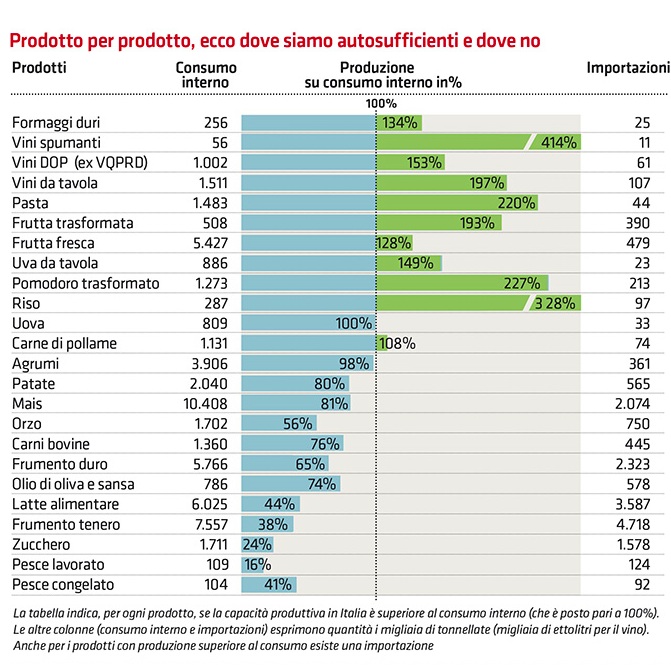
The example of pasta is instructive: Italian durum wheat only covers 65% of the requirement, wheat has to be imported from countries such as Canada, the United States and South America. The same applies to soft wheat as well, since the domestic product only covers 38% of what the sector requires, with imports from Canada, France, but also Australia, Mexico and Turkey. The situation does not change for other product categories: Italian beef accounts for 76% of consumption and for milk it drops to 44%, even for sugar and fresh fish we have to turn to other markets as we only manage to cover 24% and 40% of domestic consumption. Sugar comes mainly from Brazil, and fish from the Netherlands, Thailand, Spain, Greece and France, as well as Denmark and Ecuador.
Even most legumes are not Italian, due to drastic reductions in cultivation since the 1950s. Now imports come mainly from the United States, Canada, Mexico and Argentina, but also from the Middle East and China. The latter country became the first Italian supplier following the drought in Argentina.
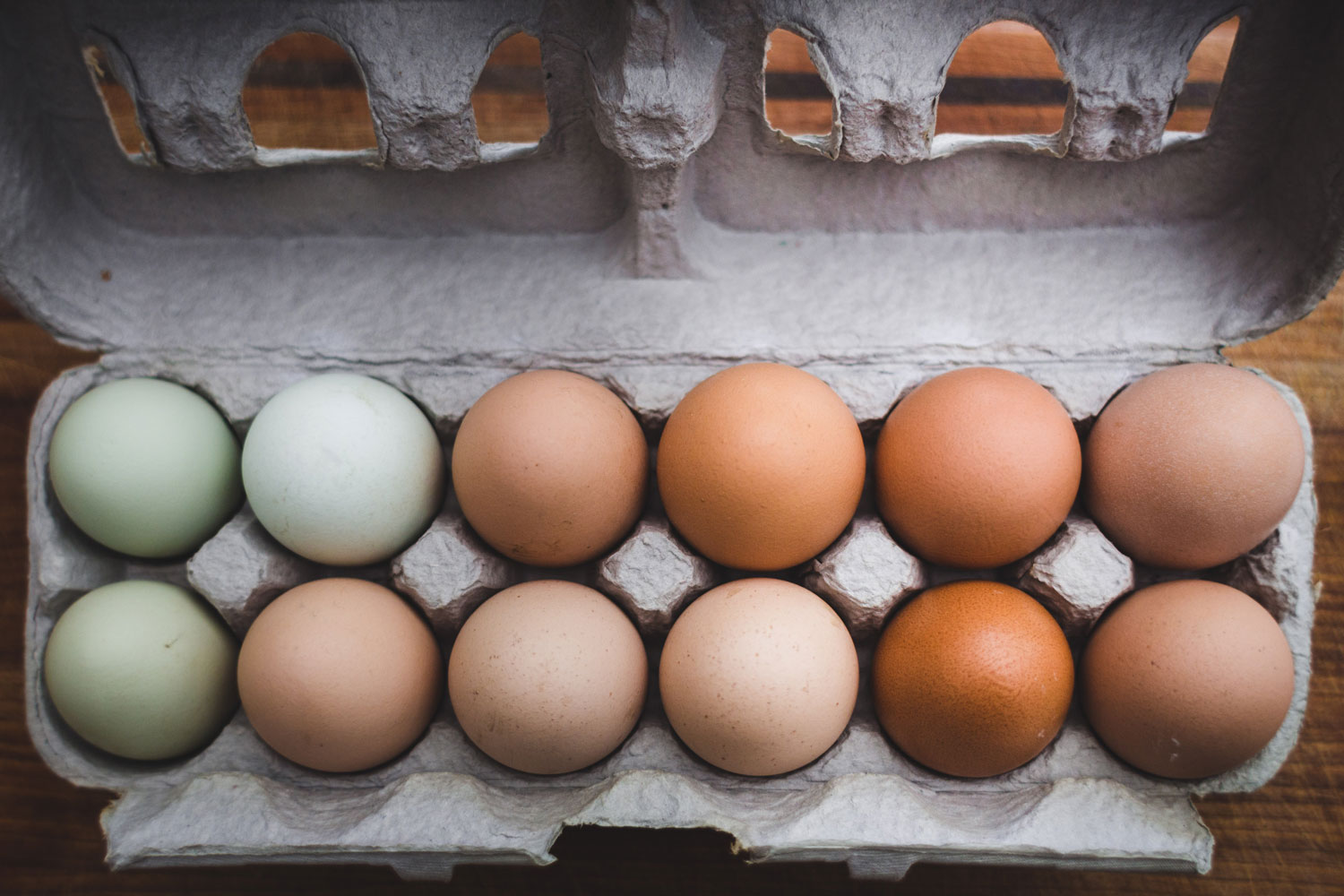
Domestic production of eggs, rice, fruit, poultry and wine meets domestic needs
We must also mention the age-old issue of tomatoes. While all the tomato sold on the shelves is Italian, we import triple tomato paste from China, which is processed and exported to other countries.
In contrast, we are self-sufficient in rice, wine, fresh fruit, tomatoes, eggs and chicken. Only in these cases do we have the almost total certainty that we are buying a 100 per cent Italian product.
The situation for processed food is the opposite: we produce 220% of pasta compared to domestic needs, which is exported, 4 times the amount of sparkling wine consumed, while for cheese this percentage is 134% (see table Coop below). Importing the raw material becomes indispensable in the case of pasta in order to be able to produce quantities to meet market demands.
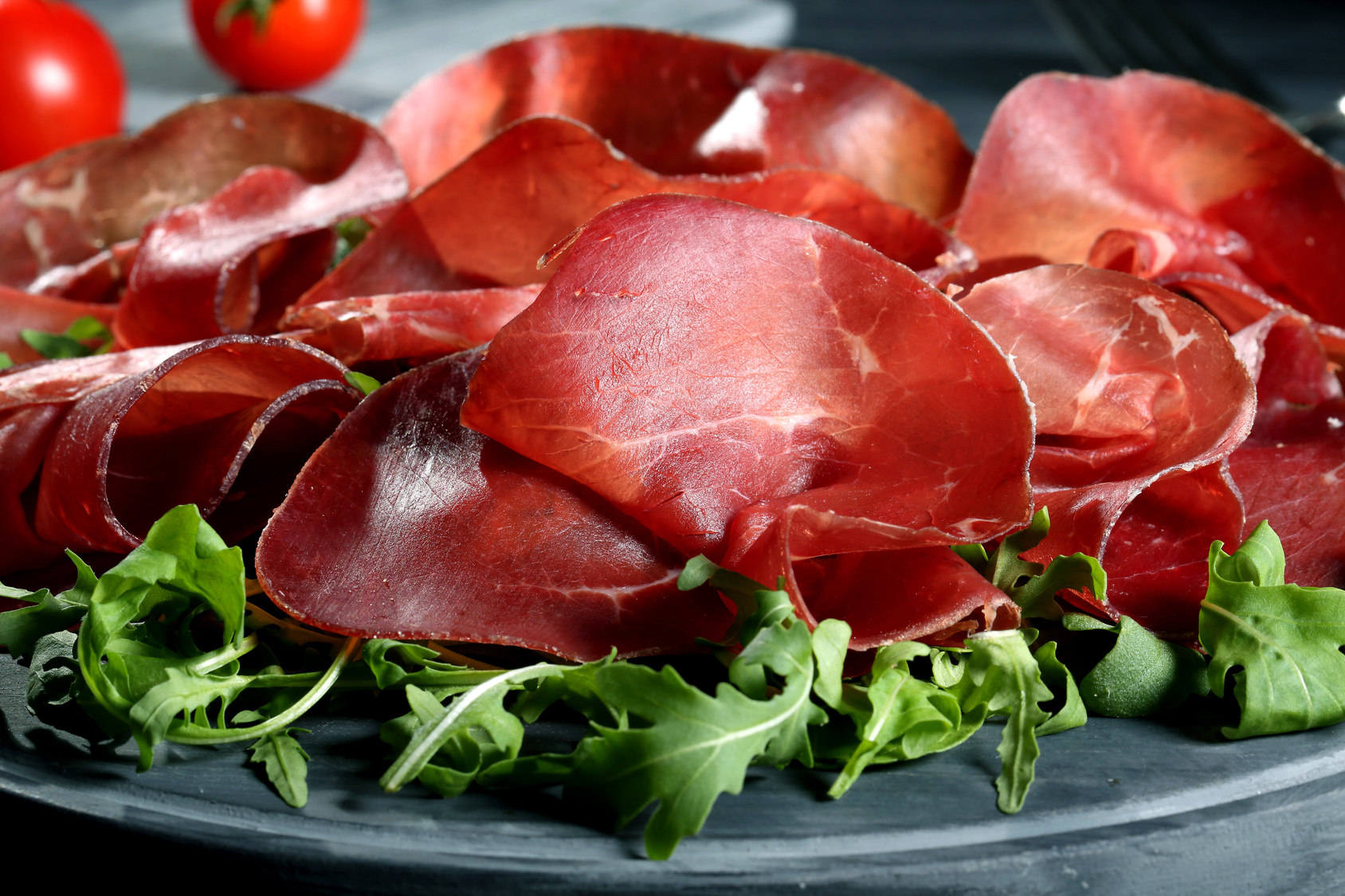
Someexamples may even be surprising: some products related to the territory, such as PGI (Protected Geographical Indication) products, are actually the excellent result of processing non-Italian raw materials. Bresaola from Valtellina is prepared with Brazilian meat. The Valtellina offers an excellent environment for the seasoning and processing of the product, but has no farms that can supply the basic ingredient (17 thousand tonnes per year, 11 thousand of which are PGI products)
… The sourcing of raw materials from abroad is not necessarily synonymous with poor quality: safety depends on controls and compliance with rules. It is more important to be able to strengthen the instruments that guarantee the quality of a product or an ingredient, regardless of its geographical origin, rather than seeking Italianity at all costs, even when this is not possible.
Table: Coop. Photo: photos.com
As you can read: we are, for example, big exporters of sparkling wines and big importers of fish.
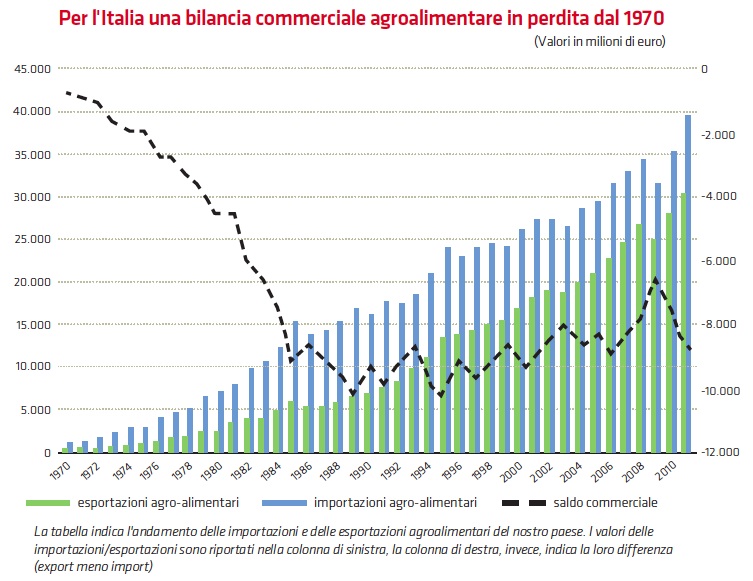
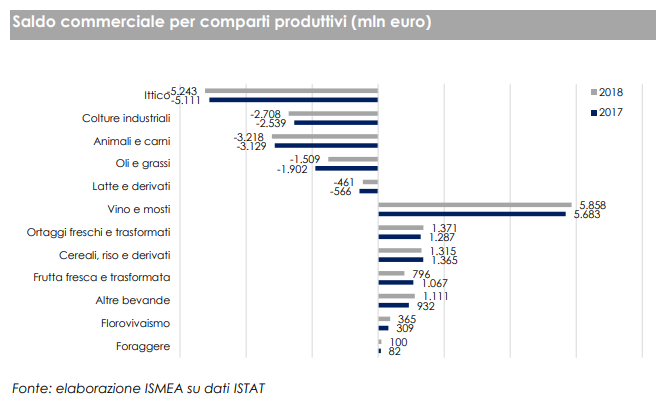
Food exports have increased since 2013 but many sectors remain in deficit, see below.
Note that while fish, meat, industrial crops (*), oil and milk have a negative impact on the trade balance (we have to import them), the positive ‘cereals’ should not mislead: this is pasta, processed from predominantly foreign wheat (USA, Canada, etc.) imported into Italy.
Then – once the wheat has been processed – the pasta is exported abroad.
In Italy, the self-sufficiency of durum wheat – which is what is needed to make pasta – was 65% in 2013 and has fallen to 60% by 2024.
(*) Five sectors are envisaged for industrial crops: industrial uses of cereal crops; industrial uses of oil crops; industrial uses of protein crops; forestry and wood products chains; biomass for […]energy and non-food uses.
Not all durum wheat is used to make pasta (see below).
And, in the end, 1 in 5 pasta dishes (20%) is made – on average (*) – from Italian wheat.
Although, after Barilla, all the big names in the sector are aiming to produce 100% Italian pasta.
To avoid running into ‘nasty surprises’, we recommend , as always, reading labels, signs etc. carefully and acting accordingly.
(*) very often ‘mixed’ wheat (a blend of various origins) is used.
To understand Barilla’s choice of 100% Italian wheat read: Barilla: only 100% Italian durum wheat? This was a “forced” choice (because Barilla was losing turnover and market share: -7.2% and -2.6% , respectively for the year ending August 2019).
“Il Fatto Alimentare” in 2024 reiterated: according to the 2024 Report on Italian agribusiness by the Istituto di Servizi per il Mercato Agricolo Alimentare (ISMEA), the Italian sector is characterised by a structurally importing agriculture that depends on foreign countries for the supply of agricultural goods that the food industry transforms into typical Italian products.
The main imported products needed for the Made in Italy agri-food supply chains are: unroasted coffee (100%), palm oil (100%), soya cake (83.3%), soya beans (68%), common wheat (64%), live cattle (57%), maize (54%), extra virgin olive oil (48%), durum wheat (44%), ham and fresh pig shoulders (37%).
And our agriculture, unfortunately, is going backwards.
This is confirmed by Fatto Alimentare, in 2025: wheat imports are at 70%.” The Italian production of soft and durum wheat is not sufficient to guarantee industrial needs. The same is true for extra virgin olive oil, which is now more than 60 per cent imported and has a steadily decreasing national production‘.
Below you will find Milena Gabbanelli’s article that talks, rightly, about hormone-treated meat , pesticides and GMOs ( so dear to Coldiretti…).
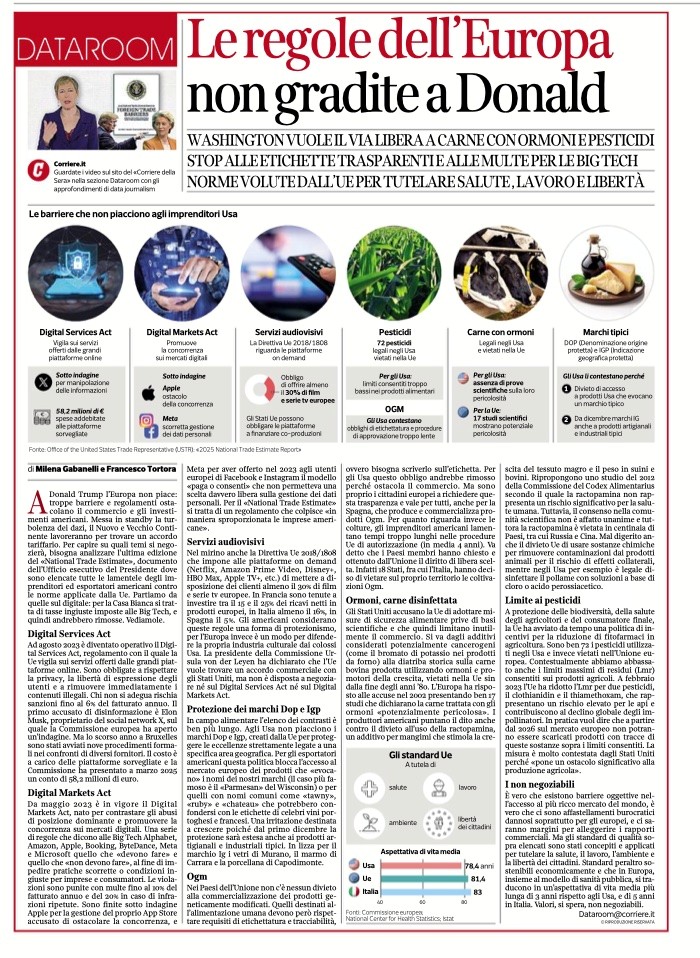
For those who ‘think bad’ I deny that the tracts are Gabbanelli’s ‘political diatrology’ against the USA: faced with large price increases – for example as will happen with pecorino romano, a cheese much loved in the USA – it is very likely that the average American consumer will buy alternative local products (‘Italian sounding’).
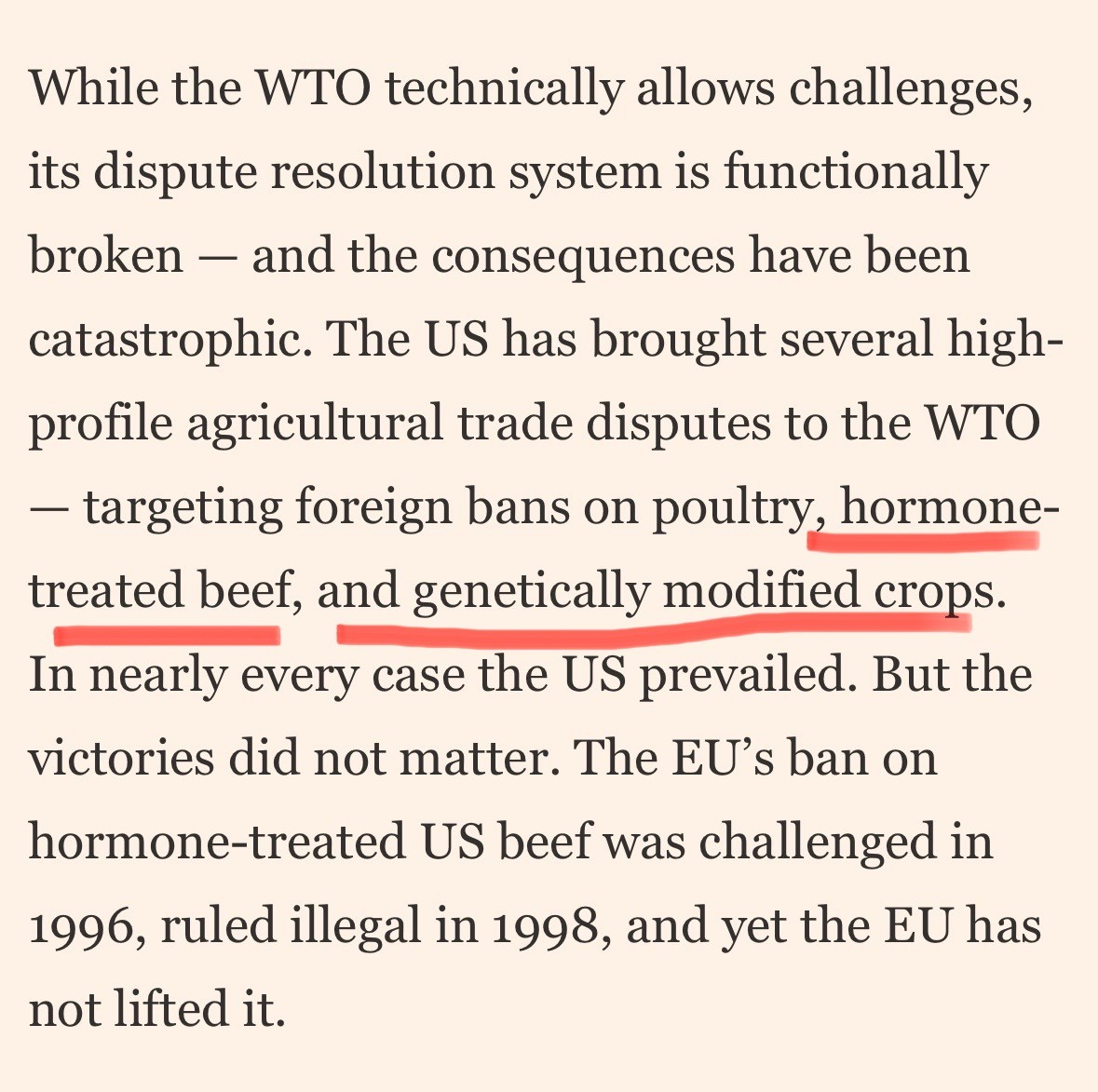
Below is an excerpt from an interview with Trump’s ‘tariff hawk’ Peter Navarro in the Financial Times, where he talks about US resentment at the EU’s refusal to import ‘Made in USA’ meat and GMOs.
I discuss this in this article.
On the taxation of big tech companies – including Amazon – you can read this article.