Compiled in 2011, updated 8 November 2022
About the Manifattura Caprotti trademark (above), created by Max Huber you can read here and also this article, where the invention of the Esselunga trademark is also discussed.
In the crucial years that saw the political unification of the Peninsula, between 1848 and 1861, Manifattura Caprotti also experienced moments of expansion and criticality, and perhaps of patriotic exaltation.
In fact,their owners themselves participated enthusiastically in the Risorgimento atmosphere, Giuseppe 2 enlisting in 1859 in the Albiatese National Guard and, the following year, militating in the Monza National Guard, and his brother Carlo 1 militating in the Hussars. However, both of them, as we will see later, like all the Caprotti of whom we have testimony, were never novel patriots, animated by a bombastic fighting spirit: as solid Lombards, idealistic excesses were not their thing. They are very reminiscent of the story of their grandfather Ricoeu who, to a grandson who had become a Garibaldian and, on nights in Calabria, wrote home nostalgically, replied and ti varda i camin che fumen, to bear witness to his discontent with the foolish man who, to follow wild fantasies, took useful arms from home.
Unity in fact, for the small Brianza company, meant first and foremost market expansion. The traditional and privileged area of its trade concerned the north-east of Lombardy (Milan, Como, Bergamo, Brescia and Varese), and the Veneto region, where it had few but excellent contacts. After the Third War of Independence (1866), and in the years that followed, when the Italian economy, after difficult years, experienced a happy expansion, the company’s range of action expanded as far as the south of Italy, albeit with considerable difficulty, at least in the early days, due to the lack of a national market.
The division into many states and statelets, in fact, also meant marked regional peculiarities in tastes, including those in clothing and fashion: the fabrics, patterns and fashions that might be liked in the north, in fact, were not necessarily also liked in the centre and south, and it took some time for the unification of the territory and the internal market to lead, inevitably, to a ‘nationalisation’ and standardisation of taste.
The Manifattura followed this expansion by also expanding itself: the factories expanded, the Caprotti family equipped them with the most modern and avant-garde machinery, which took their fabrics, the garish cotton made not for luxury but for people, to the South American and African markets.
Unity, all things considered, brought good luck to the solid, concrete Caprotti
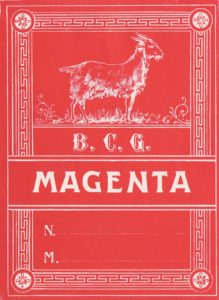
Below: fabric label of the Manifattura Caprotti , Giuseppe’s Bernardo Caprotti (1830- 1907), showing that my ancestors knew how to be self-ironic.