Published on 14 June, updated on 29 July 2026.
…McDonald’s is on the hunt for new business. Growth in burger sales in the US has slowed, and Starbucks and Dunkin’ are proving that drinks alone can generate billions of dollars.
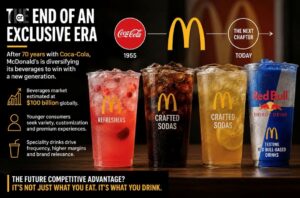
This spring, McDonald’s introduced its own range of personalised soft drinks and refreshments, and is preparing to launch a line of energy drinks in partnership with Red Bull – a first for McDonald’s…
Executives and staff at the burger chain say they have been asking Coca-Cola for more options for years… Meanwhile, the popularity of traditional soft drinks is waning as younger consumers crave exotic flavours and colourful concoctions perfect for TikTok…
The world’s largest burger chain, with annual revenue of around $27 billion, has stated that it remains committed to its long-standing partnership with Coca-Cola, whilst seeking to expand its supplier network across its 45,700 restaurants, 13,730 of which are in the United States. “We are guided by evolving customer preferences and emerging trends,” said a spokeswoman…
McDonald’s has been trialling new drinks in Colorado and Wisconsin, including a ‘Lunar Splash’ Sprite, made with Coca-Cola’s lime-lemon fizzy drink, alongside drinks featuring Red Bull and flavoured syrups. Some restaurants have also experimented with drinks based on generic energy drinks. But Red Bull stole the show.
Below: the end of Coca-Cola’s exclusive rights at McDonald’s – a momentous event.
2. Coca-Cola CFO reports uneven demand, warns of Middle East risks in 2027.
The drinks giant, which raised its annual profit target in April, said it was navigating the disruption caused by the US and Israel’s war against Iran “not perfectly well, but without fear, without trepidation”.
Below: in addition to changes to packaging – such as mini cans and sugar-free Coca-Cola, whose packaging has changed colour to red – Coca-Cola is seeking new variants.

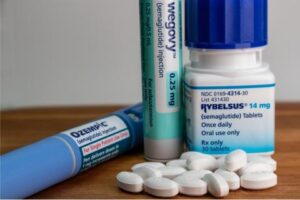
3. GLP-1:anti-obesity treatments, marketed in particular byNovo NordiskandEli Lilly, appear to pose a threat to junk food sales:
.. With one in eight American adults being prescribed a GLP-1 analogue (the nickname for these revolutionary molecules), food companies are on the front line in observing a decline in sales of crisps, sweets and even alcohol. Pepsi and Coca-Cola are selling more and more mini-cans. The American confectionery firm Hershey reports an 8 per cent increase in sales of its Ice Breaker lozenges between January and March – remedies for ‘bad breath’ (which take their name from one of these medicines).
Naturally, manufacturers are seeking to position themselves in promising market segments. On Wednesday 3 June, Nestlé announced the acquisition of all the shares in the German company Yfood. The Swiss group had held a 49 per cent stake in this start-up since 2023. Yfood produces meal replacements and aims to “replace junk food ”. In March, Danone acquired the British company Huel, another player in the nutrition sector capitalising on the need for patients on GLP-1 therapy to supplement their diet with protein or fibre.
Now, the fashion industry is trying to identify the winners and losers of this new phenomenon. On 3 June, whilst presenting its results, the American department store Macy’s reported a decline in its plus-size division. On Tuesday, Victoria’s Secret’s better-than-expected rise in bra sales during the first quarter was met with a surge of over 40 per cent in its share price, as investors see the need to renew one’s wardrobe following weight loss as a significant business opportunity.
Sports shops and gyms are rubbing their hands with glee. Even airlines could save hundreds of millions of dollars in fuel, according to analysts at Jefferies, by carrying lighter passengers.
It is entirely possible that the impact of GLP-1 is being overshadowed by inflationary pressures or the general pursuit of wellbeing. However, we cannot rule out the possibility that anti-obesity treatments, beyond public health concerns, could bring about a profound social transformation, similar to that brought about by the contraceptive pill in the 1950s. Making America sexy again.
4. Ultra-processed foods, and Coca-Cola in particular, are frowned upon in the West.
Finding little support in the‘more developed’ countries, they are expanding elsewhere, such as in Mexico: in many respects, Coca-Cola will be playing on home turf at the World Cup in Mexico, given its significant presence in a country where every adult consumes an average of 166 litres of sugary drinks a year, compared with 51 litres a year in France and 71 litres in the rest of Europe. The Coca-Cola sector alone accounts for 2 per cent of the country’s gross domestic product, providing nearly 110,000 direct jobs and over 1.5 million indirect jobs, equivalent to 2.8 per cent of the total workforce.
Thanks to partnerships with eight major groups – three of which are listed on the stock exchange – which bottle the concentrates in 73 plants, Coca-Cola controls the entire production chain, from sugarcane plantations to the recycling of plastic bottles. Its 350 distribution centres supply countless retail outlets, including over 1.5 million small grocery shops – or ‘tienditas’ – where the company sells soft drinks, energy drinks, milk, fruit juices and ever-increasing quantities of sparkling and still water, given that Mexicans are also the world’s largest consumers of bottled water…
Two of the world’s five largest independent Coca-Cola bottlers, Fomento Económico Mexicano (Femsa) and Arca Continental, are Mexican, and in 2025 they sold nearly 20 billion litres of drinks in the country. The former, operating in Mexico and eight Latin American countries, including Brazil, accounts for over 12 per cent of Coca-Cola’s global sales, with a turnover of over 16 billion dollars (approximately 13.7 billion euros) in 2025, to which must be added over $5 billion in sales from Arca Continental…
NAFTA has thrown the country’s doors wide open to ultra-processed foods, the health effects of which have been devastating: the obesity rate has skyrocketed, rising from 7 per cent of the adult population in 1980 to 37 per cent in 2022, whilst seven out of ten Mexicans – including one in three children under the age of five – are overweight.
In 2024, 305,204 people died from cardiovascular disease and diabetes, a condition affecting 14 million Mexicans, or 16.4 per cent of adults…
Coca-Cola companies currently have access to at least 71 million cubic metres of water – or 71 billion litres – per year. In a country that is largely arid or semi-arid, these drinking water concessions granted to industry sometimes cause tensions with local communities.
In the city of San Cristóbal de Las Casas, in Chiapas, various organisations have been campaigning for around ten years to revoke two concessions held by Femsa, which allow it to extract 1.3 million litres of water per day. “Some neighbourhoods suffer from water supply cuts, particularly during the dry season, and Coca-Cola has access to clean groundwater, whilst the city – which lacks a water treatment plant – is supplied with polluted surface water,” explains Alma Rosas, a member of the Education for Peace and Human Rights collective…
Despite “suffocating” lobbying, Coca-Cola’s excessive power in “developing” countries is coming to light.
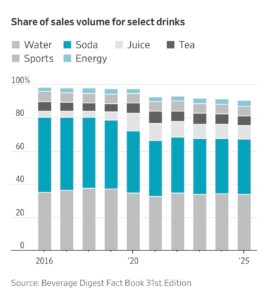
The market share of fizzy drinks (sodas) in the US has fallen from 45.6 per cent in 2016 to 33.5 per cent today: Coca-Cola is offsetting these losses in ‘developing’ countries.
But for howlongcan it continue to do so without facing the same loss of consumer support?
P.S.: Coca-Cola has been diversifying its product portfolio for some time. In Italy, for example, it bought the Lurisia water brand from the former owner of Eataly, Oscar Farinetti.