Written on 4 June, updated on 14 June 2026
Introduction:
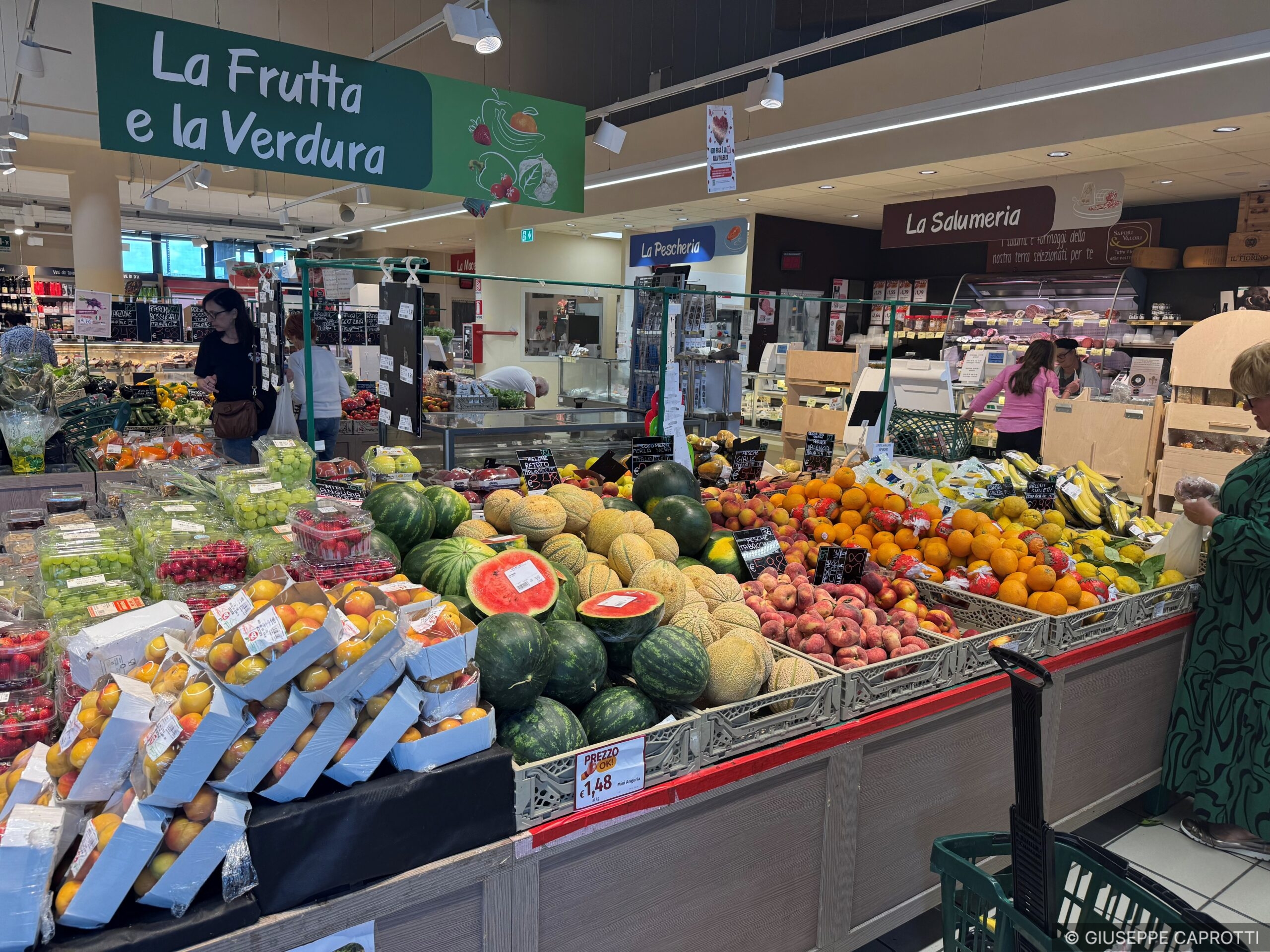
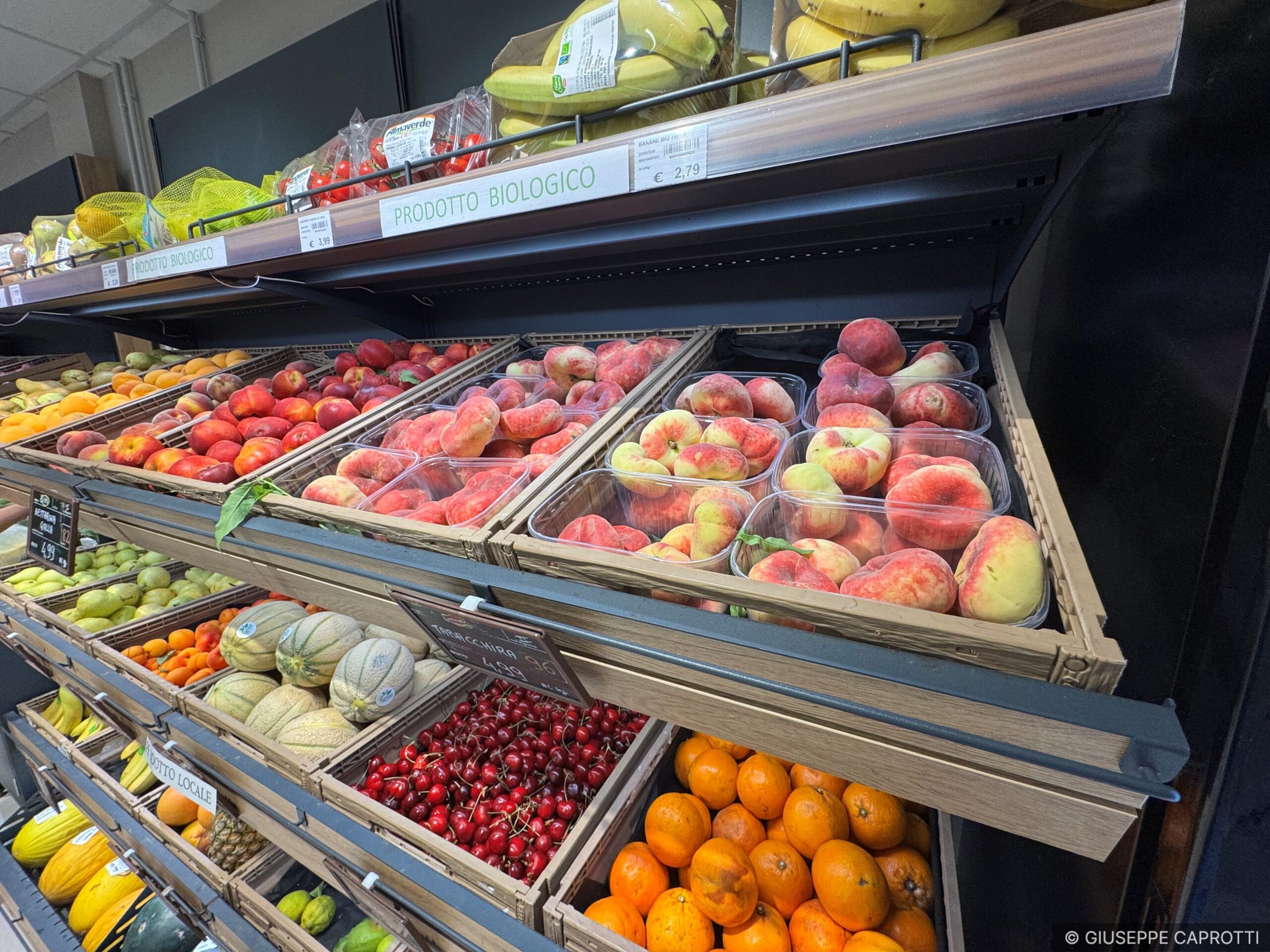
Fruit and vegetables, at least in Esselunga, were not placed at the entrance at random:
1) they were intended to give an initial impression of freshness at the start of the shopping journey.
2) they were intended to reinforce the idea that the supermarket or superstore was the place to go for fresh produce.
The text below was written by four people: Daniele Tirelli, Luigi Rubinelli, Mario Gasbarrino and myself.
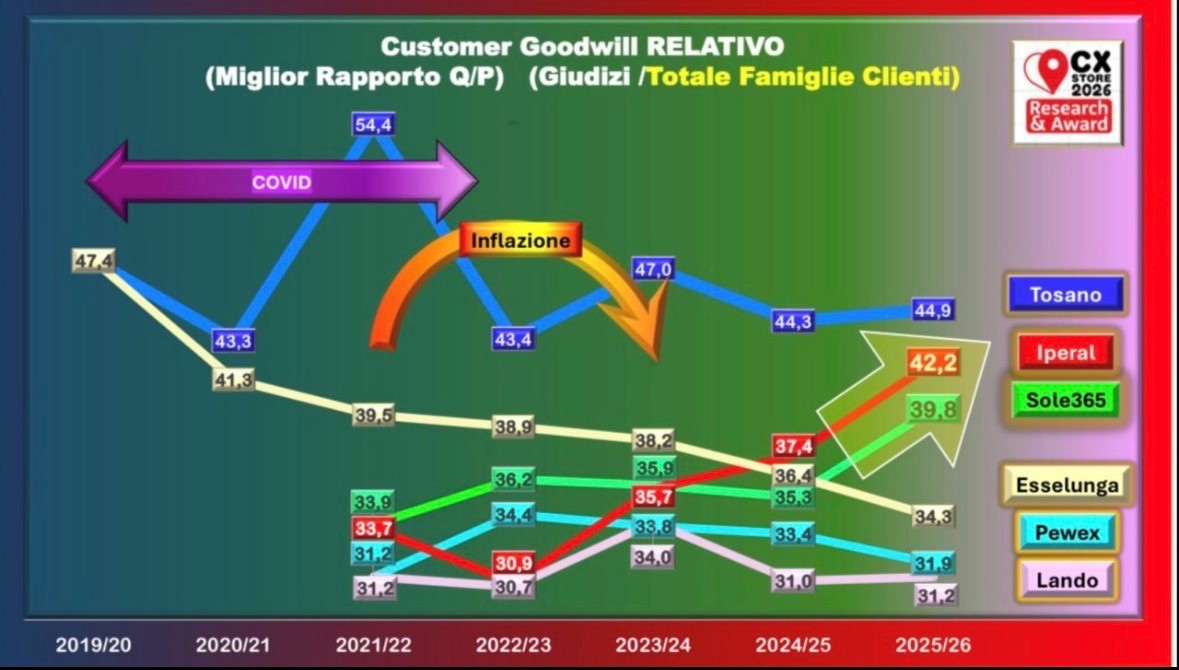
Below: Daniele Tirelli’s analysis of Goodwill – the company’s goodwill (*) –.
Esselunga’s declining trend is what draws attention more than any other factor: a brand that for decades has represented the absolute benchmark for quality in Italian food retail now sees its Relative Goodwill eroded not by a stronger national competitor, but by a constellation of local brands that surround and undermine it – each within its own catchment area – with value propositions credible enough to poach the incumbent’s customers, namely those who appreciate Esselunga’s quality but perceive it as overpriced…
2) Luigi Rubinelli: … Esselunga’s main competitor is Iper la grande I (Finiper), but also Lidl and Eurospin.
A separate consideration should then be given to Tigros and Iperal, which are, in fact, slightly smaller versions of Esselunga with less extensive and varied product ranges, but where it is probably easier to do your shopping in less time. Added to this is the presence of bistros offering good value for money.
And then, you must admit, there is the presence of a convincing fruit and veg section. This is because, regardless of the performance of the dry goods and tinned food sections, the main reason for shopping in a supermarket remains the fruit and veg section, whether you like it or not.
Below: Esselunga has lost its leading position in Lombardy to Iperal, and in Tuscany to Coop.
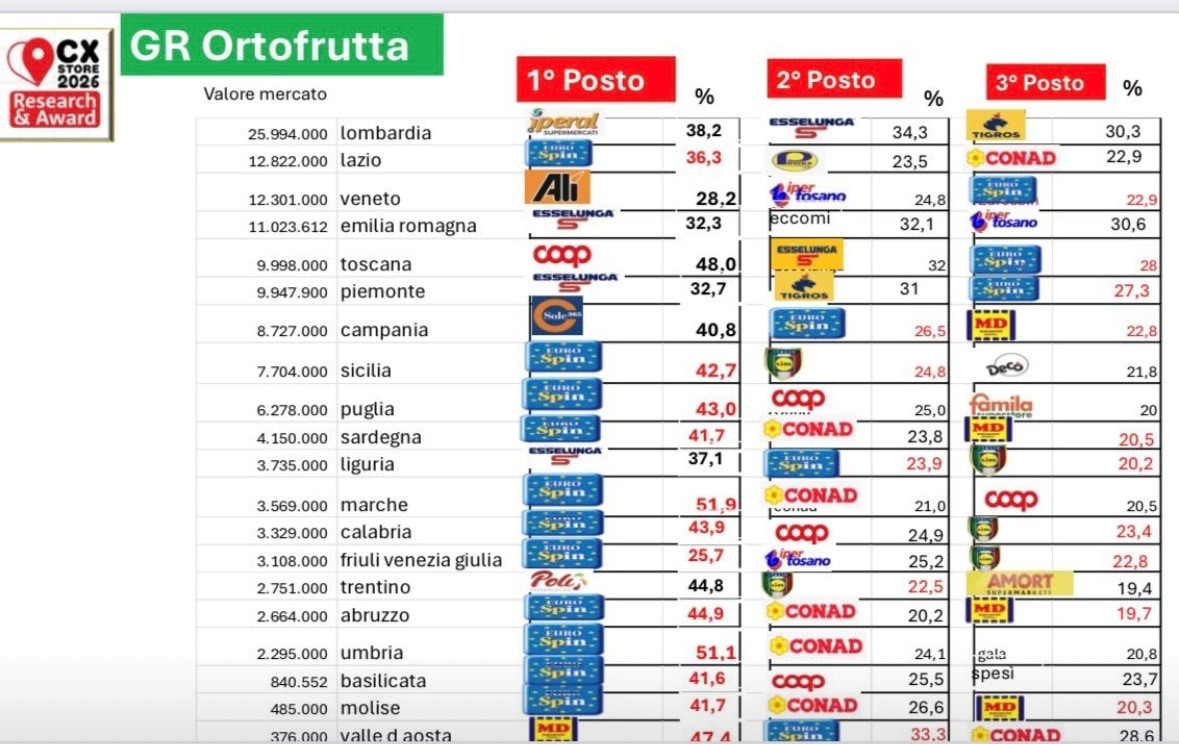
4) Mario Gasbarrino: Here – above – is the complete ranking: Best Value for Money in Fruit and Vegetables.
👉 Here is the question that #CxStore Research put to 25,358 Italian households (expansion coefficient of 1/1049):
‘’Which retailer, among those you know and have visited, do you think has the fruit and veg section with the best value for money?
But be careful:
👉 The ‘quality-price ratio’ is a linguistic construct, not a mathematical concept, because quality and price are inseparable and entirely subjective. It can be intuited. It cannot be calculated.
👉 The concept of value for money is also a relative one, which can vary from customer to customer, depending on the region where they live, their income, their expectations and experiences; therefore, it is not the same for everyone
👉 The fact that many #Discount chains feature at the top of the rankings ( Eurospin is first in as many as 11 regions, and second or third in a further six) therefore depends on these factors and means that its fruit and vegetable offering better meets its customers’ expectations.
👉 There does, however, appear to be a problem for supermarkets, which need to improve their value for money, because it is clear that if they continue to sell:
– the same quality as discount stores
– in the same way (self-service)
– but at a higher price
they are unlikely to be the preferred choice.
👉 In conclusion, therefore, if the supermarket does not want to resign itself to the idea of selling only #tinned_food, it must differentiate itself; it must reinvent a new way of selling #fruit and veg; what has been done so far is no longer enough, and the new path involves re-evaluating the sales staff, their profession and their expertise, so it is neither easy nor quick. Daniele Tirelli
5) Daniele Tirelli (from LinkedIn): DECONSTRUCTING COMMON MYTHS ABOUT FRUIT AND VEGETABLES – I understand how unpleasant it is to dissect the discount phenomenon in comparison to traditional supermarkets. I also understand why many people are reluctant to look at and accept the data for what it is.
But the CX Store Research is a repeatable – that is, scientific – experiment, with a method and its own degree of precision (expansion coefficient: 1 household per 1,049), an experiment that anyone can replicate.
CX Store Research therefore tells us that 74% of households in Lombardy and 85% in Sicily have visited at least one of the five discount stores mentioned.
It therefore tells us that the pseudo-scientific distinction between this clientele and that of the ‘other’ high-end stores is meaningless; it is a justification that no longer holds water. Four-fifths of customers use all retail formats without restraint.
It tells us that in Sicily, where the best fruit in Europe is produced, in reality, 85% of households living there have bought fruit and veg at at least one discount store, and 61% found the best value for money at Eurospin, MD, Lidl, Ard or Penny!! Spurious remarks such as: ‘… I’ve been there! … my aunt said” etc. are of no use.
There is only one conclusion: traditional modern retail failed to grasp the phenomenon described in time, a phenomenon which drags along with it even more significant issues, and regaining the lost goodwill tomorrow will be neither simple nor immediate.
Incidentally, the myth that families in the South do not buy fruit and vegetables in supermarkets must also be debunked, as must the ridiculous notion of ‘zero-kilometre’ produce. Households that stated they do not buy fruit in supermarkets account for 4.1% in Lombardy and 5.6% in Sicily.
6) Conclusion : the issue of the quality and taste of fruit and vegetables exists elsewhere too, given that Grand Frais ran this advert stating:
“We have reinvented the oldest profession in the world: tasting. To ensure our strawberries are fragrant, we taste them before putting them on sale.”
“That makes sense,” you might say.
But it must be added: it is the owners ( of the supermarket chains) who should be tasting them , given that monitoring what buyers do in the fresh produce sector – where there are no standard price lists – is much more difficult than monitoring buyers whose counterparts are Barilla, Ferrero or Coca-Cola.

I repeat what I wrote at the beginning:
Fruit and vegetables, at least in Esselunga, had not been placed at the entrance at random because
- it was intended to give an initial impression of freshness at the start of the overall shopping journey.
- it was intended to confirm that the supermarket or superstore was the destination for buying fresh produce.
So, if supermarket and superstore chains want to regain their leadership, they must take back control of their purchasing. And, as Mario Gasbarrino says, this includes the staff at the points of sale.
Otherwise, their market share is set to decline compared to local supermarkets or discount stores.
Read also: CX Store Award Research: the top three brands by region