

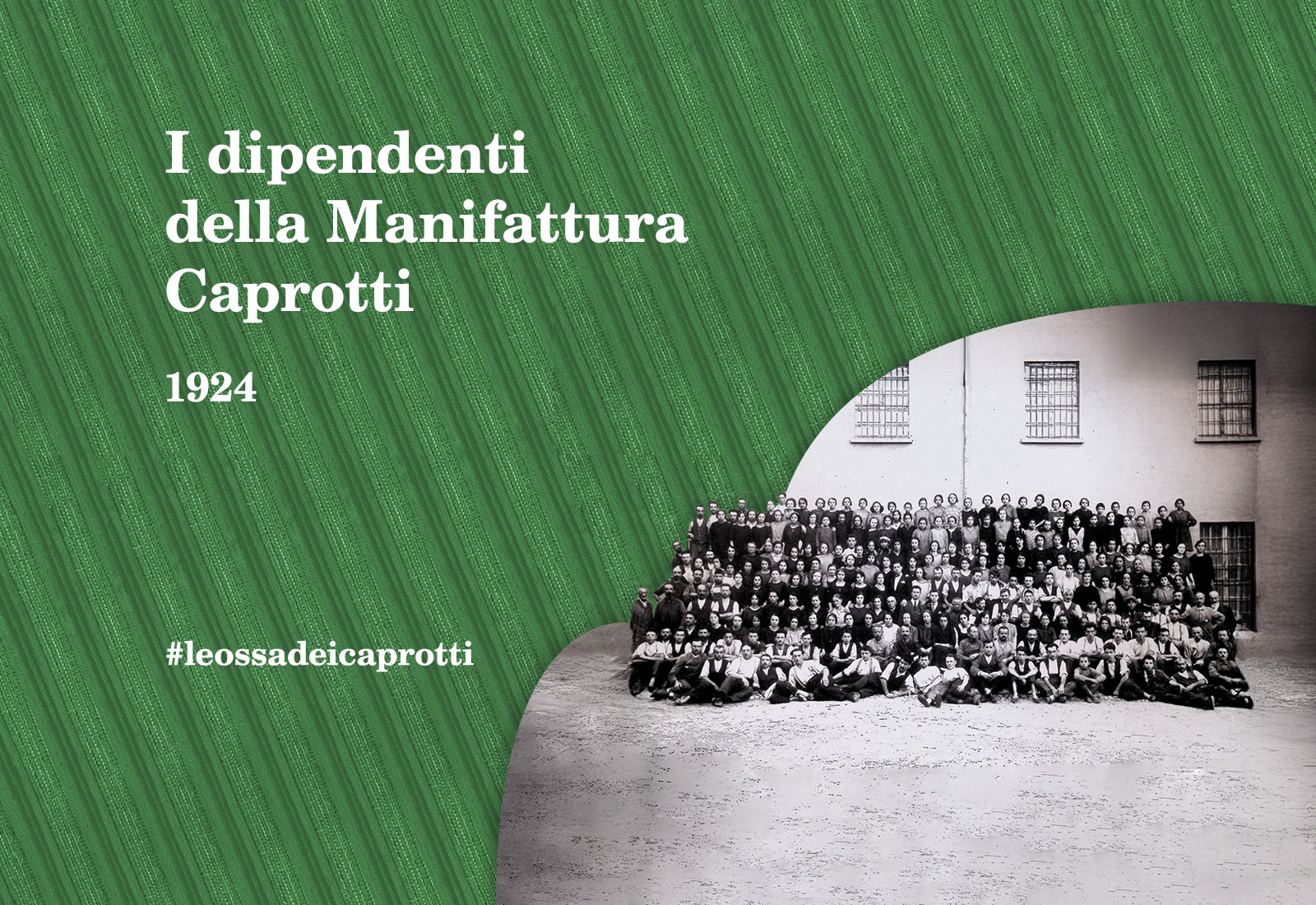
Drafted on 18 June, updated on 3 July 2026
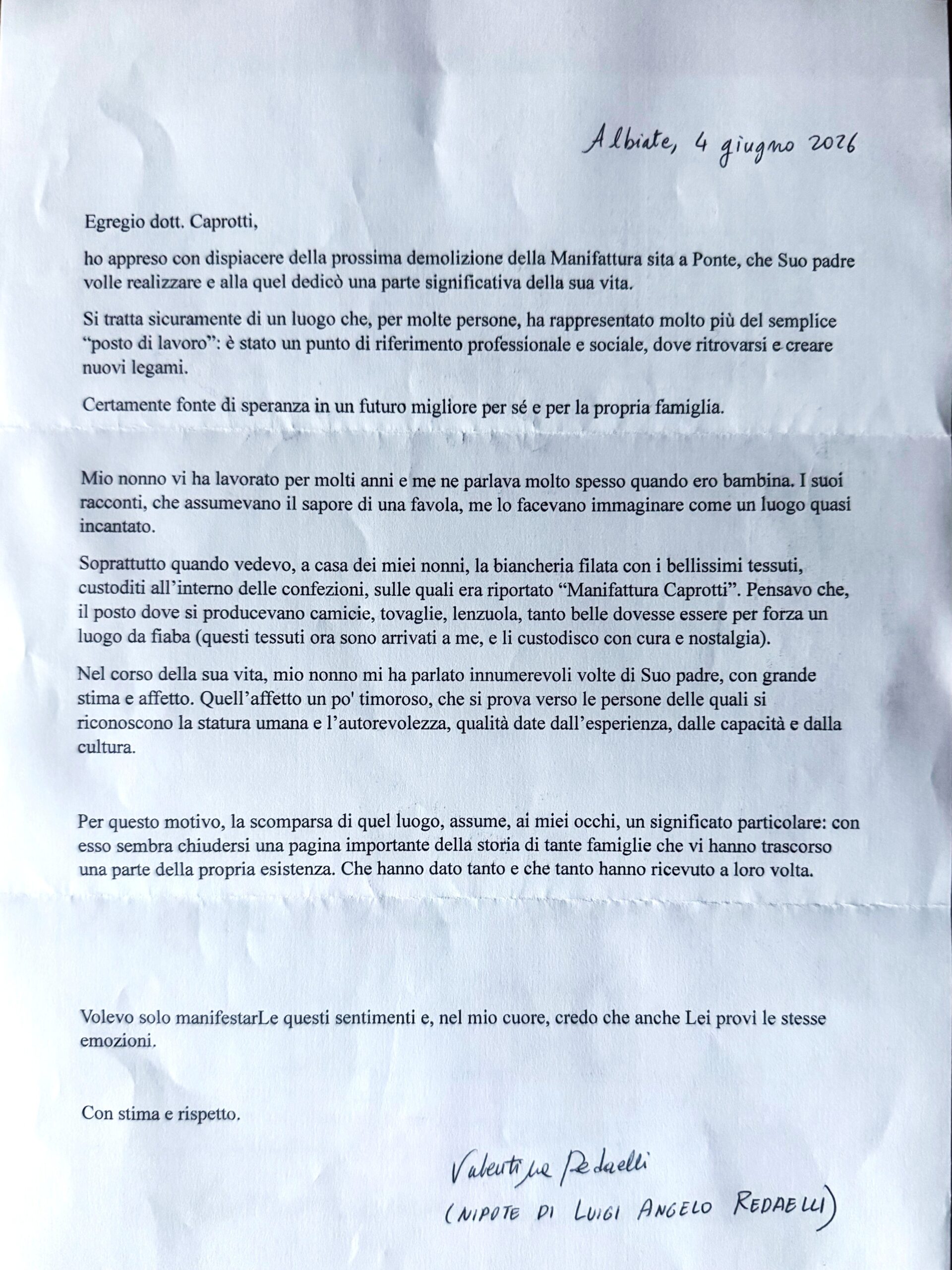
Albiate, 4 June 2026
Dear Dr Caprotti,
I was saddened to learn of the forthcoming demolition of the factory in Ponte, which your father set out to build and to which he devoted a significant part of his life.
It is undoubtedly a place that, for many people, represented much more than just a ‘place of work’: it was a professional and social hub, a place to meet and forge new bonds.
It was certainly a source of hope for a better future, both for oneself and for one’s family.
My grandfather worked there for many years and used to talk to me about it very often when I was a child. His stories, which had the feel of a fairy tale, made me imagine it as an almost enchanted place.
Especially when, at my grandparents’ house, I saw the linen made from those beautiful fabrics, kept inside the boxes bearing the words ‘Manifattura Caprotti’. I used to think that a place where such beautiful shirts, tablecloths and sheets were made must surely be a fairy-tale place (these fabrics have now come into my possession, and I cherish them with care and nostalgia).
Throughout his life, my grandfather spoke to me countless times about his father, with great esteem and affection. That somewhat reverent affection one feels towards people whose human stature and authority one recognises – qualities born of experience, ability and culture.
For this reason, the disappearance of that place takes on, in my eyes, a special significance: with it, an important chapter in the history of so many families who spent part of their lives there seems to be drawn to a close. Families who gave so much and who, in turn, received so much.
I simply wanted to share these feelings with you and, in my heart, I believe that you, too, feel the same way.
With esteem and respect.
Valentina Redaelli, granddaughter of Luigi Angelo Redaelli
I replied as follows:
Dear Ms Redaelli,
Thank you for your letter: I knew nothing about the demolition and I am very sorry to hear this, not least because my grandparents always lived there, right up until after the war.
If you’ll allow me, I’ll publish your letter on my website …, if only because it is such a beautiful expression of the affection for the Manifattura that we all hold dear in our hearts!
Warmest regards; please do not hesitate to contact me,
see you soon
Giuseppe Caprotti
I would like to add to my letter that I was born hearing stories about the Manifattura, long before I heard of Esselunga:
“…Among the many people who helped out our parents were ‘White’ Lucia and ‘Red’ Rosa. Lucia is a true housekeeper, a member of the family. She is a genuine daughter of the ‘White’ Brianza region, and very religious. A figure from a bygone era. She began working at the Caprotti factory as a child and recalls walking to work in the mornings from Rancate – a village about twenty minutes’ walk away – in her wooden clogs. When Ermanno Olmi’s film *The Tree of Wooden Clogs* was released in 1978, it felt as though I were reliving her stories, in which the stern figure of our great-grandfather Bernardo [known as Nardo. He was the one who had taken her on] stands out…” *Le Ossa dei Caprotti*, Feltrinelli 2023, page 91
Lucia was a pillar of my childhood, and her granddaughter Luisella—of whom I have such fond memories—worked at Manifattura and was greatly appreciated there.
And as I have said many times during the presentations of my book, without the Manifattura, Esselunga would never have existed.
P.S.: Few people know this, but before it closed, I sold the Manifattura’s shirts in Esselunga’s non-food promotions. Just to say that we ‘tried everything’ to help what my father called ‘the award-winning company’.
Thanks to Luca Zotti, Roberta Liberale and Eleonora Sàita


