

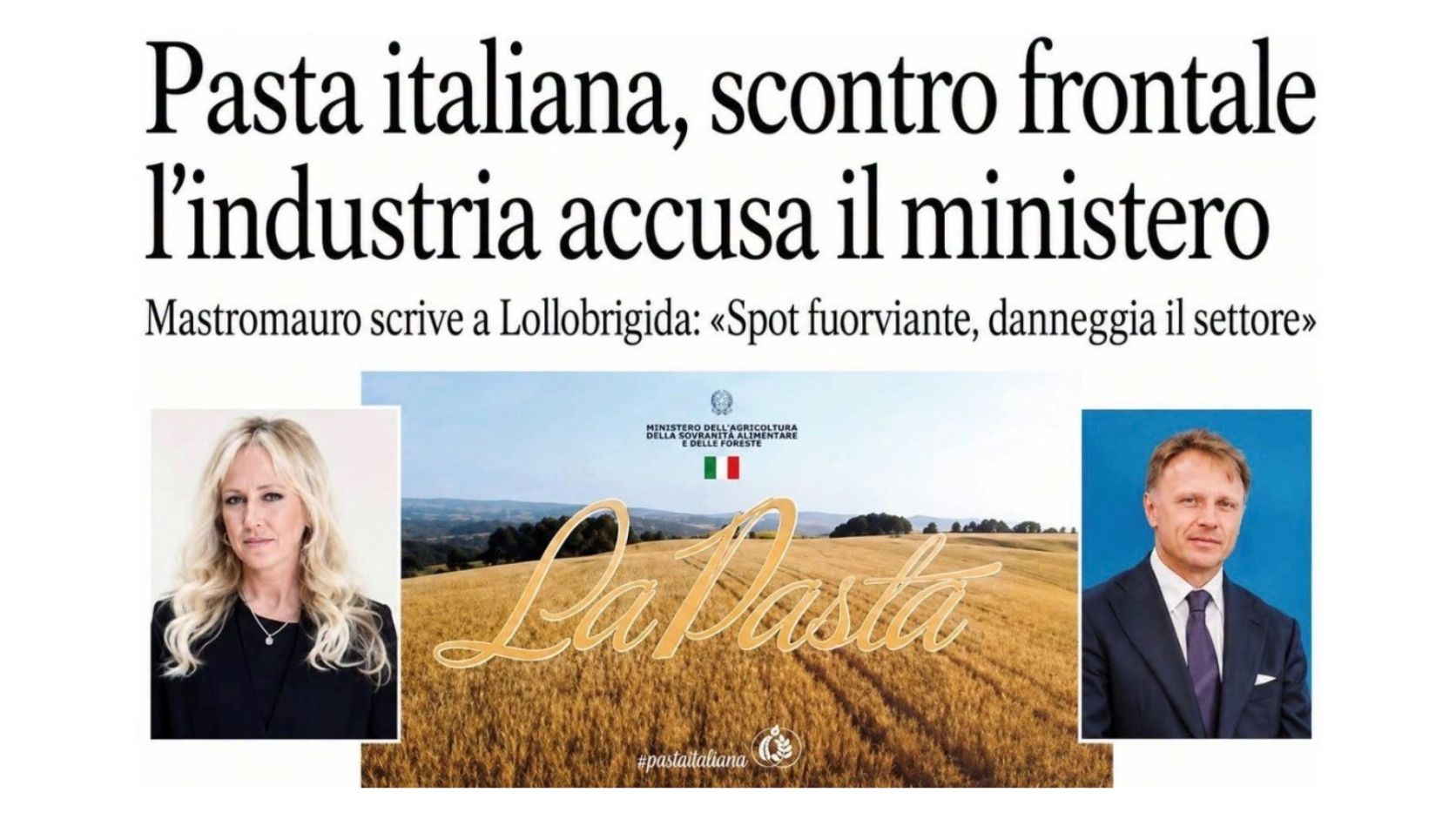
Pasta made from 100% Italian wheat: the Ministry of Agriculture claims it is safer and healthier, but is that true?
From 21 August 2026, Rai channels will be airing the first advert in a new government campaign dedicated to pasta, produced by the Ministry of Agriculture, Food Sovereignty and Forestry (MASAF), headed by Francesco Lollobrigida, in collaboration with ISMEA and the Italian Volleyball Federation. The stars of the campaign are several players from the men’s and women’s national volleyball teams, and the message is conveyed by some very well-known faces, such as Anna Danesi, Carlotta Cambi, Stella Nervini, Paola Egonu, Simone Giannelli, Daniele Lavia and Riccardo Sbertoli…
Il Fatto Alimentare argues that: the link between 100 per cent Italian wheat, greater safety and better health is completely unfounded and entirely incorrect, as it suggests to consumers that there are health benefits that do not exist…
The industry has protested: Margherita Mastromauro, president of the pasta makers’ association within Unione Italiana Food, wrote to Lollobrigida, describing the advert as misleading and harmful to the sector.
Perhaps, given that Italian durum wheat is sold below cost and that, over 13 years, the area under cultivation has fallen by 10 per cent, whilst the proportion of demand met by domestic production has plummeted from 78 per cent to 56.5 per cent, we didn’t need an advert – paid for with our money – but
- a serious crackdown on unfair practices, which, as far as I know, nobody is undertaking.
- And, before doing that, the issue of unclear pasta labelling needed to be resolved: there’s no point in saying ‘Italian pasta is tastier and/or safer’ if, standing in front of a shelf, you can’t tell which is made with Italian wheat and which isn’t.
In this regard, we would point out that Barilla has backtracked on its claim that its pasta is made from 100 per cent Italian wheat.
Below: there is a great deal of confusion on pasta labels: note the first label, where the origin of the wheat is omitted. But even the distinction between EU and non-EU wheat lacks transparency.
Before running an advert for Italian pasta – claiming it is healthier and safer? – efforts should have been made to protect Italian farmers and consumers.
Photographs taken at Carrefour in Milan


