The story is not new to the news, even if, as in many unpleasant situations involving big brands, it has never been reported by ‘important’ newspapers. For this reason, as well as for duty of reporting, we are reporting it.
In this regard, I recommend reading how consumers could change the fate of certain sectors: the cases of Barilla, De Cecco (wheat), Casino, Carrefour with JBS (meat) and Ferrero (hazelnuts)
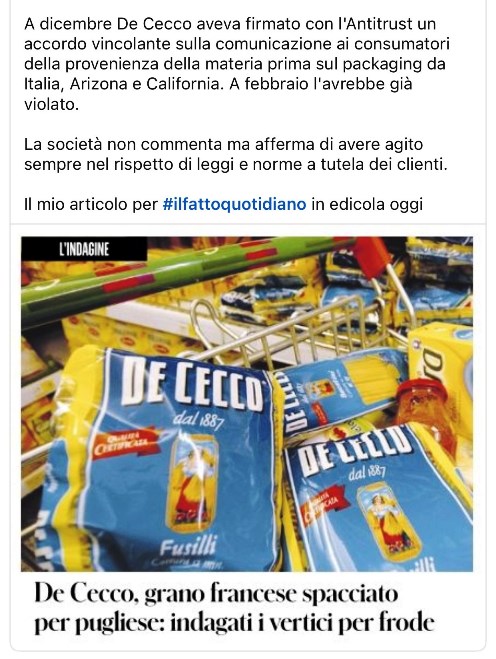
Note how, over time, the news has changed: first it seemed that the French wheat used by De Cecco had been ‘transformed’ into Apulian. On this subject, we recommend you also read this article.
Not any more, how come?
When I think that, at one point, De Cecco was to become Esselunga’s private-label supplier, replacing Delverde, I breathe a sigh of relief.
De Cecco, the Abruzzese pasta company in the dock for trade fraud
The accusation, brought by prosecutor Luisa Bertini, concerns the marketing of some batches of pasta, particularly long pasta, which allegedly contained false information on the origin of the wheat used.
redazione@ilnuovomolise.it
According to the indictment, it was indicated on the packaging that the raw material came from California, Arizona and Italy, while in reality about 7% of the wheat, or 4,475 tonnes, came from France. A detail that, if confirmed, could undermine consumer confidence in a historic brand like De Cecco.
22 January 2025 will be a crucial date for the Italian food industry. On that day, at the Court of Chieti, the trial will be held in abbreviated form for fraud in trade involving the defendants Filippo Antonio De Cecco, president of the Board of Directors of F.lli De Cecco Spa, Mario Aruffo, purchasing director, and Vincenzo Villani, former quality director. F.lli De Cecco Spa is involved for administrative responsibility. But what brought one of the most respected names in Italian pasta to this point?
THE ACCUSATIONS AND THE CONTEXT
The accusation, formulated by prosecutor Luisa Bertini, concerns the marketing of some pasta lots, particularly long pasta, which allegedly contained false information on the origin of the wheat used. According to the indictment, it was indicated on the packages that the raw material came from California, Arizona and Italy, while in reality about 7% of the wheat, or 4,475 tonnes, came from France. A detail that, if confirmed, could undermine consumer confidence in a historic brand like De Cecco.
THE DEFENCE: TRANSPARENCY AND FAIRNESS
The defendants’ lawyers, including Augusto La Morgia, Marco Femminella, Marco Spagnuolo and Antonio Marino, produced documents already in the prosecutor’s file, stressing the company’s transparency and fairness. Lawyer Femminella said: ‘They are relevant because of the clarity of the company’s conduct, which is very transparent, and therefore they were useful to give to the judge to read, but they were already there, so much so that the prosecutor asked for these documents to be archived’. Among the documents presented, there is also the one from the control authority that guaranteed the conformity of the advertising and representation of the product.
THE ROLE OF VINCENZO VILLANI
An interesting aspect of the case concerns Vincenzo Villani, former quality director, who left the company for reasons unrelated to the affair. The lawyer Antonio Marino, who defends him, said: ‘Villani left the company for other reasons unrelated to this affair, even at a time before this affair took place. I can add that he is absolutely calm in the knowledge that he acted with the utmost fairness, as did the entire company’.
THE ABRIDGED PROCEDURE: A STRATEGIC CHOICE
The decision to opt for the abridged trial, admitted by Judge Morena Susi, is a strategic choice by the defence. This type of rite allows for a quicker verdict and, in case of conviction, provides for a one-third reduction of the sentence. Lawyer Marino explained: ‘The abbreviated procedure is a procedural choice, we believe that already in the state of the acts there is overall clarity that can lead, as we hope, to the acquittal of my client’.
IMPLICATIONS FOR THE FOOD SECTOR
The De Cecco case is not just a legal issue, but has wider implications for the entire Italian food sector. Consumer trust is crucial to the success of any brand, and allegations of fraud in trade can have devastating effects on a company’s reputation. Transparency and fairness in the communication of product information are key to maintaining public trust.
A PRECEDENT FOR THE FUTURE?
Regardless of the outcome of the trial, the De Cecco case could set an important precedent for the future. Food companies may be pressured to review and strengthen their internal controls and communication practices to avoid similar allegations. It could also increase pressure on regulators to ensure greater vigilance and transparency in the sector. 22 January 2025 will be a date to mark on the calendar not only for industry insiders, but also for consumers who closely follow food quality and safety issues. The hope is that the truth will emerge clearly, whatever it may be, and that it will help to strengthen confidence in the Italian food sector.
Below is the November 2020 article on the trade fraud on French wheat that ‘became’ Apulian.