First draft 16 April 2014, Last updated 23 January 2026
We are, unfortunately, in 100% agreement with her.
The reasons for this mediocrity are many:
the coffee, which like many whiskies is blended (blended with various qualities), is often ‘cut’ with coffee of poor quality(robusta, Vietnamese or African origin).
The staff sometimes do not know how to make coffee and, of course, do not even maintain the machines.
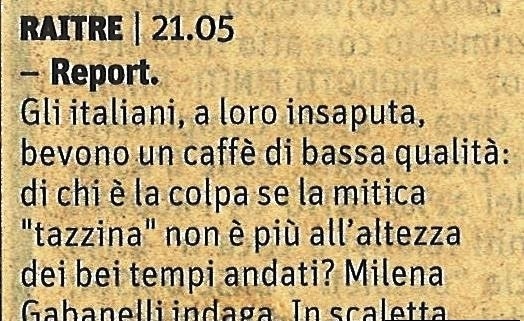
Report highlighted the contrast between family-owned Italian coffee bars, which often serve mediocre coffee, and the approach of the multinational chain Starbucks, which trains its employees and serves good coffee, with consistent quality between one Starbucks Coffee and another, from the US to Japan via Switzerland.
What the programme did not highlight was that:
1) coffee prices – in general – in Italy are far too low to be able to differentiate between the best coffee and the worst.
On a price scale that generally ranges from 0.90 cents to €1.10, it is difficult to tell that the latter is perhaps a pure Arabica (like the one at Esselunga organic, at least a few years ago ),
Moreover, with such a low price, it is also difficult to invest in staff training:
there is no money or time, of course, to explain to the barista how to manage the machine and serve a coffee well, an activity that should include explanations on the type of coffee served because, as Gabbanelli showed very well, Italians – in general – do not distinguish bad coffee, cut with Vietnamese robusta, from 100% Arabica coffee, of superior quality.
2) In Italy, the black economy discourages anyone who wants to enter the market,
the BLACK (and we are not just talking about labour) means that there are two circuits:
a legal one (very restricted) and an illegal one (very vast) that competes unfairly with the former.
If I were Starbucks I would not enter this market [in the meantime it has done so, with mixed fortunes] for the reasons already stated, to which is added a much more recent one:
3) the deteriorating quality of coffee in some places that should be cult or the bastion of Italian ‘savoir-faire’.
I am referring to Sant’Ambroeus in Milan.
This historic café in Milan has always had excellent coffee, from the Illy roasting company in Trieste
the new owners of the historic bar-restaurant, who are not Italian, thought it best to heavily lower the quality of the coffee (we omit the name of the roasting company of the ‘new’ coffee, although we know it), maintaining the price of the espresso at €5!
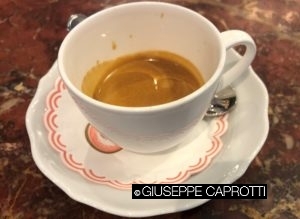
These practices are absolutely legal (lowering the quality of the product while maintaining the same price) but, in our opinion, not very correct, which end up making us say that ‘la Gabbanelli is right’…
While, as Italians, we would very much like her to be wrong.
After more than 20 years on Gabbanelli’s show, the only real change is the price at the bar, which has gone up due to inflation.
(*) points 1) and 2) depend on national policies, point 3) on individual operators.
I am pleased – not for my country – that the Gambero Rosso in 2024 confirmed what I was writing 10 years ago:
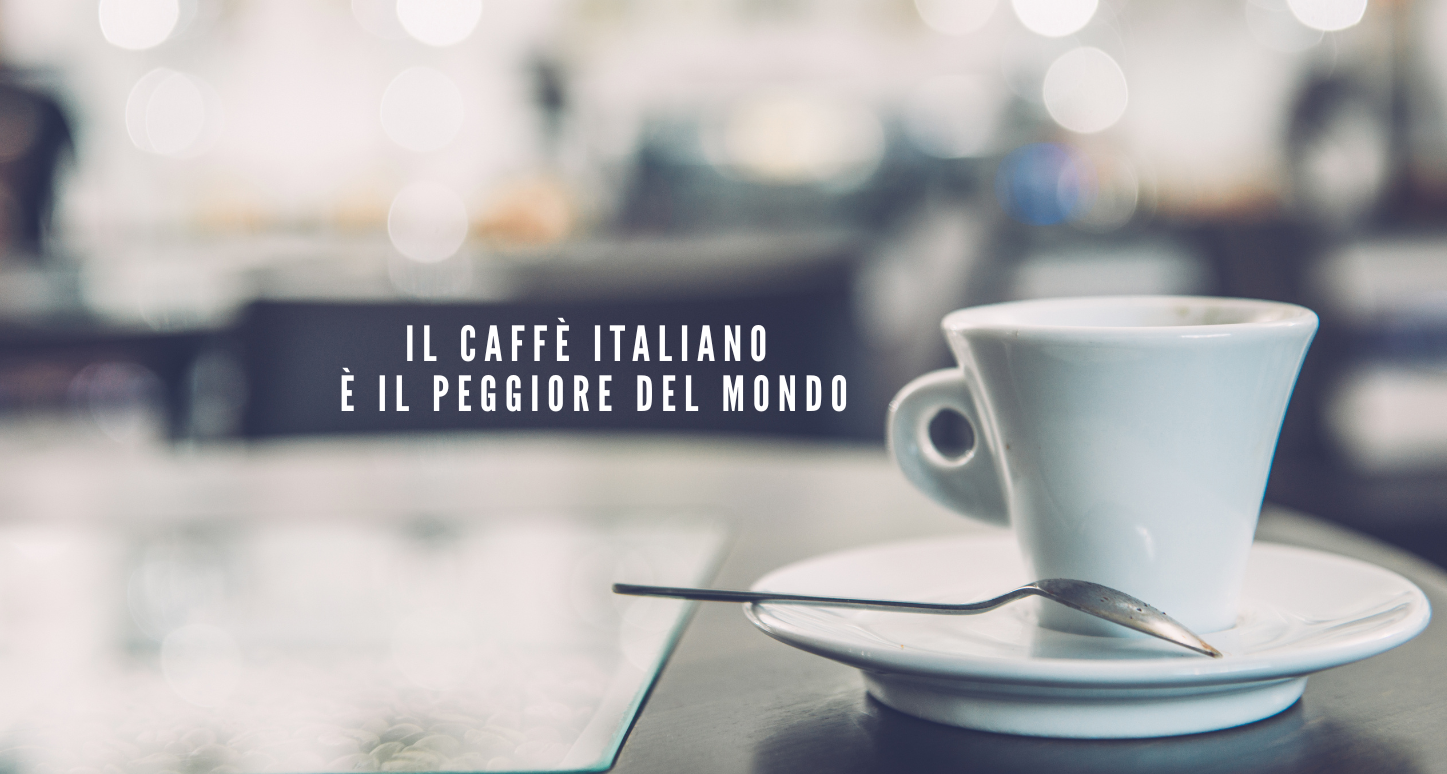
Italian coffee is the worst in the world. Bar survey. Here’s what’s inside your cup.
And then, unfortunately, certain images say it ‘longer’ than any article.
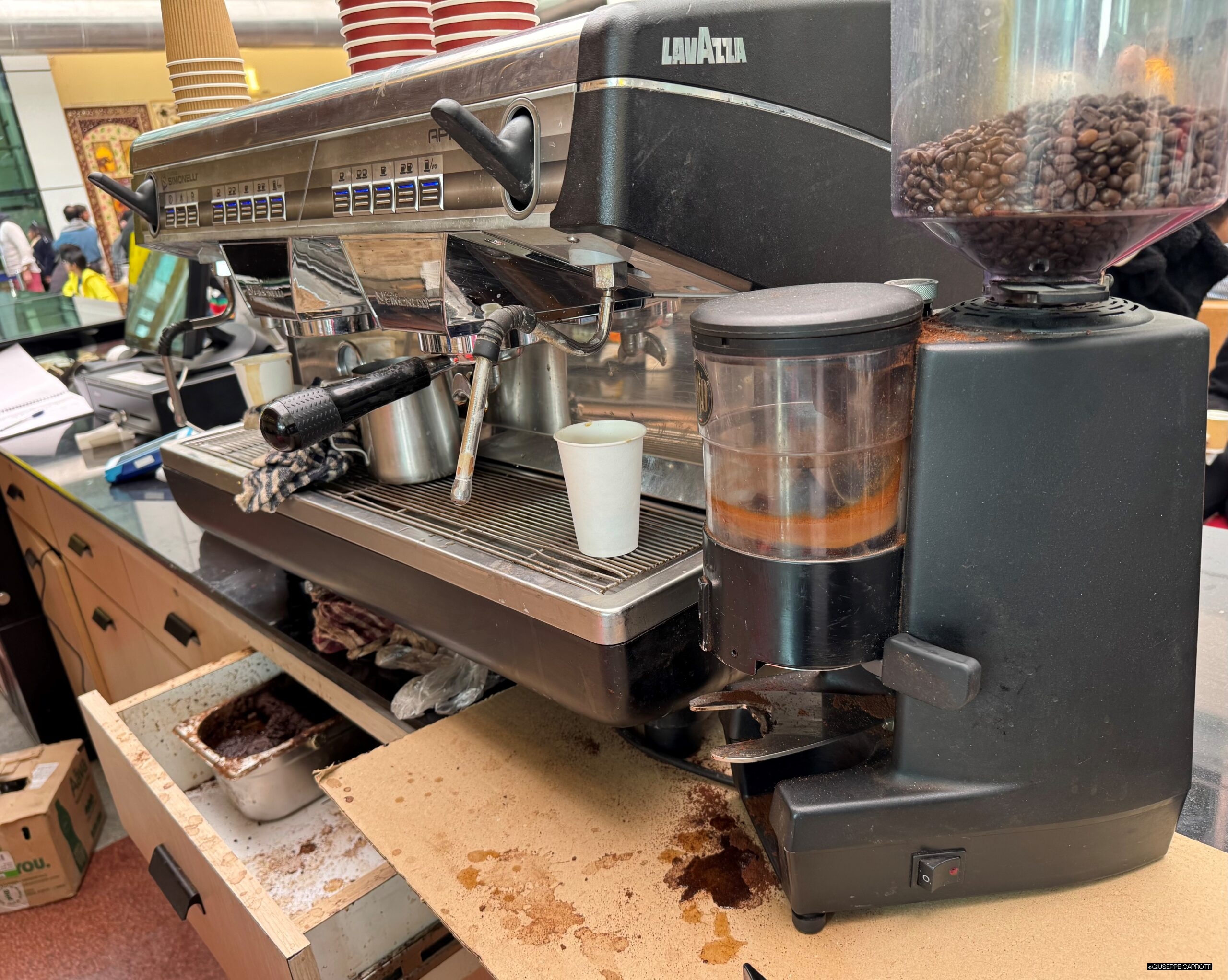
This Lavazza machine, horrible to look at as it is, I photographed it in January 2025, in an international airport.
I tried the coffee, which was obviously very bad.
And so I can’t help but agree with Report, which published a new investigation, 10 years after Gabbanelli’s, which once again ruled that ‘Italian-style’ coffee is – often and willingly – undrinkable.
Below is a transcribed piece:
“Italy still has a long way to go.
Bartenders have a lot to learn.
Roasters have a lot to improve.
But, above all, they still have to learn to really know what they are buying.
We don’t have genetically modified taste buds: we just got used to drinking faulty coffee.
We have got used to the taste of burnt coffee.
We have got used to opening a coffee shop and asking the roaster for money.
We have got used to choosing a café only if it has a lever machine, otherwise ‘it’s no good’.
But it is not all like that.
Report is particularly keen to show a partial reality, only one version.
I am sorry they did not knock on our door, in Salerno…’
Burnt coffee is also a constant in France, and has its own specific reasons: In conventional coffee, extreme roasting is used to mask the defects of coffee beans, often bought cheaply.It is also a way of standardising tastes’,
The consequences of this situation on the coffee world, if there are no major positive developments, will be twofold.
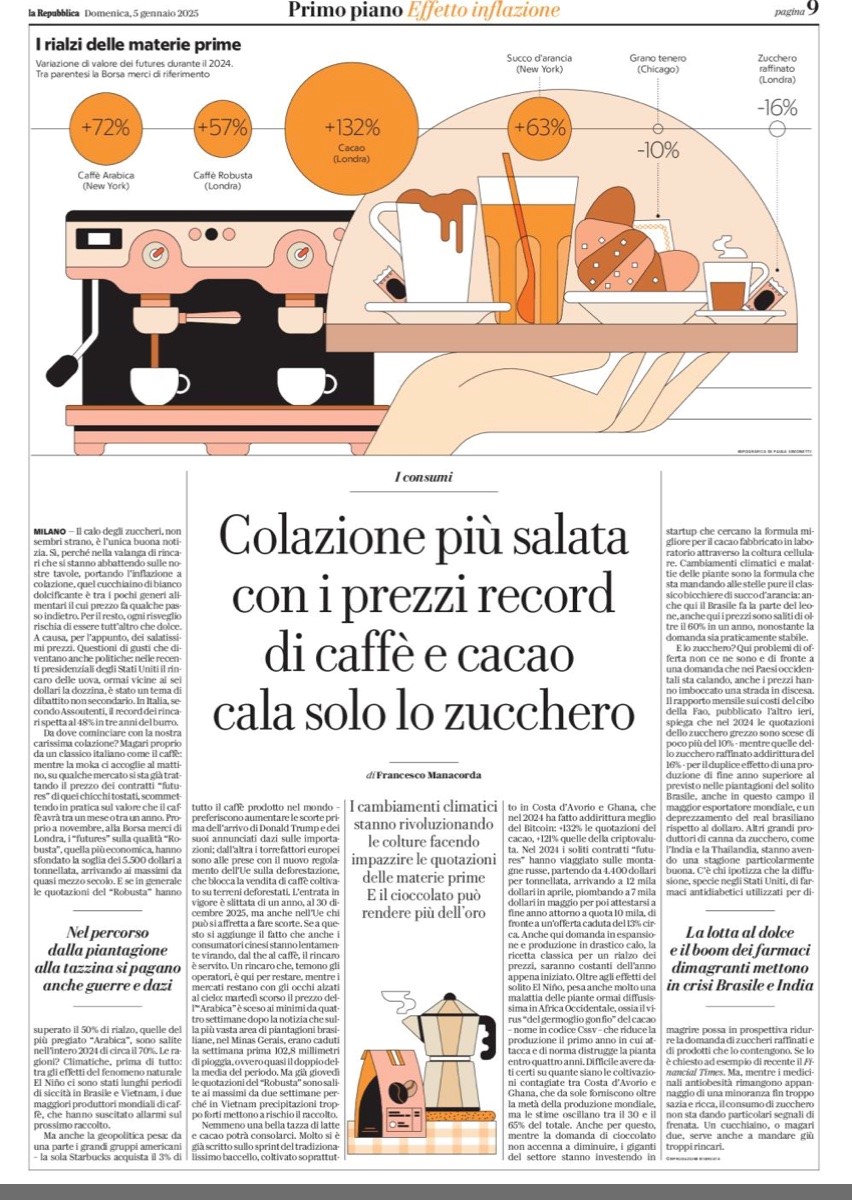
- According to the Financial Times (August 2023), coffee consumption has almost doubled in the last 30 years.
Starbucks plans to open one outlet every 9 hours in China in the next two and a half years [in the meantime, the American company has been struggling in this market where it nevertheless owns 7,600 coffee shops , source retail & food December 2024].
If demand continues to rise , coffee consumption is expected to double again by 2050.
With climate change, the price will only go up.
2. In Italy, quality, with prices – at cost – going up, is in danger of going further down, if Scocchia’s (*) calls for price repositioning and Trucillo’s better management are not heeded. Note this positive sign, which could become a trend: Italian breakfasts discover the savoury and focus on premium products.
I can attest that abroad, very often, they don’t know how to make espresso, but coffee is a pleasant drink, with less caffeine and, above all, the blend is not burnt, while over-roasted products such as ‘Italian-style’ coffee are in danger of becoming unfashionable, accused of causing cancer (‘Acrylamide is a substance used in various industrial processes; it is contained in tobacco smoke and can be formed in the cooking of foods containing starch (potatoes, biscuits, bread, etc.) and in the roasting of cereals and coffee, but only at high temperatures… The International Agency for Research on Cancer (IARC) has classified acrylamide as a ‘probable humancarcinogen ‘).
To the Lavazza machine operators I can only advise what we used to do at Esselunga or what Ferrero does all over the world: lots of continuous training, inspections and sweeping checks.
Perhaps the Turin-based company should also work to make this happen; it’s not enough to sell the machines if the espresso – which partly bears their name – is undrinkable. And if you end a relationship, as happened, for example in India, it is perhaps better to buy back the equipment that bears your name.
To complete the picture :
Report 9 February, about coffee
Coffee labels are incomplete. Here is the information we should read
In the pizzerias of Naples the coffee is not good (October 2025).
Three bars close in Italy every day, maybe the model needs to be rethought (October 2025)
But then there are the exceptions, the positive examples to follow such as Ditta Artigianale, which is an entrepreneurial case to study: 8 premises in 12 years, 160 employees, a budget of 9.5 million euro. And a focus on quality
Below: Armando Testa advertising