

Drafted 24 May, updated 9 June 2025
The sentence in English, on page 8, is this: ‘a measure of conservatism in the sizing of new shops holds greater promise of reward than indiscriminate building’ which can be translated as follows: a measure of conservatism in the sizing of new shops holds greater promise of reward than indiscriminate building of [new supermarkets]… That is: ‘make fewer, smaller and more focused on customers’ needs’.
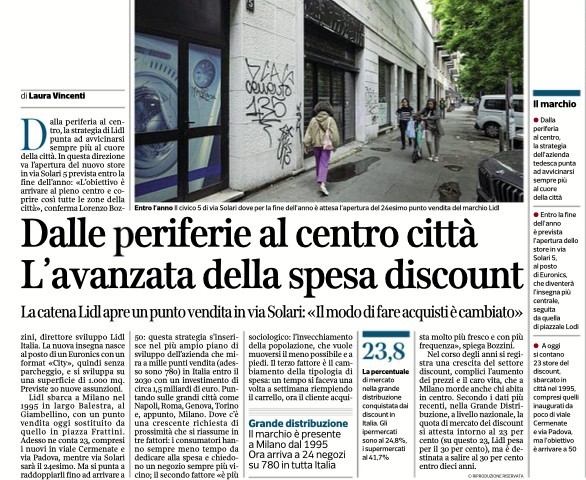
Lidl takes a strategic step in its Milanese expansion with the opening, planned for the end of the year, of its first shop located in the city centre, precisely in Via Solari 5, just beyond the Area C circle.
The new store will be built on the site of a former Euronics store and will adopt the ‘City’ format, with no parking space and an area of 1,000 square metres. The opening will involve the hiring of 20 new resources.
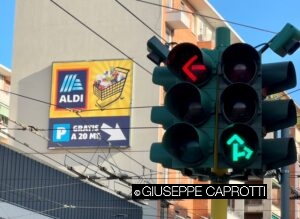
This is a ‘long-term’ trend: Aldi is taking over from Bennet in Viale Monza in Milan. The following photo was taken on the Circovallazione, in Milan.
This was revealed by the Corriere di Milano, in an interview with Lidl Italia’s development director Lorenzo Bozzini: the manager says that the brand’s objective is to cover the entire Milanese territory in a capillary manner, getting closer and closer to the central districts.
Target 50 stores in Milan
Since its debut in 1995 with the first shop in Largo Balestra, Giambellino, now replaced by the one in Piazza Frattini, Lidl has grown to 23 shops in the city. The new store in Via Solari will be the 24th, with the ambition of doubling the Milanese presence to 50.
1.5 billion to grow, especially in big cities
This local development is part of the group’s broader national growth plan, which aims to reach 1,000 shops in Italy by 2030, up from the current 780. The plan envisages a total investment of around EUR 1.5 billion and focuses mainly on large cities: Milan, Rome, Naples, Turin and Genoa.
The escalation of discount stores: focus on proximity and convenience
Underpinning this expansion is a transformation in shopping behaviour: consumers are shopping more frequently and prefer proximity shops. Bozzini emphasises three key factors: lack of time, an ageing population that prefers short trips and walking, and the evolution of shopping, which is increasingly oriented towardsbuying more fresh products more frequently.
In parallel, the discount sector is experiencing significant growth, also fuelled by inflation, which impacts all segments of the population, including those living in central districts. Currently, discounters account for about 23% of the national retail market, with Lidl covering about 30% of this segment. Projections indicate a possible increase in the market share of discounters to 30% within the next decade.
Below: Corriere della Sera article of 21 May 2025. Lidl to conquer the centre of Milan: the discounter arrives where it did not dare before. Also read this article.
Conclusion:
1) in Italy discounters, now perceived as supermarkets, are more agile tools than superstores and better respond to the needs of customers who want “more service, shorter distances and a more concentrated offer”.
Read the confirmation here : Large-scale retail trade Area 1: discounters and supermarkets win, hypermarkets and superstores fail.
2) where competition is fiercer, as in France, this ‘supermarket’ policy has not worked at all: ‘in an ultra-competitive sector, the number one, E.Leclerc, has taken the upper hand. In 2024, Lidl represented 7.9 per cent of the French market, compared to 7.8 per cent in 2023, while E.Leclerc’s market share, as measured by the Kantar institute, increased from 23.6 per cent to 24.2 per cent over the same period’…
…What is happening to Lidl in France? To understand this, we have to go back a few years. After thriving in the hard discount market since its arrival in France in 1989, the brand moved upmarket in 2012, abandoning its original niche for the ‘soft discount’, as insiders call it. With less austere shops, better quality products and French sourcing, particularly for fruit and vegetables, “Lidl wanted to attract new customers with slightly greater purchasing power,” says a union representative who wishes to remain anonymous. “Thanks to this, we doubled our turnover in a dozen years, but inevitably the running costs of the shops increased.
To support this change, advertising expenditure has increased every year. Lidl has become the second largest advertiser in all sectors of the French market – the first is E.Leclerc – according to data from the Kantar Media Institute. Excluding online advertising channels (banners, videos, etc.), the group spent €577.7m gross (net of discounts and negotiations) in 2024, compared to €569.2m in 2023 and €403.7m in 2019..
The crisis in the purchasing power [of the French] has also left its mark on non-food sales.So much so that, at the end of 2024, warehouses found themselves overstocked…
Faced with rising costs, Lidl was forced to stop turnover: 2,000 people who left the company were not replaced. And the trade unions denounce the ‘exponential increase in workload’.
The upward repositioning that has borne fruit in Italy, where the GD sector is on average weak, has not worked in France, where the brand has certainly moved out of the discount ‘ghetto’ but is perceived as expensive.
Balancing quality and convenience is not easy.


