

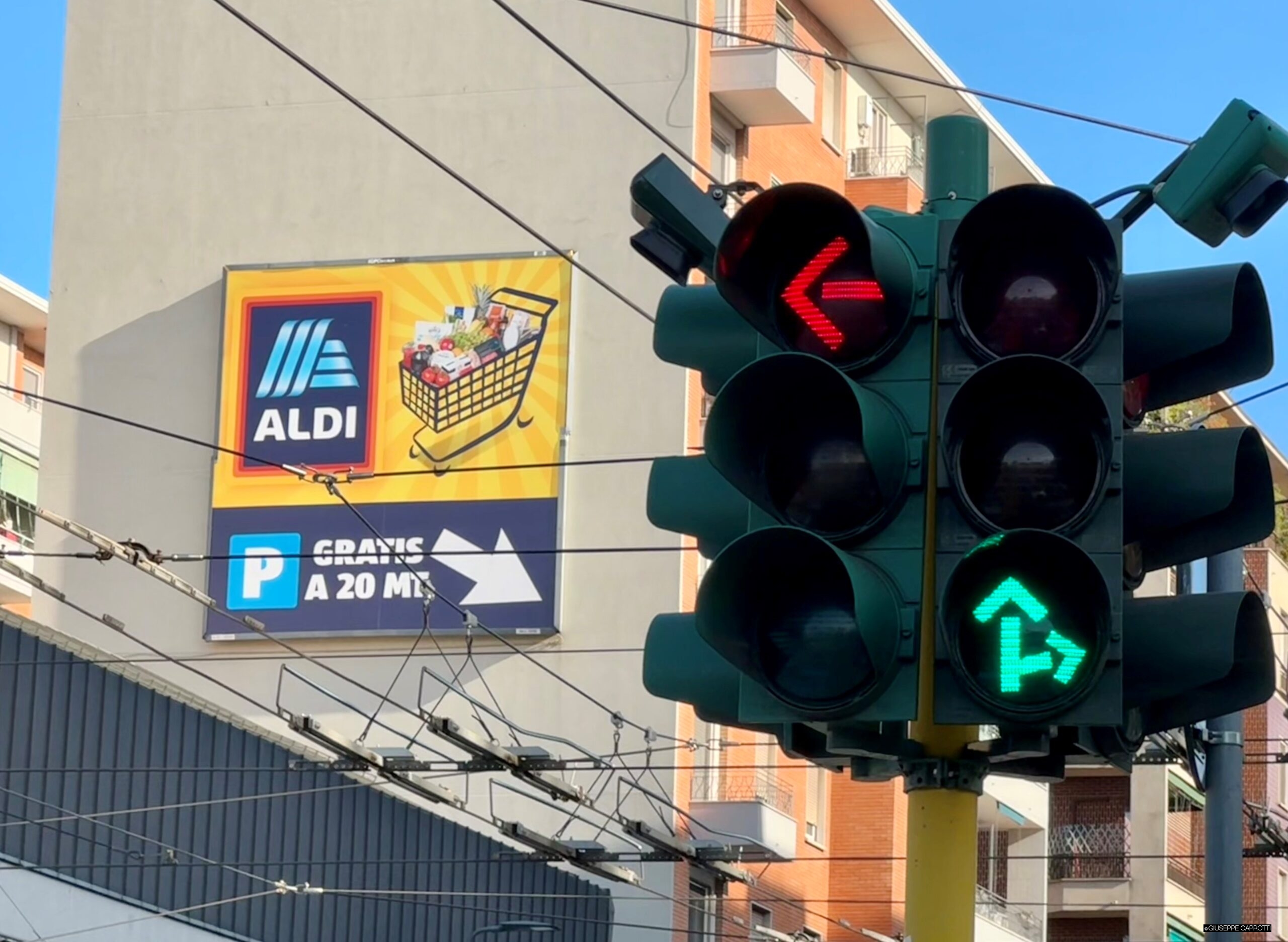
Drafted 7 January 2024, updated 21 May 2025. Above an advertisement for Aldi in Milan, the discount chain has encircled the city.
What is happening in distribution, among the discounters and supermarkets in Milan, the richest square in Italy?
I took the cue from this article to take a step back and recall what I wrote in ‘Le Ossa dei Caprotti’ :
One thing that irritates him [my father Bernardo] very much is that, with the invaluable help of Marino Fineschi, I finally came up with a format for the smaller supermarkets, the Esselunga Sottocasa.
These are already existing outlets, smaller in size, which we are adapting to a new social context, characterised by the increase in singles and pensioners. Nicola Piepoli, who started working with us at Bernardo’s suggestion, is a great supporter of the project. He himself does not drive and does not own a car: he realised that these increasingly numerous categories of customers are not inclined to travel too far to go shopping and do not need to leave the supermarket with overflowing trolleys. They prefer speed, with shops as close to home as possible.
I say to my father: ‘Look, 30 per cent of people in Milan don’t have cars and the population is getting older’. Or: ‘We should calculate better the catchment areas, the type of population, its needs’.
I warn him that we can’t set up in Volterra, a town of 10,000 inhabitants, with a giant superstore, the kind he likes and that satisfies his failed architect aspirations. He calculates that we could build 83 Esselunga Sottocasa, renovating existing Esselunga supermarkets, with areas of up to 1,500 square metres, such as the supermarket in Viale Piave in Milan or the Esselunga in Via Pisana in Florence. We would do this by greatly anticipating the plans that competitors would put into practice in the following years and that Esselunga would find itself chasing long afterwards.
It will not be until the end of 2019 that the company, now controlled by my sister Marina and my mother Giuliana, will open its first minimarket, in Corso Italia, Milan. It will be called ‘LaEsse’, initially renouncing the Esselunga brand that my father in his day had asked to always put on every initiative. In a little over a year, the ‘LaEsse’ shops will rise to six, five in Milan and one in Rome.
I won’t go into the merits of the formula chosen by Marina or those who work with her, which is profoundly different from the one I proposed so many years ago and which can still be seen in some shops, in Tuscany or Milan, today. I only note that perhaps Marina had to fill a void in the company’s territorial presence, left by Bernardo’s decision to abandon the Esselunga Sottocasa project. It seems to me that a lot of time was lost, and that’s a shame.
Instead, Bernardo, after he gets me out of the way, will only make superstores, in his own way, without any feedback on the catchment areas and demographic profile of the area. On the other hand, my father has all the plants in Milan designed for food production, fresh pasta, ice cream, ready meals, without ever drawing up an industrial plan… .
… Yet in the development done exclusively with superstores, without giving a push to e-commerce – which he detests – and without bothering to open additional smaller supermarkets, he will end up leaving a significant part of the city of Milan, the heart of his market, to the competition.
I also showed him the profit and loss account of our most profitable shop, which had 1500 square metres of floor space.
In vain.
“Le Ossa dei Caprotti” on pages 244 and 245
- There are 7 Esselunga Sottocasa outlets, in Milan and Tuscany.
- The most profitable shop was in Sesto San Giovanni, later sold to Carrefour.
- today there are 5 Aldi’s in Milan, but they will probably become many more, as in 5 years they have opened 177 shops in Italy.
- milanese consumers do not distinguish between supermarkets and discounters, they go where they find the quality/price ratio they consider best.
- chinese and American companies such as Amazon, which have understood the marketplace concept, are rampant in e-commerce. The Italians – in the food retail sector (but also in the non-food sector) – are decidedly ‘underrepresented’.
- My father [Bernardo Caprotti], many years ago, had given me a book (‘The Economics of Food Distributors’, McKinsey, 1963) which, on the size of outlets, recommended great caution.
The sentence in English, on page 8, is this: ‘a measure of conservatism in the sizing of new shops holds greater promise of reward than indiscriminate building’ which can be translated as follows: a measure of conservatism in the sizing of new shops holds greater promise of reward than indiscriminate building of [new supermarkets].
Then, most likely, he forgot this important lesson.
Below are Nielsen figures showing Esselunga’s market share dropping from 8.8% in 2020 to 7.6% in 2023.
These are national figures, I do not have those of Milan, but it can be assumed – given the weight of the Milanese marketplace’s turnover on Esselunga’s – that the drop in share, country-wide, derives from that of Milan (and not vice versa).
In Lombardy, Esselunga has a 23.62% share but the five main discount chains (Lidl, MD, Eurospin, Penny and Aldi) weigh, adding their shares, 16.45%.
To further confirm this you can read this article: This is how Italians choose (and change) their supermarket, where it turns out that ‘In the last year, 20% of families have changed their opinion on the store with the best quality/price ratio… the local competitive scenario counts, as well as the quality of products and departments. Of the latter, fruit and vegetables remains the most important (57% of households) … “.
Of course, it does not matter that Aldi loses “a lot of money” because it can amply afford it ( ” losses from operations, compounded by a negative financial balance, have produced in the four-year period 2019-2022 cumulative net losses of €346.7 million to which a further €135.1 million of accumulated losses since incorporation should be added, totalling €481.8 million, including those generated by charges for the leasing of outlets owned by the subsidiary Aldi Immobiliare” ).
Read also :
- Eurospin: shops around 1,000 sqm are growing the most.
- Aldi: concentration in Lombardy with 59 out of a total of 180 stores.
- Discounters grow (cumulative figure) in volume by 2.4%
- Italy: brand and brand loyalty, dwell time in the store and impulse purchases are falling
- Aldi reaches 186 shops in Italy, of which 66 in Lombardy
- Lidl in Via Solari in Milan where there is an Esselunga: the advance of discount stores towards city centres (May 2025).


