[vc_column_textDrafted 5 October, updated 28 November 2024
By Luigi Rubinelli
Some say that there are no more discounters because they are now assimilated to supermarkets. For consumers this is probably so, these days the consumer is looking for price tout and promotions, but technically speaking the discount store model is different from that of the supermarkets. When the discounter has abandoned it we will write and comment on it.
For the moment we are talking about discount supermarkets: this applies to all Eurospin or Todis, Lidl and Aldi, Md and Penny and the others.
Here, then, is a roundup of numbers and percentages on how discount supermarkets are doing, first with regard to the other classic types of sales, then going on to an in-depth analysis by region. This is followed by market shares, both national and by Nielsen areas, and finally by sales per square metre (for the latter, the average surface areas of the various brands, which are very different from each other, must be taken into due account).
Market shares of the different types, 2010-2024, %
Types/Year 2010 2015 2020 2024
Discount 12.6 15.7 20.3 23.7
Hypermarkets 32.9 13.6 28.5 25.1
Self-service 13,4 10,7 9 9,4
Supermarkets 41.1 41.8 42.2 41.6
Discount mkt shares by region, %
Sicily 36.8
Sardinia 35,6
Apulia 33,5
Molise 30,4
Basilicata 30.3
Abruzzo 29.4
Calabria 29.3
Umbria 29.3
Liguria 26.1
Friuli V.G. 26
Latium 24.8
Marche 24.5
Piedmont 23.5
Trentino A.A. 21.7
Emilia Romagna 20.9
Veneto 20.3
Campania 20.2
Lombardy 19.1
Tuscany 16.9
Valle d’A. 16.2
Italy average 23.7
Market shares by sign, 2024, %
Lidl 25,1
MD 13,9
Penny 5,7
In’s 4.5
Todis 4,3
D Plus 3.4
Aldo 3.1
Prix 2.1
Ard 1,9
Ekom 1.3
Ecu 0.7
Here 0.7
Others 1,9
Area 1
Lidl 32.2
Eurospin 18,5
MD 16,4
Area 2
Lidl 32.7
Eurospin 26,2
Prix 9.3
Area 3
Eurospin 43.5
Lidl 17.6
Todis 12,4
Area 4
Eurospin 36.4
MD 21.5
Lidl 19,8
Sales per square metre, euro Average square metres
Eurospin 8,627 913
Lidl 8,793 1,175
MD 7,012 756
Todis 7,000 590
Ekom 6,452 499
Penny 5,211 732
Aldi 5,037 1,054
Prix 4,975 620
In’s 4,683 521
Ard 4,148 585
D Plus 3,852 629
Some conclusions
As can be seen from the NielsenIQ source tables, Q1 2024, the discounter is doing well. It has been marginally affected by the volume sales crisis and the reduction of the average receipt.
- In contrast to other types, discounters are highly concentrated: the top two brands have 56.4 per cent of the market, the top three 70.3 per cent.
- Lidl and Aldi have now surpassed the 1,000 m2 average sales area, other brands are also increasing their floor space in new openings.
- The productivity of sales per square metre is now similar to that of supermarkets for the top three, but with smaller areas and less extensive and deeper assortments.
- In areas 1 and 2 Lidl is the leader, while in areas 3 and 4 the leader is Eurospin, although the latter is the founder of the discount supermarket in Italy.
- On a national level, Eurospin is first.
- The growth of Aldi and Todis (Conad) and the good performance of Ekom (Sogegross) should be noted
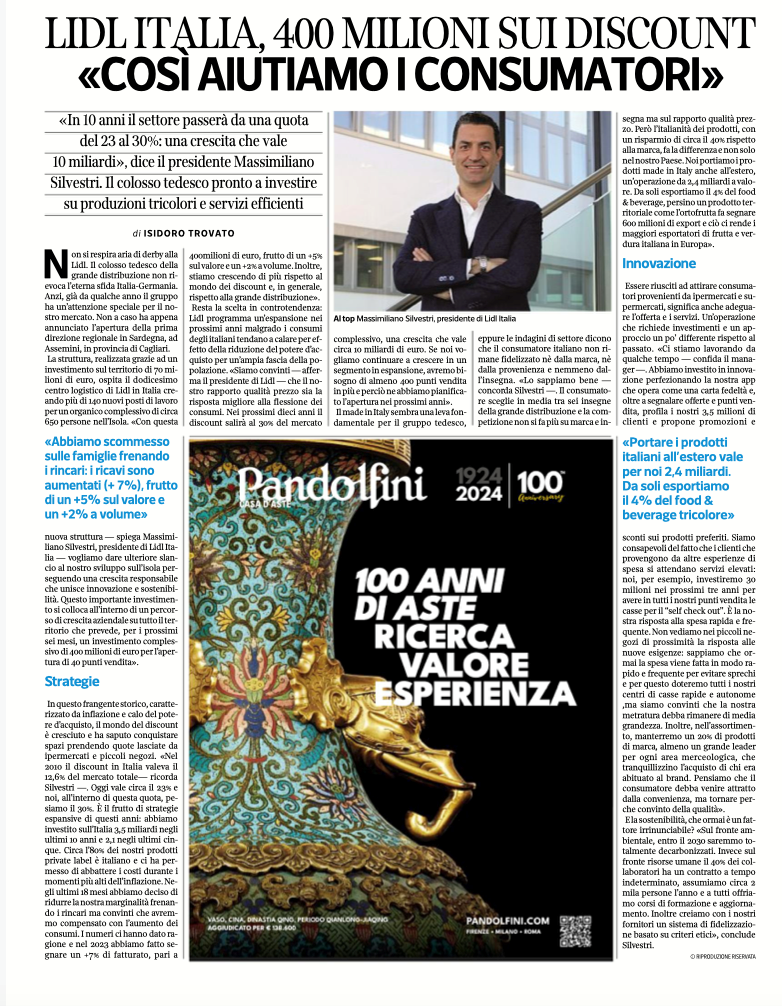
Below: when Massimiliano Silvestri of Lidl says that the discounters will reach a 30% share of the market, one has to believe him.
- industry companies need to reduce prices or push on discounts to attract price-conscious consumers
looking at some companies
- the CEO of Nestle said that people are particularly looking for ‘value’ and that the promotional level was particularly high
- the CEO of Mondelez said that at this time there needs to be a particular focus on product prices
Incorporating August 2024
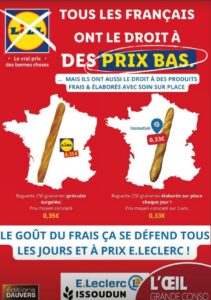
I am talking about price doping for FMCG and improved efficiency for discounters who are increasingly trying to look like supermarkets when they are not.
In this regard read what the leaders, Eurospin, are doing.
And supermarkets should go back to trying to express convenience but also quality. A bit like Leclerc does in France, where it is the absolute leader.
Also because the quality of food is deteriorating. And some formats, like the superstore, ‘risk’.
P.S.: in March of this year, 41% of Italian consumers made at least one visit to a discount shop.