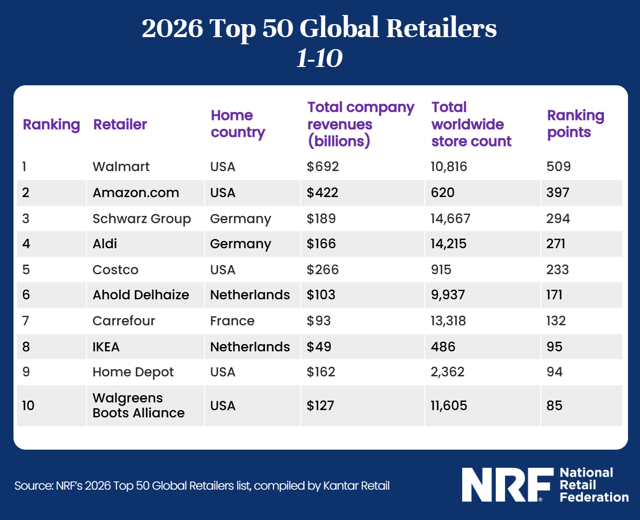
Global giant Walmart has once again claimed the top spot in the National Retail Federation ‘s (NRF) annual ranking of the world’s best retailers, a list compiled by Kantar based on retail-specific revenues generated during 2025. The Bentonville-based giant’s continued investment in international markets and digital services has allowed it to maintain its leading position, surpassing a solid line-up of world-renowned brands.
These names include Amazon, Schwarz Group, ALDI, Costco, Ahold Delhaize and Carrefour, which maintained the positions they held in last year’s ranking. Further down, IKEA and The Home Depot moved up one notch to eighth and ninth place respectively.
This year, only one new entry made it into the NRF top 10: Walgreens took the place vacated by Seven & I, the parent company of 7-Eleven. The company had dropped from the top of the ranking following the divestment of its department store business in Japan, finishing in eleventh place…
Four thoughts on this ranking:
- Obviously no Italian chains are present (but this doesn’t surprise us that much)
- Among the top 10 it is noticeable that behind Walmart and Amazon there are Lidl and Aldi and in fact Kantar pointed out that “small is beautiful” (except in non-food where there are phenomena like Costco or Ikea).
- Missing from this ranking are Chinese retailers like Shein or JD.com. A flaw they will have to remedy next year.
- The US market, like the Italian market, is saturated and the struggle in the US is concentrated in the countryside:
The main obstacle for Amazon is Walmart Inc. which won the US heartland decades ago during an aggressive expansion to become the world’s largest retailer. Walmart took years to get rural customers used to going to its shops to shop for groceries and then taking advantage of that to buy clothes, televisions, and slow cookers.
It has a big advantage over Amazon in terms of proximity, with shops and Sam’s Clubs located within a 16-kilometre radius of almost two-thirds of rural households, a Bloomberg analysis shows.
Walmart is also boosting its e-commerce presence, turning its thousands of locations into sorting centres and pick-up points for products ordered online’…
Below: top 10 and total ranking
- Walmart (USA)
- Amazon (USA)
- Schwarz Group (Germany)
- ALDI (Germany)
- Costco (USA)
- Ahold Delhaize (Netherlands)
- Carrefour (France)
- IKEA (Netherlands)
- The Home Depot (USA)
- Walgreens (USA)
- Seven & I (Japan)
- Rewe (Germany)
- Jeronimo Martins (Portugal)
- AS Watson (Hong Kong SAR)
- Apple (USA)
- Inditex (Spain)
- Metro AG (Germany)
- Tesco (UK)
- TJX (USA)
- Alibaba (China)
- Aeon (Japan)
- H&M (Sweden)
- Auchan (France)
- Intermarche (France)
- Coop Schweiz (Switzerland)
- Aspiag (Switzerland)
- Fast Retailing (Japan)
- Sephora (LVMH) (France)
- Couche-Tard (Canada)
- Leclerc (France)
- Ceconomy (Germany)
- Adeo Group (France)
- Decathlon (France)
- Action (Netherlands)
- Euronics International (Netherlands)
- Best Buy (USA)
- JD Sports (UK)
- Cencosud (Chile)
- CP All (Thailand)
- Kingfisher (UK)
- FamilyMart (Japan)
- Lululemon (Canada)
- dm drogerie markt (Germany)
- Primark (UK)
- Phoenix (Germany)
- Expert (Switzerland)
- Reliance (India)
- Migros (Switzerland)
- Falabella (Chile)
- Lulu Group (United Arab Emirates)
To be included in the ranking, retailers must have direct investments in at least three countries. Kantar evaluates companies based on revenues derived exclusively from retail, both domestically and internationally.
About the Italian problems and deliveries “in the countryside” I had talked about here.