

Compiled 31 October 2024, updated 8 November 2025
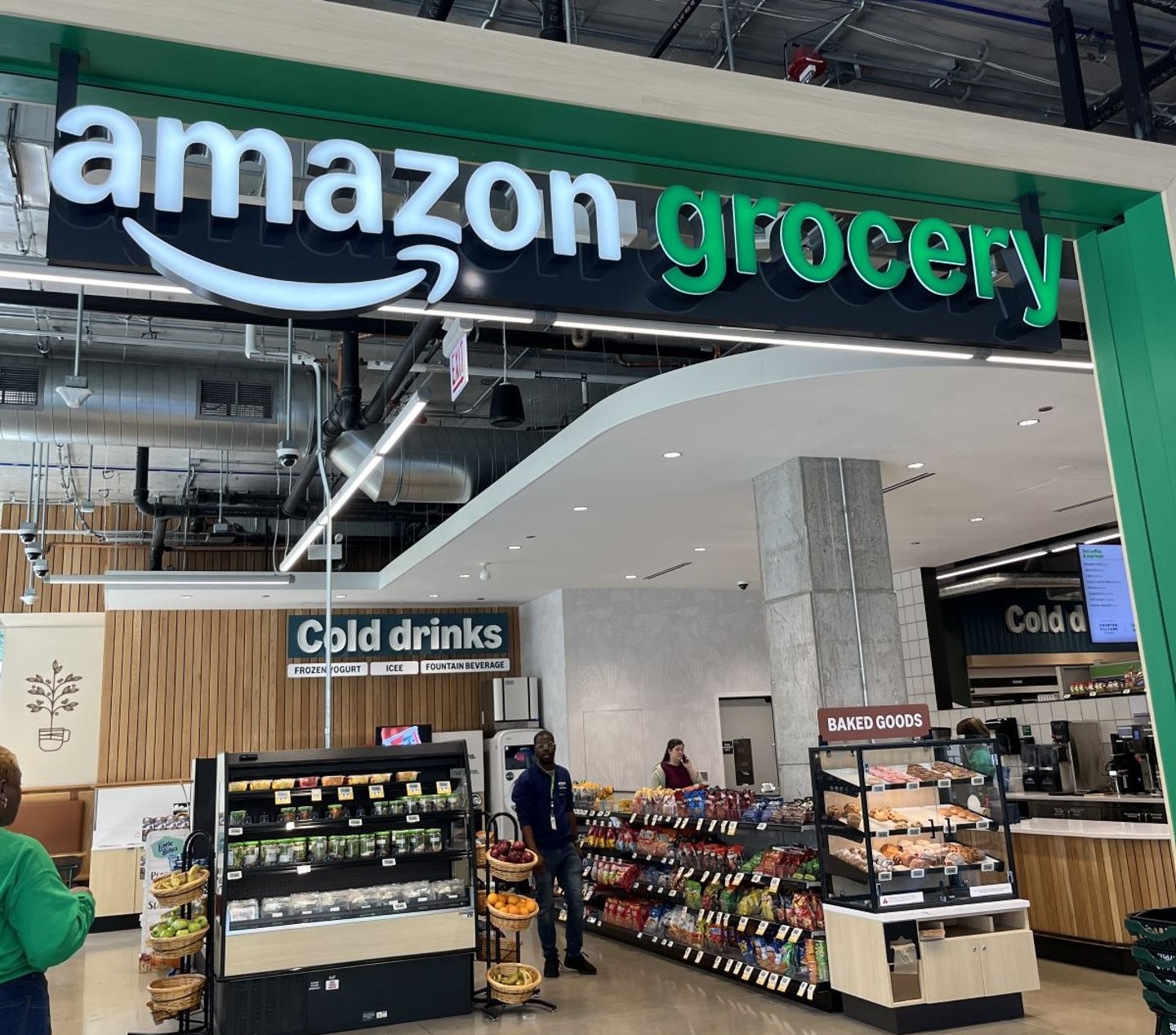
Take a look inside the new Amazon Grocery supermarket located next to a Whole Foods
Progressive Grocer visits Chicago’s smallest shop
By Lynn Petrak, with my comment at the end
Amazon is testing a new Amazon Grocery format next to a Whole Foods shop in Chicago’s Gold Coast neighbourhood.
This is not so much an add-on or pop-up as it is an integration of the same customer-centric retail approach: the new small Amazon Grocery shop adjacent to a Whole Foods Market in Chicago is designed to give shoppers more options.
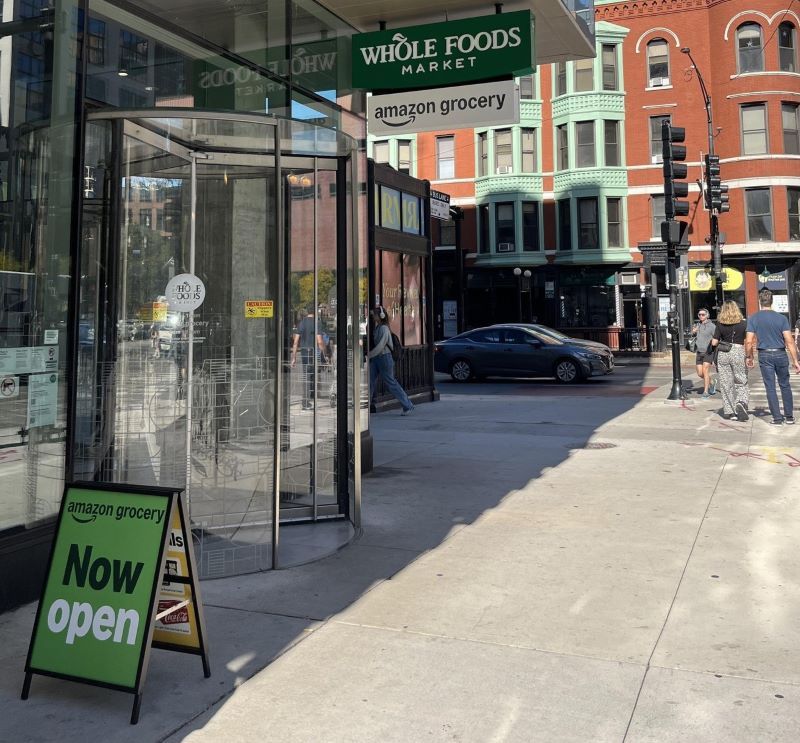
Below the Whole Foods shop that sits next to the new Amazon Grocery shop (Amazon’s logo can also be seen in small print on the photo)
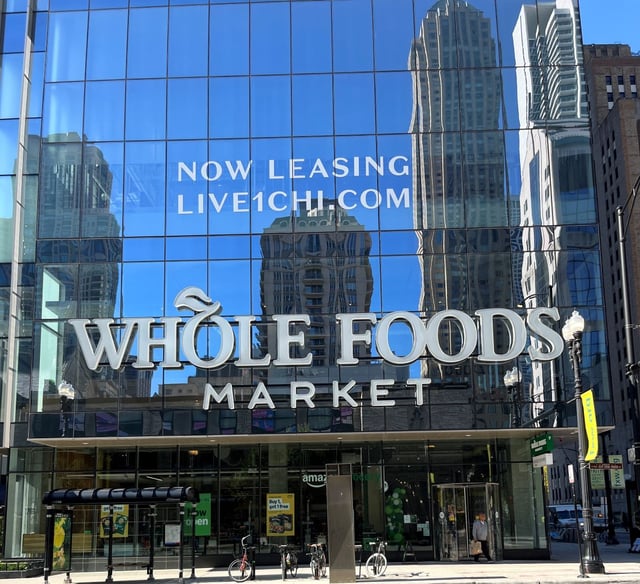
Progressive Grocer visited the Amazon Grocery outpost that opened its doors a few days ago. The convenience store occupies the first floor of a space at 14 W. Superior Street in Chicago’s Gold Coast neighborhood and is just steps away from an escalator to a full Whole Foods Market.
This new type of physical shop merges many of the company’s options and services, offering traditional branded products that are not on Whole Foods shelves. “We’re always looking for ways to make it easier for customers to shop, both online and in-store. We’re testing and learning with a new grocery shopping experience with a smaller Amazon shop under the same roof as Whole Foods Market in the One Chicago building,” Amazon spokeswoman Jessica Martin told Progressive Grocer. “With this new concept, customers can buy their favourite natural and organic products from Whole Foods Market and get a wider assortment of products from Amazon, all in one trip, saving time and money.”
The near-store concept is in line with Amazon’s retail strategies highlighted at the recent ‘Delivering the Future’ event in Nashville. Among other updates, Amazon announced that it is putting the finishing touches on its first automated micro-avoidance centre at a Whole Foods shop in Plymouth Meeting, Pennsylvania, which will integrate products available in that marketplace with items from Amazon.com and Amazon Fresh.
The new Amazon Grocery in the One Chicago multi-use building was doing very good business during PG’s recent visit. Customers could browse through 3,500 products inside the 3, 800-square-foot (about 380 sq m) shop and pick up groceries and everyday essentials, along with take-out meals and snacks, which ranged from freshly baked cinnamon rolls to cans of Farmer Fridge salads. An on-site café is another service that caters to nearby residents and urban workers.
Amazon’s technologies are also on display at the Amazon Grocery store. Customers can pay with the palm of their hand, enjoy a frictionless checkout and return Amazon.com parcels via a kiosk near the front door.
Upstairs, the Whole Foods Market houses a popular hot food bar, along with a range of fresh produce and home and self-care products. That shop opened in 2022 .
Amazon, headquartered in Seattle, is ranked No. 2 on the PG 100, Progressive Grocer’s 2024 list of the top grocery and consumer goods retailers in North America . Whole Foods Market, based in Austin, Texas, is a wholly owned subsidiary of Amazon. Both Whole Foods and Amazon were named among PG’s Retailers of the Century, which also named Whole Foods one of its Top 10 Sustainable Grocery Retailers of 2024 .
Conclusion:
this looks like yet another Amazon experiment in the world of food. But looking at the photos in the link, one would at least say that this new facility is definitely ‘warmer’ and closer to American customers than the icy Amazon Fresh and Amazon Go.
The fact remains that the two logos side by side could create a bit of confusion in the minds of frequent visitors.
However, food is so marginal for Amazon that it can certainly allow for more mistakes: the Seattle giant’s experimental phase in food has been going on since at least 2016, before the acquisition of Whole Foods, when it developed its first and fairly mediocre private-label products.
Amazon’s real challenges lie elsewhere, in e-commerce, in AI, in data centres, in cloud computing.
And indeed, I personally find this news about data centres, large consumers of water and energy, much more interesting for the general public:
The four largest US internet groups – Microsoft, Meta, Amazon and Google’s Alphabet – this week offered investors brief glimpses of the benefits they are seeing from their headlong rush (*) into generative AI, claiming it was boosting the performance of core services and helping to contain operating costs.
(*) which sees Amazon as the number one company by capital employed (Capex).
But the stock market spasmed on Thursday [31 October] as investors scrutinised the imprecise gains to focus instead on another big – and very measurable – leap in data centre chip and infrastructure spending as the AI race accelerates…
It must be added that unfortunately, one of the indirect and undesirable effects of this race is that temperatures on earth are travelling towards a 3.1 degree increase by the end of the century.
Read also: Data centre : Amazon Web Services invests 1.2 billion in Milan. It will certainly take ‘an adjustment of the capacity of the energy transport network to ensure continuity of supply’. Otherwise there will be great inconvenience and an environmental problem, with Amazon ‘devouring’ energy and water.

In the context of global warming and the energy transition, big tech is a protagonist “ in the bad” – big polluters and big energy consumers –… but also “in the good” :
renewables will become the world’s leading energy source and Amazon is the world’s leading investor in this sector.
In this field, whose investments would serve to reduce Italy’s energy bill, making it more competitive, it is very likely that Amazon will only play a leading role in countries close to us, such as France – see above – , because our government, in the field of energy, does not consider renewables as strategic and has a major conflict of interest.
Italy, we see below, risks remaining on the sidelines of the global competitive scene, behind even Hungary.


