Published 6 June 2023, updated 22 March 2024
Canadian wheat is used to make pasta
RAW MATERIALS
2023
Boom in Canadian wheat imports. Glyphosate alarm triggered
In just two months, almost 300,000 tonnes arrived in Italy from North America, where the free use of the herbicide raises fears for the consequences on the food chain and health
Raffaele Lorusso
Imports of Canadian wheat into Italy are growing. According to the latest Istat data processed by Centro Studi Divulga, in the first two months of this year imports of durum wheat from Canada grew by 747 per cent compared to the same period in 2022. They rose from 33 thousand tonnes to more than 286 thousand tonnes. Durum wheat arrivals from Canada in the first two months of this year alone accounted for 47 per cent of total imports for the whole of 2022. An exponential growth accompanied by health concerns, since a large part of Canadian wheat, about 70 per cent, is treated with glyphosate in pre-harvest. The use of this herbicide causes plants and seeds to absorb the substance which, as a result, risks remaining in the wheat or other crops even after harvest. According to a recent study on glyphosate residues, out of a sample of 8,000 cereal, vegetable, fruit and vegetable products sold in Canada, 42 per cent contained detectable residues of this substance.
There is enough to alarm experts and scholars around the world. In Italy, the Centro studi Divulga has produced a report entitled ‘Glyphosate: facts, figures and legal history of the herbicide that has conquered the world, damaging health and the environment’. Use increased dramatically in the 1990s with the introduction of modified GMOs. Today, glyphosate is the most widely used herbicide in the world. Available estimates of world production indicate up to one million tonnes. In value, the market is close to EUR 9 billion in 2020. Growth of 6 per cent per year is estimated for the next decade. An increase that could take the market to EUR 16 billion in 2031. In Europe, 20 per cent of sales are the prerogative of France, which kept the consumption level of the molecule almost constant in the period 2013-2017, with about 9.3 thousand tonnes. This is followed by Poland and Germany, with shares of 14 per cent and 10 per cent of European sales, respectively. Hungary, Austria, Poland and Spain are the countries with the highest growth in sales. Hungary, in particular, recorded 86 per cent growth in quantity between 2013 and2017. Italy, which used around 4,500 tonnes of glyphosate-based herbicides in 2013, had reduced its consumption to just under 4,300 tonnes in 2017.
Some studies report a correlation, not yet isolated as strictly causal, between glyphosate exposure and the occurrence of non-Hodgkin’s lymphoma. The probability of developing lymphoma is reported to be 41% higher. For this reason, Italy is among the European countries that, already in 2016, introduced very restrictive regulations, allowing the use of glyphosate only as a herbicide and banning it in the pre-harvest phase and in the care of public green areas.
“Doubts about the health impacts of glyphosate have been growing in recent years, also thanks to independent studies,” explains Professor Felice Adinolfi, director of the Centro Studi Divulga and professor of agri-food economics and policy at the University of Bologna. ‘We need common rules at a global level and, above all, we need to speed up with the experimentation of sustainable alternative products, such as pelargonic acid,’ is Adinolfi’s wish Traces in the environment are still high. A recent study by the University of Milan and the Water Research Institute found a concentration above the minimum level of 0.1 microgram per litre established by law. The alarm concerns the waters in Lombardy closest to agricultural areas. Some companies have had to give up selling their products because of abnormal levels of pesticides in the water used to irrigate their fields.
Due to its easy diffusion in the air, its permanence in the soil and crops, and its presence in surface water, glyphosate enters the food chain directly and indirectly. Researchers have shown that the herbicide is able to penetrate and persist in the soil. The risk, in this case, is a reduction in the uptake of micronutrients, increased vulnerability to disease, and a consequent decrease in crop yields.
Read also : Wheat, import boom from Canada. And conventional costs as much as organic.

2024
Going a little deeper into the matter, it turns out that Felice Adinolfi is very close to Coldiretti.
On this subject, we recommend reading: Is Canadian wheat really contaminated with glyphosate?
In this piece you can see that glyphosate is a bit of a ‘weapon of mass distraction’, like cultivated meat or insects: these are arguments that serve to avoid addressing the real problems of Italian agriculture.
First and foremost, the profitability of products sold to the large-scale retail trade.
This is practically nobody’s story.Even Repubblica (AF) has fallen into this propaganda ‘trap’ of the union run by Prandini.
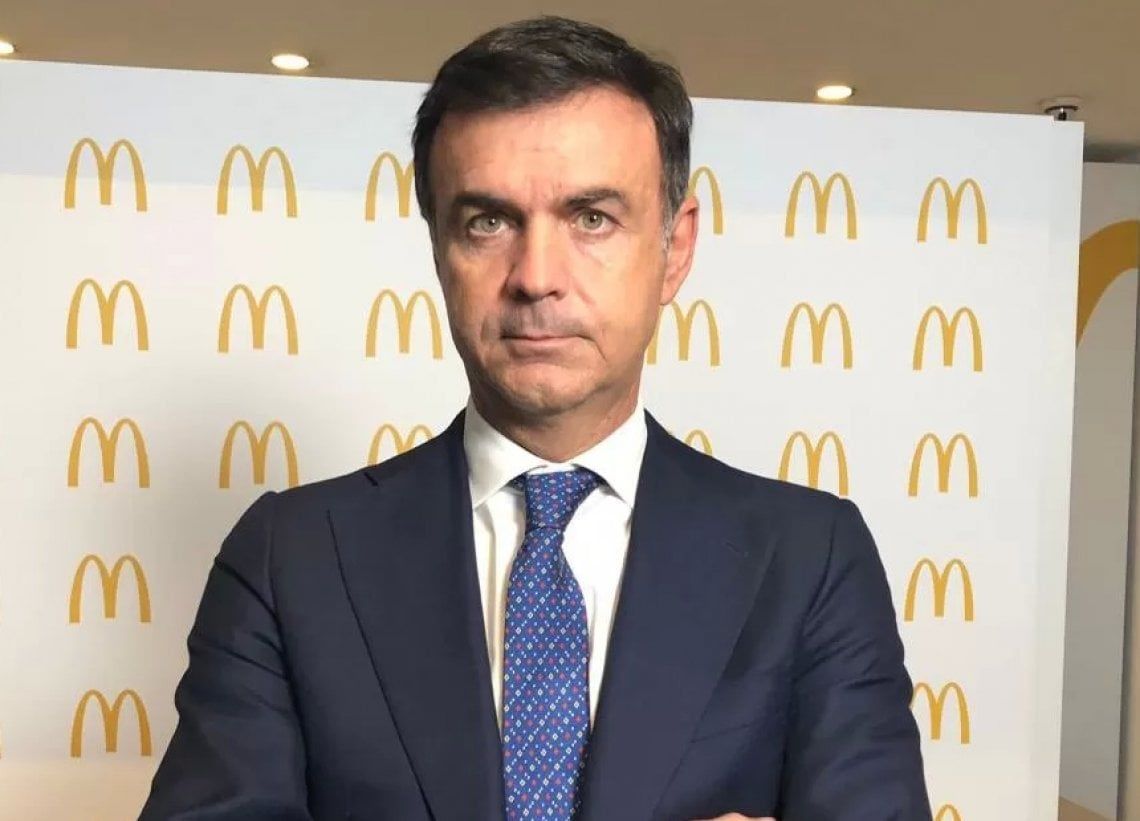
Below Ettore Prandini, president of Coldiretti and ‘sponsor’ of Mc Donald’s.