Shein’s fast fashion rivals may find that shops are their best defence
Inditex, owner of Zara, is improving sales by upgrading and expanding its main locations
By showing a wider range, Zara is inviting shoppers to spend more per visit.
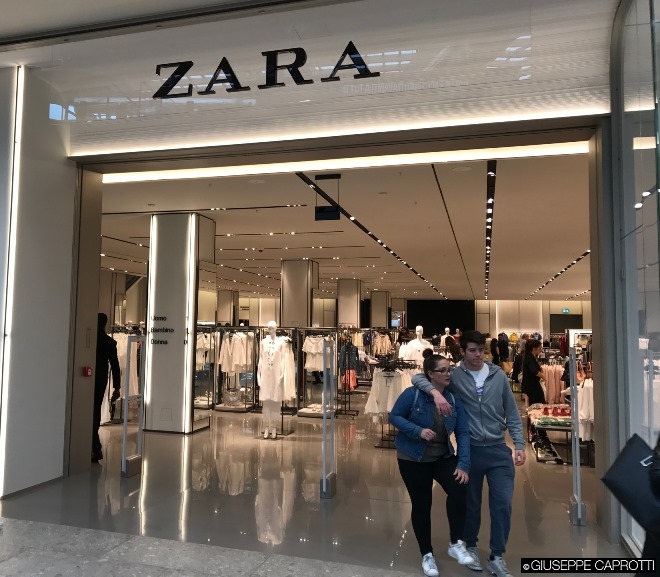
When it opened its newly renovated Paris shop in 2022, Dior had significantly expanded the space and included features such as a restaurant and patisserie. Zara and H&M shoppers may not demand fine dining at their local outlet, but fast fashion retailers can learn from their luxury peers. Fewer but larger and well-designed shops should be one of their most powerful weapons against the onslaught of online rivals like Singapore-based Shein.
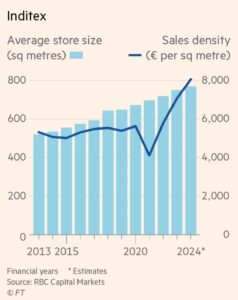
Take for example Inditex, owner of Zara. Over the past 10 years, the average size of Inditex’s shops has increased from around 500 square metres to 750-800, according to estimates by RBC Capital Markets. The retailer, which also owns Pull & Bear and Massimo Dutti, is closing smaller shops but upgrading and expanding flagship store locations. Last year it opened its largest ever Zara shop in Rotterdam. This may seem counterintuitive when sales continue to move online. However, it is enabling Inditex to improve sales per square metre from around €5,000/m2 in 2013 to around €8,000/m2, according to RBC estimates. Fewer, larger shops mean efficiency, for instance by requiring fewer deliveries. Basically, they show a wider range, enticing shoppers to spend more per visit. Shoppers visiting shops want to be inspired, says Swetha Ramachandran, head of consumer brand strategy at Artemis Fund Managers. ..
Below : Over the past 10 years, the average size of Inditex’s shops has increased from about 500 square metres to 750-800 and Inditex to improve sales per square metre from about €5,000/m2 in 2013 to about €8,000/m2
E-commerce and physical shops also do not operate in isolation. Web traffic can increase by almost two-fifths in the quarter after a brand opens a shop, according to a 2023 report by e-commerce platform Shopify. Retailers are simplifying in-store online order picking. So-called first-generation fast fashion retailers, such as H&M and Inditex, must look for ways to exploit the advantages over Shein, whose rise has been helped by the TikTok video app.
Fashion often looks to the past for inspiration. Used intelligently, shops can help in the fight against fierce competition from online rivals… This also seems to apply to Ikea and Lego.
The logic of expanding space and assortment, in my opinion, does not apply to food, however: I would never set up a superstore with 12,000 food items!
For a question of freshness of products and costs
In the city, then, small formats are more agile against discounters (while small shops, up to 400 square metres, are in crisis, the larger ones, those from 1,000 square metres upwards, are in ‘good health’).

Everything is however relative as Inditex, owner of the Zara brand, develops 25% of its turnover through e-commerce.
We are therefore talking about €9 billion.
And even here the difference with the food world is obvious: Mercadona, which has the same size as Inditex – roughly €36 billion – is limited to 2%.
The logics of the sectors are different : Zara has to fight not only against Amazon but also against Shein, which only does e-commerce.
But above all there are mentalities: Juan Roig, when I was with him, more than 20 years ago, was not particularly ‘open’ to online (a bit like Oscar Farinetti of Eataly in ‘Le Ossa dei Caprotti’ on page 197 ).
Now, Mercadona‘s e-commerce is not only growing by 19% but also making money. This pleases me.
The question I would ask today is: is Mercadona investing in artificial intelligence?
It is very likely.
Better shop management and on-line means that Zara is doing very well, emerging victorious not only in the war against Shein but also with H&M and other more traditional rivals, who are closing sales units, in Spain and elsewhere.
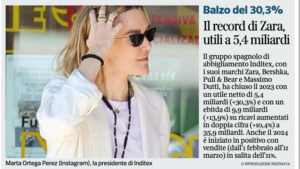
Below: Zara’s results in Corriere of 14 March 2024