I have modified – at the top – the title below because it is only about English supermarkets and discounters.
Compiled 6 December, updated 12 December 2024
Maxi tomato fraud: the BBC’s scoop on supermarkets and the Petti group
A BBC investigation has uncovered a major food fraud involving the Tuscan company Petti. Tonnes of tomatoes imported from China and the result of forced labour were mixed with semi-finished Italian products and then sold as ‘100% Italian’. The British newspaper detected Chinese tomatoes in 17 products out of 64 analysed: the counterfeit products were sold in chains such as Tesco, Asda, Waitrose, Penny and Lidl
From the Editor
An investigation conducted by the BBC has revealed a maxi-food fraud on tomatoes, with purees labelled as Italian but in reality made with product mainly from China and other non-EU countries. The analysis of the authoritative British newspaper was based on some of the tomato concentrates sold as Italian and most popular in Europe: the products were subjected to an in-depth organoleptic analysis to identify the trace elements useful to determine the territory of cultivation, then cross-referencing the results with data on shipments of tomatoes from China.
The British newspaper had 64 products analysed for its investigation , 17 of which appeared to contain almost exclusively Chinese tomatoes. The analyses were carried out by a specialised company, Source Certain, which examined the presence of minerals and other elements that tomatoes absorb from water and soil while growing in a certain area. It turned out that the profile of Chinese tomatoes is very different from that of Italian tomatoes.
Fraud and labour exploitation: Petti at the centre of investigation
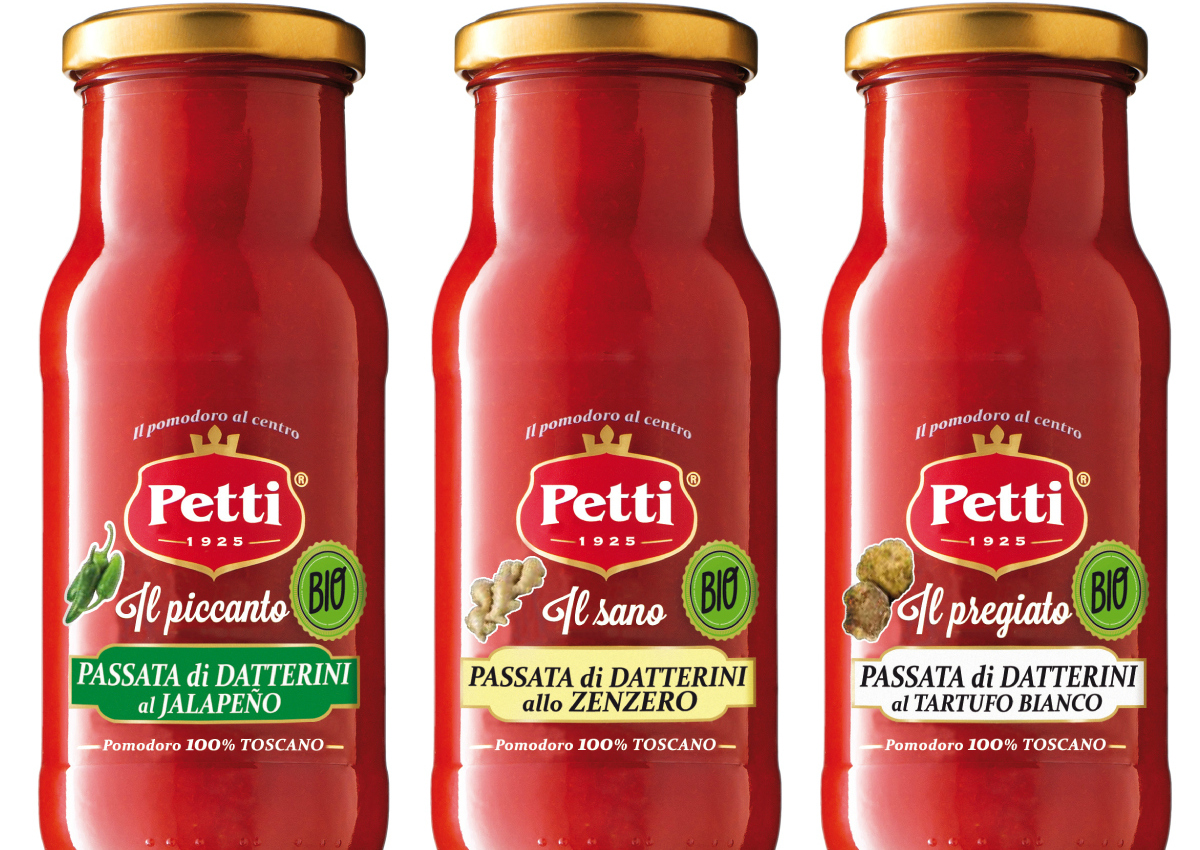
At least ten of the counterfeit processed tomatoes are said to be distributed by Petti, a Tuscan company already at the centre of investigations for fraud and counterfeiting in the past, which were then closed without convictions. According to the BBC’s reconstruction, the company based in Venturina Terme (LI) allegedly imported dozens of tonnes of tomatoes from the Chinese region of Xinjiang, where the Beijing government holds more than one million people from the Uyghur Muslim minority, forcing them to perform forced labour. Subsequently, the Petti tomatoes would be marketed as an Italian product in the supermarkets of some major chains in the UK and Germany.
Italian sounding in Gdo
In total, there are 17 products that, according to the investigation, contain Chinese tomatoes. Some have ‘Italian’ in the name, such asTesco’s Italian Tomato Purée, as reported by Open. Others have ‘Italian’ in the description, such as Asda ‘s Double Concentrate, which says it contains ‘pureed Italian tomatoes’ andWaitrose’s Essential Tomato Purée, described as ‘Italian tomato puree’. Others hark back to Italy in name, like Lidl’s Baresa tomato paste, or in colour, like the one sold by German chain Penny. Analysing the shipment data of the tomato batches, the BBC claims that not all of the red gold in these products actually came from Italy.
The supermarkets involved have stated that they are seriously committed to verifying what emerges from the investigation and in some cases have stopped selling the products involved.
Petti: ‘We will no longer buy from China’
For its part, the Petti group told the BBC that it no longer bought anything from Xinjiang Guannong following the sanctions imposed on the Chinese company by the US in 2020 against forced labour. However, Petti said it continued to source tomato paste from another Chinese company, Bazhou Red Fruit, which it said was not involved in labour exploitation. The Tuscan company also said it wanted to stop buying and selling tomato products from China and strengthen controls on suppliers ‘to ensure respect for human and workers’ rights’.
Coldiretti: ‘Chinese tomatoes ready to invade European markets’
Coldiretti and Filiera Italia also intervened on the matter, emphasising how the BBC’s investigation highlights the urgency of ‘arriving at compulsory labelling of origin to protect the real Italian product, also considering that the Asian giant has increased its tomato production by 38% in the last year, with which it could invade European markets’.
“China ,” Coldiretti/Filiera Italia denounce, “could become the world’s largest producer of industrial tomatoes this year, overtaking the United States. Forecasts in August gave a growth to 11 million tonnes (they were 8 in 2023 and 6.2 in 2022). Considering that the Chinese consume just 1 kg per capita per year of tomato products (compared to 22 kg for Europeans), the increase in production is bound to spill over to Western markets. Overall, a quantity of product arrives in the EU from Beijing that is equal, in fresh tomato equivalent, to 10% of EU production of tomatoes for industry.
With this in mind, Coldiretti and Filiera Italia reiterate the need to introduce mandatory origin labelling on all food products on the EU market.
The tomato in Italian supermarkets
The story raised by the BBC has nothing to do with the preserves sold in our country prepared with fresh tomatoes grown in Italy and recognised as a product of excellent quality. This is confirmed by an Altroconsumo test on 25 brands dated May 2023, which promotes all samples with more than positive judgements. Similar conclusions were reached in a January 2023 test published by Il Salvagente magazine on 20 brands.
In this framework, the BBC report and the Petti scandal (subject in 2021 to a maxi seizure and an investigation into the very origin of the tomato) take on different contours and exclude any connection with the Italian product. Any reference other than this is in bad faith. Unfortunately, this fake news is now well established among many consumers and also among some journalists, who have the bad habit of mistranslating articles published in foreign magazines and copying Coldiretti’s press releases on Chinese tomatoes without the necessary checks.