Compiled 5 April, updated 30 May 2025
Having seen “far” and being able to describe it, at least in part, in my book “Le Ossa dei Caprotti” (on pages 244, 245, 246 and 247) gives me satisfaction.
To be more precise :
1) at the end of the 1990s in supermarkets with a small footprint (about 1500 square metres) the most profitable format.
On page 247 I wrote ‘I also showed him the profit and loss account of our most profitable shop, which had 1500 square metres (I was referring to our Esselunga in Sesto San Giovanni, which my father sold to Carrefour after 2004).
2) I foresaw the transformation of Esselunga’s smaller supermarkets into ‘Esselunga Sottocasa‘.
I had imagined 83 of them.
Today there are still 7.
Modestly, even though I did superstores with my father a few years later, I realised that the market was changing (singles, growing elderly population, etc.).
This article, written by Andrea Meneghini, confirms that my vision was correct.

A study of over 8,000 shop accounts highlights the evolution of the proximity market. The data explain that today it is not a question of the attractiveness of discounters compared to supermarkets. Therefore, a total reinterpretation of consumer behaviour is called for because, numbers in hand, medium-sized supermarkets and discounters of the same size perform equally well.
In recent years, the concept of proximity in large-scale retailing has undergone a profound transformation, redefining the characteristics and formats of shops.
Traditionally associated with small neighbourhood shops, proximity today also extends to larger formats, with areas between 800 and 1,500 m². These shops are no longer considered ‘proximity’ solely on the basis of pedestrian distance, but also on the basis of their accessibility within a 5-minute radius by car. This has led to the spread of medium-sized supermarkets in urban and semi-urban settings, responding to the growing demand for convenience, assortment and speed of shopping.
Discounters are the big players in this format, and it is no coincidence that they have almost doubled their market share in just over 10 years, from 12.6% in 2011 to 21.9% in 2022. This dynamic has had a significant impact on the sector’s distribution. But they are not the only ones changing the rules of the market. In general, supermarkets and discounters with floor space over 800 m2 are progressively eroding the space of smaller formats.
The direction of the sector now seems to be set, medium-sized formats (800-1,500 sqm) are expected to expand further in the near future, thanks to their ability to combine breadth of assortment, convenience and accessibility, and in proximity shops the focus on local and fresh products will grow, thus responding to consumer demand for quality and sustainability.
In this article, thanks to the work produced by the GDONews Research Department, we will outline the state of being of this format, the most important in terms of turnover, and take a snapshot of the ‘forces in the field’.
To understand the dimensional importance of the new proximity – i.e. sales formats between 800 and 1,500 square metres – we need only consider some significant data. The ultra-proximity shops, those with an area of up to 400 square metres, generated a turnover of EUR 15.3 billion, according to the latest available balance sheets. The next format, the classic or historic proximity (400 to 800 square metres), recorded a total turnover of EUR 23.2 billion.
The most interesting figure, however, concerns the so-called ‘modern proximity’, i.e. supermarkets and discounters with between 801 and 1,500 square metres. According to the latest consolidated balance sheets, this category achieved a turnover of EUR 40 billion. A value that is not only clearly higher than the other formats, but which unequivocally confirms that it is precisely in this size range that the most important game within the large-scale retail trade is being played.
Another crucial aspect is growth. While the market average has recorded an increase of around 7%, the distribution formats between 801 and 1,500 square metres have shown a growth trend of close to 10% in the last two budgets, thus significantly higher than the sector average.
Analysing the composition of these EUR 40 billion in more detail, it emerges that traditional supermarkets contribute EUR 23.1 billion. Their growth stands at 9.5%, which is very close to the overall segment average, including discounters. On the other hand, the latter, which in the same size bracket generate a turnover of EUR 16.8 billion, grew by 10.2%.
In summary, within this market segment – the most relevant in terms of turnover for the entire large-scale retail sector – the growth of traditional supermarkets and that of discounters are practically aligned. A figure that belies the idea of a net prevalence of the discount format and which, on the contrary, shows how it is the very concept of proximity that has been completely redefined.
P.S.: the ‘proven’ proof that there was and still is space for small shops, at least in Milan (Esselunga’s reference square) is given to us by the existence and development of to.market (Cortilia, new foray into the physical: partnership with to.market kicks off).
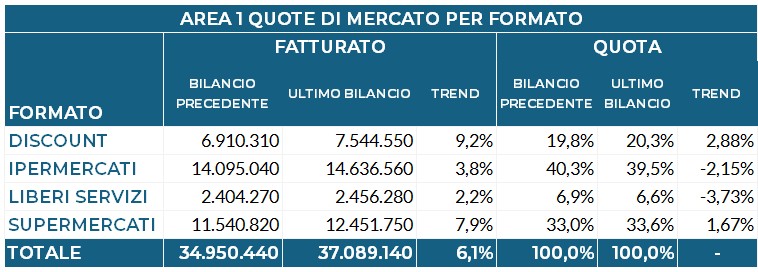
In May 2025, the GDO Area 1 confirmation arrives punctually : discount stores and supermarkets win, hypermarkets and superstores badly (see data below).