Drafted 12 June 2022 and updated 1 December 2025
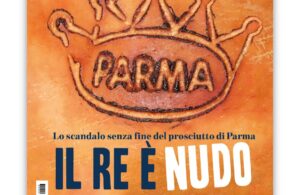
Then we come to these sad and convoluted events: ‘The new control body Csqa suspended‘ (2022)
The news appeared again in June 2022 after a ‘saga’ that will last eight years in all (from 2016 to 2024).
This affair involved Assica (Confindustria), Coldiretti and the Parma Quality Institute (*) with the following results:
- “The Parma Quality Institute (Ipq), after collecting six months of suspension in 2018 for not realising that almost one million fake Parma raw hams were circulating….”
- “2 million thighs – equal to 20% of the national production – were allegedly readmitted to the PDO Parma and San Daniele without having the requirements“
(*) TheIpq was then replaced by the Csqa, which in turn was suspended.
The balance sheet of Prosciuttopoli (2024) is interesting , in a never-ending affair: “Even for the Prosciuttopoli scandal of 2019 brought to the fore by Il Fatto Alimentare, the Consortium had not noticed anything, yet it was an 80 million euro fraud with 300 subjects reported to the judicial authorities, 810,000 legs seized, 480,000 hams excluded from the market and over 500,000 legs removed from individual breeders“.
P.S., in 2023 I wrote: if the market has “always behaved badly” it is not the case to continue.
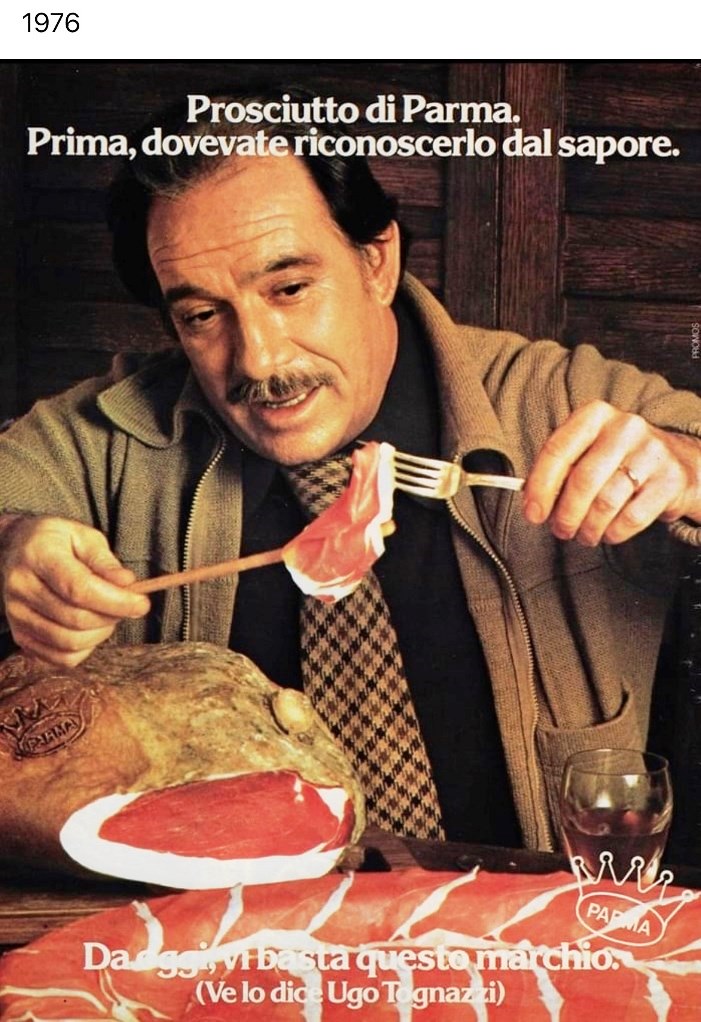
Above is an old advertisement with Ugo Tognazzi saying in 1976:“Prosciutto di Parma. Before you had to recognise it by the taste. From today this brand is enough for you‘.
Unfortunately, the brand may no longerbe enough if the bad management of the sector continues.
The short-sightedness of the above-mentioned bodies and associations involved suggests that the aim was to try to destroy, in every possible way, the reputation of a quality product – Italian ham – by favouring foreign competitors.
Will ‘our heroes’ succeed in their intent, damaging the whole of Made in Italy?
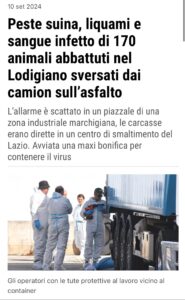
This is the dilemma that seems to be posed by the scandal of fake hams, the continuation of mismanagement in the sector and the underestimation of the swine plague that is now spreading throughout Italy, with devastating effects.
And it is obvious that this pandemic will have very heavy effects on our exports – boycotted by many countries, on our image – see below – but also on inflation (the higher costs of this crisis will, of necessity, be passed on to consumer prices) and on our country’s competitiveness.
This is said by someone who, more than 20 years ago, after consulting Juan Roig of Mercadona, put Spanish ham – branded Campofrìo – in Esselunga’s delicatessens.
Even then, ‘Jamòn’ was already ‘more fashionable’ than our Parma ham!
Below: ‘ham in danger’, in the Financial Times. Both the authoritative newspaper and Repubblica mention barriers, which depend on the Ministry of Transport and Infrastructure, as a remedy against wild boars. Not the culling of wild boars, as Coldiretti claims instead. Both would probably be fine. Is there a lack of ‘political will’?
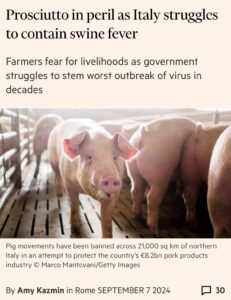
And I would add that not talking about it, not writing about it, as the Corriere della Sera does, for example – but finding the news, instead, in the Financial Times, is not good for the country: the swine plague affair concerns food, health but, by now, also public order (see below).
In France, sheep farms are affected by three types of epizootic disease and it is being reported in all the newspapers. Just as in the USA, the 9 deaths from listeria in cold cuts have been talked about almost everywhere.
Also because the epidemics, in Italy, have followed one another and the media should have an obligation to inform the citizens: blue tongue alarm in Italian sheep and cow farms with hundreds of outbreaks and thousands of dead animals due to the disease that is spreading in Sardinia, Piedmont, Lombardy and Calabria but also in other areas of the country.
Below: in May 2024, the government announced that it had deployed the army to cull wild boar: negative publicity abroad and zero consequences in Italy, where the situation, unlike in Belgium, for example, has worsened.
While our ministry was busy with propaganda and appointments.
Conclusion:
- the scandal of fake hams has been resolved.
- the swine fever affair has improved considerably but remains, under trace, in some regions.
- lessons should not be forgotten.
- consumption of Parma ham but also San Daniele ham should be relaunched (with great transparency, starting with the raw material processed). Certainly episodes such as this rodent and piglet carcasses on La Pellegrina farms (AIA group, November 2025) continue to damage the image of PDO ham.

On this subject, read also :
The decline in meat production and Nestlé’s strategies
The stark reality: the never-ending Parma ham scandal.
Parma Ham: new specifications, yet another scam?
Prosciuttopoli: swine plague in Langhirano (2024)
“Prosciuttopoli”: trial concluded with 2 convictions and 3 acquittals
Prosciuttopoli, the many accomplices in the Parma and San Daniele scandal
Swine fever, red zone triggered: 60,000 animals slaughtered, 26 outbreaks
Swine fever: the number of pigs slaughtered now stands at 120,000. Coldiretti’s forgetfulness
18 million in refunds to farmers
Swine fever : Coldiretti knew since 2018 but did absolutely nothing
Swine fever: more than 100,000 pigs slaughtered
Prosciuttopoli : the strange point of view of the San Daniele consortium
Sardinia has defeated swine fever, all restrictions lifted: ‘An historic day’ The European Commission decided today to lift the last remaining restrictive measures still in force on the island, which has been battered by the terrible disease for more than 40 years