Compiled 22 June, updated 27 July 2025
Mattia Malgara on LinkedIN writes about this:
… Benetton and Del Vecchio, with the GS operation, made one of the biggest capital gains in Italian history: over X billion €, tax-free thanks to a structure in Luxembourg.
With which the Benettons then went on to buy motorways for Y € billion in 1999 to then exit at Z billion in 2022.
While Del Vecchio began his shopping spree in America starting with Ray-Ban and the largest chain of eyewear shops in America.
Both of these transactions laid the foundations of what are now Italy’s two largest industrial groups …
Mario Gasbarrino replies:
Dear Mattia , … i will give you a rereading on the Del Vecchio and Benetton operation: indeed for the two companies it was the deal of a lifetime, but the responsibility (or the merits), depending on the point of view, was first and foremost the short-sightedness of the government at the time;
At the first auction, only Rinascente presented itself and was not given because they did not want the concentration in the Agnelli family, owner of Rinascente and Sma Supermarkets (to which they had recently given Alfa Romeo).
At the second tender, Rinascente lost the auction to the Benetton-Del Vecchio duo for just 50 billion of the old lire.
Someone still has to explain to me why, in a retail market that needed concentration [and expertise], the government allowed a group that didn’t even have a delicatessen, to buy GS (which belonged to Sme =IRI= Italian State! ) and then resell it quietly to a foreign group (Carrefour) after a few years.
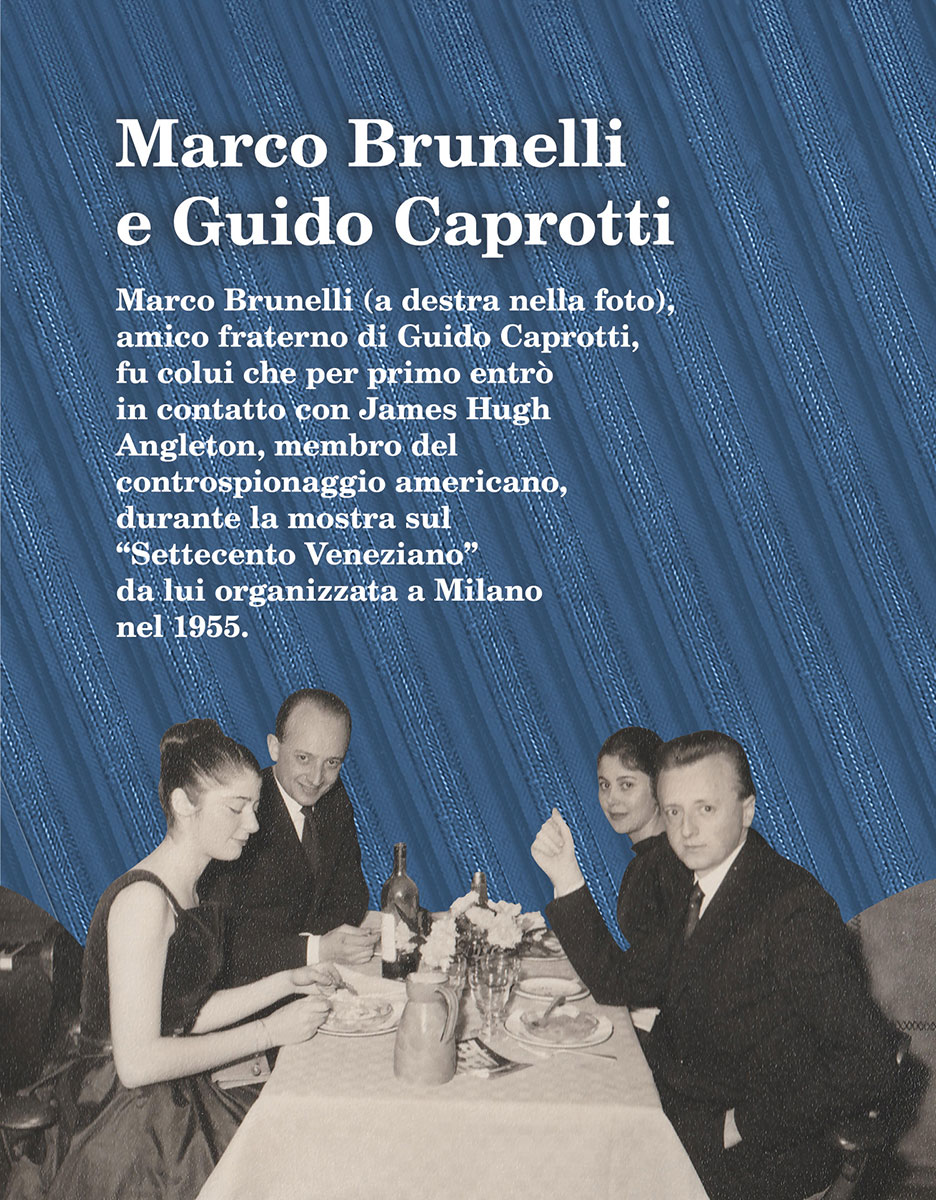
If Sma all’Epoca had bought GS perhaps the future of retail in Italy would have taken a different direction [personally I would have preferred that the auction did not take place and that GS remained in the family, with my uncle Guido Caprotti and Marco Brunelli, co-founders of Esselunga and GS. A large complementary group: strong in northern Italy – with Esselunga – and with good coverage in the south – with GS – would have changed the face of Italian retail. I talked about this during the presentations of my book Le Ossa dei Caprotti].
Today the games are over and I don’t see any companies around in Italy with a format able to counter the discounters [or families with the necessary capital and know-how, it’s too late now].
Mario Gasbarrino (with some additions of my own for which, I am sure, Mario will forgive me)
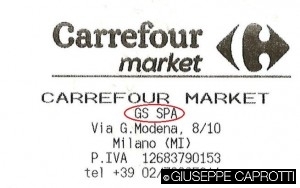
Below: Carrefour receipt in Via Gustavo Modena, Milan, which testifies that a GS company – used not to have its brand copied – still exists.
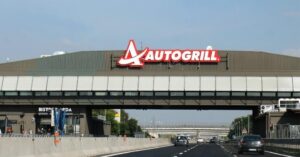
SME was an Italian holding company that grouped IRI’s food, large-scale retail (GS) and catering (Autogrill) activities. In the privatisation process, SME was sold, and the activities of GS and Autogrill were acquired by a consortium led by the Benetton family. Subsequently, Autogrill was listed on the stock exchange and its activities expanded internationally.
Here is a more detailed chronology:
- 1993-1994:
IRI initiates the privatisation of SME, selling off holdings in the food, large-scale retail (GS) and catering (Autogrill) sectors.
- 1994:
A consortium consisting of Edizione Holding (Benetton family), Leonardo Finanziaria (Del Vecchio family), Mövenpick and Crediop acquires the holdings in GS and Autogrill.
- 1997:
The Benetton family lists Autogrill on the Milan stock exchange and continues its international expansion with acquisitions in France, Belgium, the Netherlands, Austria and Germany.
- 1999:
Mövenpick leaves the company, selling its stake to the Benetton family.
In summary, GS and Autogrill, initially part of SME, were privatised and acquired by a group of investors led by the Benettons, who then listed Autogrill and expanded its activities.
What is missing from the AI chronology is that then Autogrill, like GS, was also sold.
Distribution and catering not considered strategic, wrongly, by the Italian state.
From Le Ossa dei Caprotti:
p.43
Brunelli, who had started dating my uncle Guido immediately after the end of the war, when they were both in their final years of high school, is an entrepreneur who was able to found three different supermarket chains. In the early years of Esselunga’s life he was its main Italian shareholder, after the Americans who were the real creators and who had expressly demanded a majority shareholding so that they could make their decisive mark. Later, again together with his uncle Guido, he founded GS in Rome, which at one point had come to compete with Esselunga itself in Milan. Finally, he founded Finiper, the group that still owns the Iper hypermarkets and Unes supermarkets today.
Page 67
The struggle for control
I don’t know what relations were like between Bernardo and Marco Brunelli in the early years of their cohabitation as minority shareholders in Esselunga, in the shadow of the Americans. In a recent conversation with Benedetta, Uncle Guido’s daughter, my cousin told me that Brunelli had said that he had struggled to get along with my father right from the start. What is certain is that the first disagreements began to manifest themselves blatantly at the beginning of 1960. In May, in fact, Brunelli and my uncle Guido founded together a chain of supermarkets whose aim was to focus on Rome, the city that IBEC’s men had discarded. The intent was declared right from the name of the company, christened La Romana Supermarkets. The first supermarket was opened a year later, ‘through an operation of recovery and reuse for commercial purposes of a part of the Olympic village’, as historian Luciano Segreto recounted.
Page 68
It was a splendid location because it was close to the Parioli district, in an area with a good road network and ample space to allow customers to arrive by car and park easily. Success was immediate and the company began to expand like wildfire, quickly involving other partners and in 1966 it entered the state orbit: 60 per cent of the capital was in fact taken over by the public finance company SME, which moved its registered office to Naples, changed its name to GS (Società Generale Supermercati) and decided to land on the Milan market as well, buying the Stella Supermarkets. In short, Brunelli and Uncle Guido had got it right, starting what was to become one of the strongest large-scale distribution companies in a very short time. The GS brand would live on for a long time and the network of supermarkets built over time still exists today: after a few corporate changes, it was taken over by the French Carrefour in 2000.
Page 68
Brunelli and Guido did not act covertly towards the Americans of IBEC. I have been able to trace at least two testimonies on this point. In 1980, on the occasion of yet another clash between them, Bernardo accused Guido of having acquired a shareholding in Romana Supermarkets without telling him. His brother would reply that the initiative had already been conceived two years after the foundation of Supermarkets Italiani ‘in the conviction that the Americans would always maintain the majority stake and that there would be no hope of operating on their own in the sector’. Guido recounted that Rome was chosen ‘after a clarifying interview’ with Boogaart, who ‘was adamant in stating that he had no intention of opening any business in the capital’. The second testimony came directly from Marco Brunelli, in the meeting we had in 2019. Brunelli recounts that he himself had pointed out a plot of land in Rome to Boogaart and that the American manager, not considering it interesting, had discarded it. Brunelli and Guido thus decided to do the operation together, splitting the shares 50-50.
Page 69
Guido commented: ‘So we become a family of cousins’. And he recounted that La Romana – the future GS – had the highest sales per square metre in Italy, but that Bernardo, despite the success of the operation, fell out with his brother, calling him back to Milan. Uncle Guido could not even attend the inauguration of the first shop, despite being an equal partner with Brunelli. He suddenly stopped hearing from him, leaving his friend bewildered. A frost descended between Brunelli and my father, who had urged his brother to break off relations: the two never spoke again and it was from that moment on that, for Guido’s best friend, Bernardo became ‘the unnamed’.
Brunelli later regretted having sold GS to SME, which was interested in spreading the supermarket system throughout southern Italy: ‘It was the biggest mistake of my life,’ he said.
I am obviously puzzled by this operation: New Princes buys Carrefour Italia supermarkets (where I remember the ‘reckless operations’ with Auchan- Conad but also with Standa).