
@belchonock/123rf. Drafted 3 April 2024, updated 25 March 2025
You will find my remarks at the end of the article
Chicken breast from intensive farms: full of fat, Aia and Esselunga among the worst in the test
The new test, conducted by Salvagente on 18 chicken breasts from well-known brands, reveals a significant increase in fat content. Among the products analysed, those from Aia and Esselunga register worrying values, exceeding three times the fat threshold considered normal by Crea.
When we think of chicken breast we associate it with a lean meat variant. But is this really the case? A new test conducted by ‘Il Salvagente‘ shows us a slightly different situation than we imagine. According to an analysis of 18 chicken breasts, in fact, the nutritional composition of this meat seems to have changed radically in recent years, with a significant increase in fat content.
But let’s start at the beginning. The survey sampled chicken breasts of different brands (including organic), among the most popular and purchased in supermarkets in our country. These are:
- AIA
- AMADORI
- CARREFOUR
- CARREFOUR BIOCOOP
- COOP VIVIVERDE
- CONAD
- CONAD VERSO NATURA
- ELITE
- ESSELUNGA
- ESSELUNGA SMART
- EUROSPIN
- FILENI
- IN’S
- LIDL
- MD
The sample of chickens analysed was selected to evaluate their fat content, the only parameter taken into account in the test. The objective of assessing fat content stems from the desire to understand the impact of fast-growing breeds and intensive farming on the nutritional composition of chicken meat.
All samples analysed in the test originated, were raised and slaughtered in Italy.
The indications given by the producers on the labels mainly concern the type of breed used, the feed and the criteria for rearing the animals. In particular, Fileni bio and Carrefour bio are the only two brands that specify, respectively, the use of chickens ‘bred at least 81 days’ and ‘slow growing’.
As far as fat content is concerned, Regulation 1169/11 ‘Food Information for Consumers’ exempts raw meat packages from the obligation to display the nutrition table on the label. However, some manufacturers such as Lidl and Fileni have chosen to voluntarily include this information.
It is important to note that manufacturers have very generous analytical tolerance margins with respect to what is declared on the label (plus or minus 1.5 grams for amounts of fat less than 10 grams per 100 grams of product).
The results
The results of the laboratory analysis were compared with the nutritional value of fats in the Crea food composition table, which gives a value of 0.8 g/100 g for raw chicken breast.
Some samples were in line with this value but many others showed a significant increase in fat content. The worst chicken breasts contained from 2 grams of fat, i.e. more than 150% above the reference value, to 2.5 grams, i.e. 212% above the reference value.
The analysis revealed an overall average of 1.6 grams of fat in the tested samples, well above the 0.8 grams of the Crea reference. This suggests a significant change in the nutritional composition of chicken meat, which could be attributed to several factors, including intensive farming and the use of fast-growing breeds (which develop breasts quickly).
The nutrition and limited mobility of chickens, both due to lack of space and asymmetrical development of pectoral muscles in relation to legs, contribute to the problem. These factors have led to a significant increase in the fat content of chicken compared to the past.
Professor Massimiliano Petracci, lecturer at the Department of Agri-food Science and Technology at the University of Bologna, confirmed this trend to Salvagente, pointing out an increase in the fat component in chicken meat over the past 10-15 years.
But it is not only the quantity of fat that is a cause for concern, but also (and perhaps above all) the quality. As Debora Rasio, oncologist, nutritionist and researcher at La Sapienza University in Rome, told Salvagente, today’s chicken meat seems to be imbalanced towards an excess of pro-inflammatory omega-6 fatty acids:
We should not be worried so much about the richness in fats as their profile: chicken meat today, in fact, is strongly imbalanced towards an excess of pro-inflammatory Omega-6 fatty acids. And this depends on the diet of the animals and the way they are reared.
In short, intensive rearing and the selection of fast-growing breeds seem to contribute to the increase in fat in chicken meat, which radically changes the nutritional landscape of this protein source traditionally considered lean and healthy.
The worst chicken breasts
Here is a list of the chickens that came out worst in the test in terms of fat content:
- Sliced chicken breast: 2.5 grams of fat per 100 g of meat
- Esselunga sliced chicken breast: 2.5 grams of fat per 100 g of meat
- Conad sliced chicken breast: 2.2 grams of fat per 100 g of meat
- Md Bontà di Italia sliced chicken breast: 2.1 grams of fat per 100 g of meat
For the full test results please refer to the April issue of Salvagente.
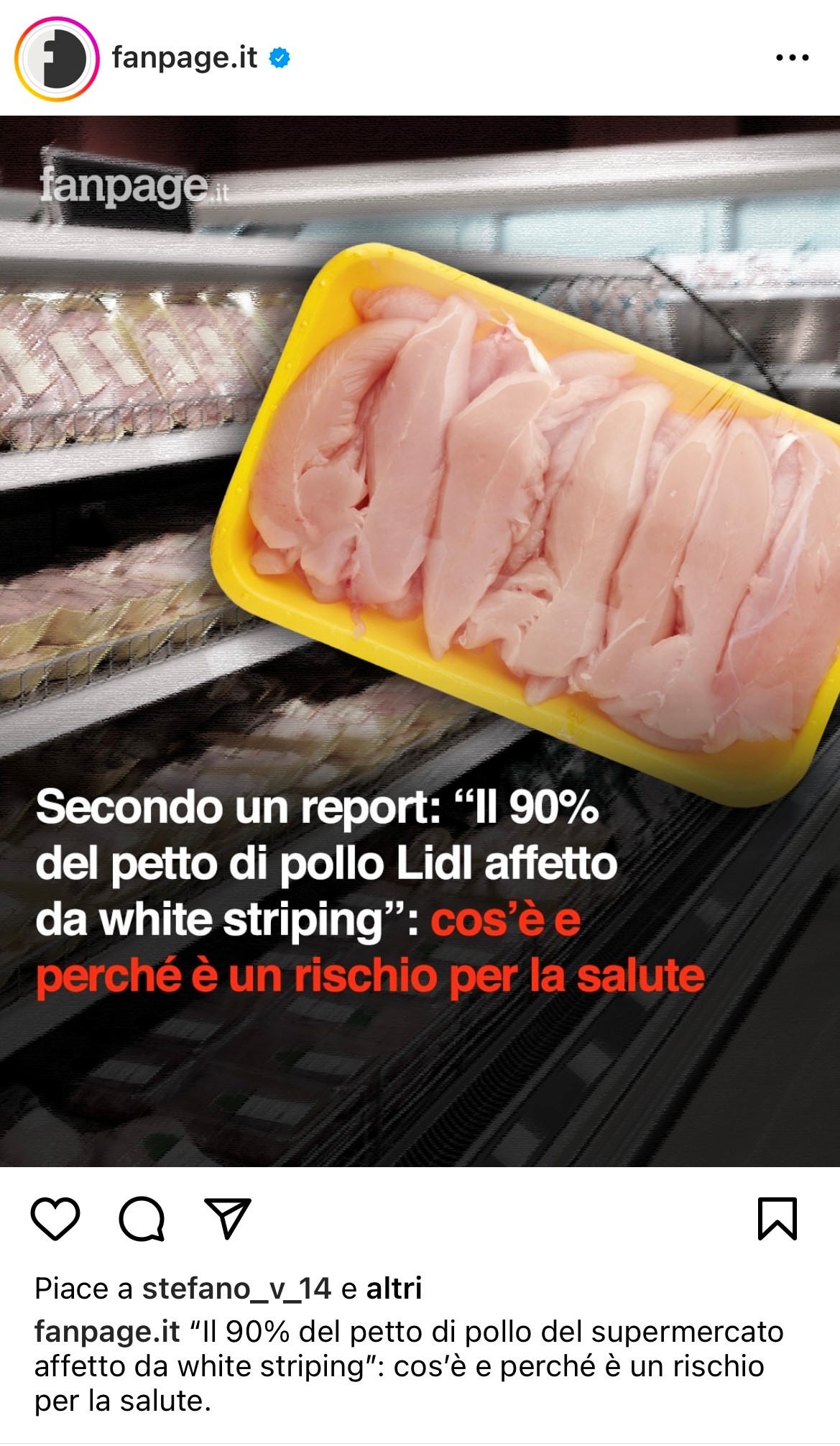
The story seems to pendant with this one, which concerns animal welfare even though the chicken story starts from here: the continuous price war between brands ends up leading to the deterioration of food quality.
Read also
Aldi: chicken with white stripes and burns
Double the fat in chicken meat.
Chickens in Italy are produced by three companies.
The story goes on about the Esselunga chicken with qualified interventions , but what is certain is that animal welfare is absolutely not cotemplated in these intensive farms, as this terrifying Report document confirms . On the myopathy of chickens read this article.
Meanwhile bird flu is rampant , not only in the US, but very few are talking about it.