The Caprotti family, innovation and tradition in an Italian factory: workers from San Vittore prison
When, in the early post-unification years, the Caprottis built their first large factory in the true sense of the term, eventually finding themselves with thousands of square metres of space, they were initially not quite clear what to put in it. They probably envisaged a kind of ‘centralised manufacturing’, and to this end they purchased various machines by turning to various manufacturers, including the Milanese prison of San Vittore whose director, Eugenio Cicognani, was personally passionate about and invented a newly developed regulator loom, built by the inmates.
The Caprotti family, innovation and tradition in an Italian textile manufacturer: Alessandro Belgiojoso and the ‘La meccanica della Caprotti’ exhibition
Alessandro Belgiojoso is an internationally renowned photographer, husband of Albertina, daughter of Gianni Albertini D'Urso, in turn daughter of Gianni Albertini, an explorer and my great-uncle. Years ago, in 2008, I approached him to photograph a documentary collection kept in my archive, from which a panel exhibition was to be created in 2011. His uncle Giuseppe Barbiano di Belgiojoso (1924 - 2022) was a friend of my father Bernardo and probably also of my grandfather PeppinoThe Caprotti family, innovation and tradition in an Italian manufacture: Albiate and Switzerland
Bernardo Caprotti, an agricultural owner, founded Giuseppe Caprotti’s Bernardo Caprotti cotton weaving company on his land in Ponte Albiate. Caprotti’s company was still based on an almost pre-industrial production system: few simple machines, many warehouses, worker-farmers weaving mainly at home. In 1866 there were about 1500 of them. However, the great industrial revolution that would transform Europe was underway…
Exhibition: the mechanics of Manifattura Caprotti
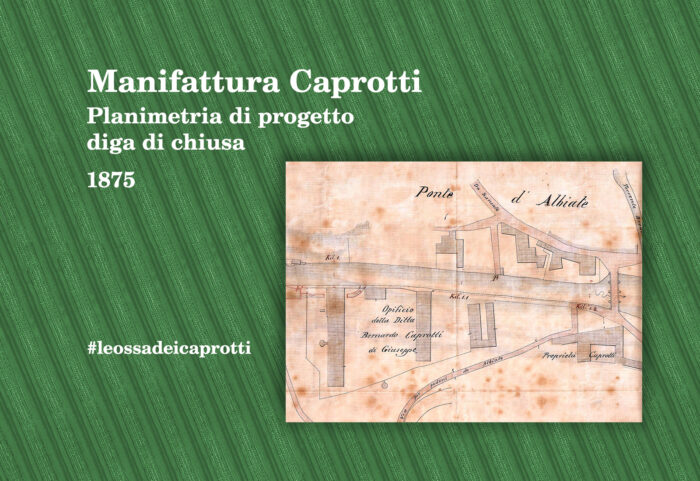
The collection contains about 100 industrial drawings, some of them very beautiful, all of them interesting. These images tell the story of Manifattura Caprotti and, in 2011, were the subject of an exhibition
The Caprottis and the fabrics of Manifattura Caprotti
Solid bleu linings/Oil-dyed linings/Oil-dyed men’s fillets/Solid-coloured overstretched linings/Common linings, and these are most commonly used, especially if they are beautiful in design and colour and reasonably priced