Written on 31 August 2024, updated on 24 June 2026 (see also: Walmart, in its biggest deal of the last two years, acquires an advertising technology company)
Introduction and conclusion by the author
I am publishing this article because I have read various calls on social media for the Italian retail sector to refocus on its core business (food). In principle, this concept is absolutely correct. But there is a ‘however’:
- if you do ‘food’ well, you can certainly do other things too. For example, non-food items and services. Walmart’s latest excellent results – turnover: 4.2% on a like-for-like basis – are proof of this. They have contributed to a sharp rise on Wall Street and sent out excellent signals of optimism regarding the state of the US economy, which is eagerly awaiting an interest rate cut by the Fed.
- At Esselunga, amongst many other innovations, I introduced the standardisation of internal messaging across our stores and, subsequently, the sale of adverts from our suppliers on the network broadcasting Radio Montecarlo’s music.
- No one in Italy would be capable of doing what Walmart does today in the United States – broadcasting adverts even for products not sold within its network – because no one has the clout that Walmart has in America: the Coop group has a central purchasing organisation but lacks centralised management. The same goes for Conad. And all the others are either too small or lack centralised management.
In Italy, I see few businesses that are truly focused on what they do: for decades, we have been ‘conquered territory’ for Amazon and, above all, for discount retailers, which the supermarket chains have failed to counter.
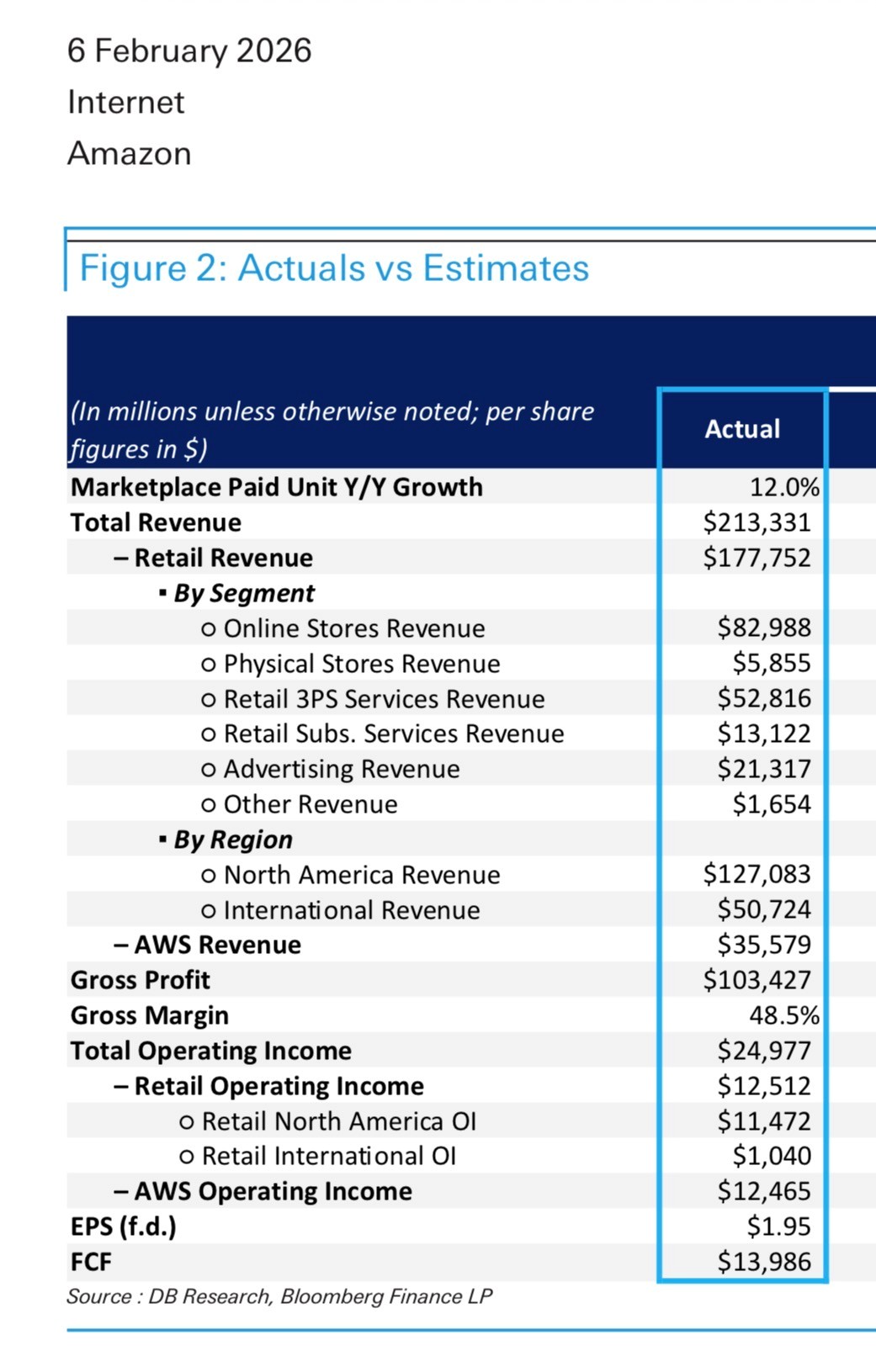
Below: only 38.9 per cent of Amazon’s sales in the fourth quarter of 2025 were linked to e-commerce from Amazon’s warehouses (82.9 out of 213.3 billion dollars, according to Deutsche Bank data).
We have no data on Walmart (apart from eMarketer’s figures for advertising, which we’ll discuss below), but we believe that a substantial portion of its revenue no longer comes from direct sales but, for example, not only from advertising, but also from subscriptions and the marketplace (commissions received from suppliers who use Walmart’s platform but not its direct logistics).
How does Amazon manage this, especially as it also has AWS, the cloud service?
How Walmart has become an advertising powerhouse
Is a high-margin, fast-growing advertising business changing the retailer’s relationship with brands?
by Gregory Meyer in Springdale, Arkansas, 19 August 2024
On the 14th last week, Walmart reported an increase in sales of household goods such as clothes, groceries and toys. But its profits have risen even faster, thanks in part to a product that doesn’t fit in a shopping trolley: advertising. The world’s largest retailer has bought a myriad of newspaper, television and online adverts over its 62-year history. Now, it is selling airtime to other advertisers, competing with traditional media companies for marketing dollars. Its US advertising business, Walmart Connect, is part of an emerging sector known as ‘retail media’, in which large retailers flex their muscles as gatekeepers between sellers and consumers to sell adverts to brands seeking a competitive edge.
US spending on retail media is set to exceed $54 billion in 2024, according to eMarketer, up from $18.7 billion in 2020. E-commerce giant Amazon is expected to hold a dominant 77 per cent share [with revenue of nearly $42 billion], whilst eMarketer analysts see Walmart claiming 6.8 per cent of the market, with ad revenue of $3.7 billion.
Walmart’sadvertising business in the United States has grown by 30% over the past year, outpacing the growth rate of the company as a whole. With eMarketer forecasting that the retail media industry will reach $130 billion in four years’ time, high-street chains are seeking to catch up. Advertising is far more profitable than the operating margin of around 4 per cent that Walmart earns from selling products and groceries, and brick-and-mortar retailers see an opportunity to wrest business away from their arch-rival in e-commerce. Sarah Marzano, an analyst at eMarketer, said:“Amazon is often where consumers now start their product searches, rather than going to Google. With retailers becoming the destination for consumers to search for what they want to buy, there is an opportunity for retailers to monetise that traffic.
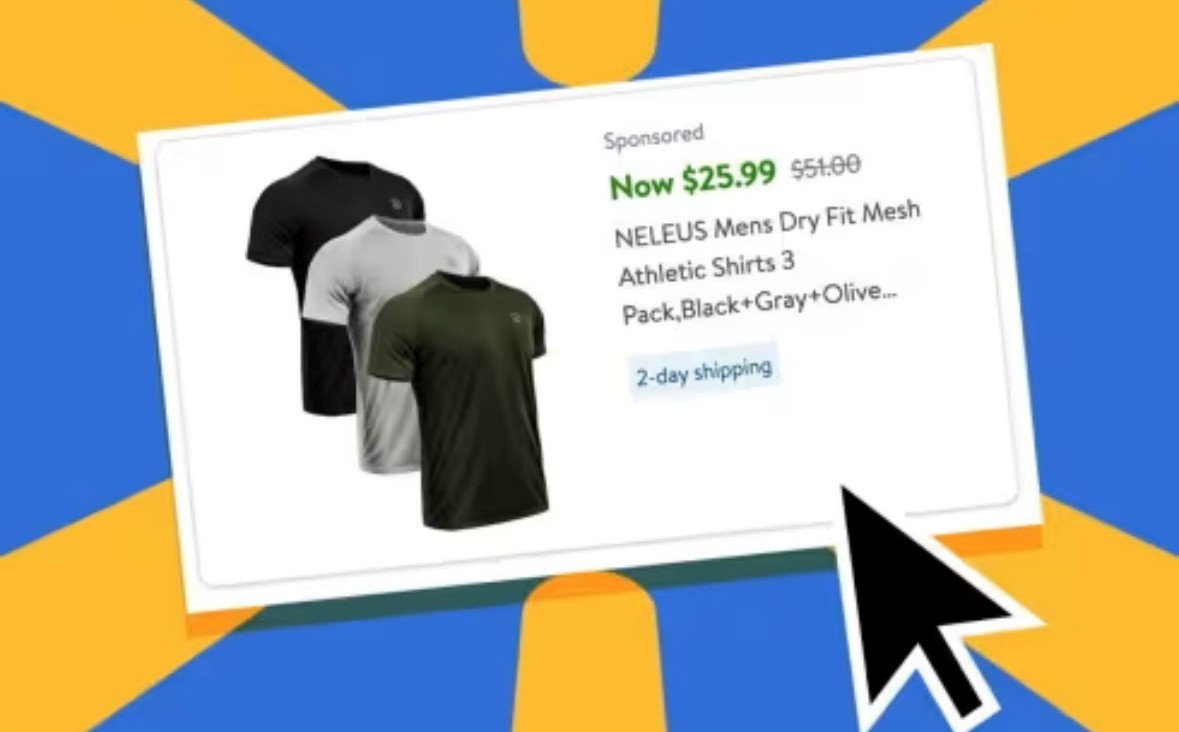
The prospects for higher-margin businesses such as advertising have excited investors, helping to drive Walmart’s share price up by 38 per cent this year. The retailer now ranks as the 16th-largest ad seller by revenue outside China, according to Madison and Wall, a media and technology consultancy. A key source of revenue is sponsored search results on Walmart’s app and website , where suppliers pay to have their products featured prominently. A recent online search for washing-up liquid yielded sponsored listings from Procter & Gamble’s Dawn brand, whilst a search for chicken breasts offered a variety of cuts from meat packer Tyson Foods. These companies already purchase general search results on platforms such as Google. The difference in the retail sector is that Walmart and Amazon have data not only on what consumers see on their apps, but also on whether this leads to a purchase.
Ryan Mayward of Walmart said: “140mn people shop here every week . . . Around 110 million people tune in to the Super Bowl. That’s an audience larger than the Super Bowl every week coming through our stores” – “After clicking on an advert in a generic search engine, they don’t know what you did next,” said Ryan Mayward, senior vice-president of retail media sales at Walmart US. “First comes the click, and we also know that you went on to check out and purchase those specific items after being exposed to or interacting with the adverts. This is the core value proposition of retail media compared to other types of media. Walmart is doubling down on advertising with its $2.3 billion deal for Vizio. The smart TV manufacturer has been losing money on device sales, but made $336.3 million in profits last year thanks to technology that tracks what people are watching and serves them targeted adverts. Agreed in February, the acquisition is currently under review by the federal competition regulators [FTC, antitrust]. Unlike Amazon, Walmart has 4,600 large stores across the US, as well as hundreds of other Sam’s Club outlets. “This is where Walmart has a scale that Amazon cannot compete with, ” said Marzano.
John David Rainey, chief financial officer, noted that Walmart can link customers’ purchases to the adverts they viewed days earlier by using bank card and electronic payment data. “A week goes by, you decide to buy that item in-store, we know there was attribution relating to that advert,” he told an analyst in June. The company is unable to identify in-store customers who pay in cash, said Mayward. Walmart is also increasing in-store advertising to complement its online campaigns. Mayward, a former Amazon executive, argued that for marketers, physical stores can help counteract the effects of media fragmentation.
During a recent tour of a Walmart Supercentre in Springdale, Arkansas, Mayward paused at the meat and bakery counters where digital screens had been installed. “We’re launching advertising opportunities on deli and bakery screens in a matter of days,” he said. On a nearby ‘TV wall’, where some of the televisions on sale are advertised via Walmart’s advertising service , the company is trialling the sale of so-called ‘non-endemic’ adverts for products not sold in its stores, such as cars or cruises. Advertisements also punctuated the music playing in the store. “It’s a light load of adverts,” said Mayward. In the checkout area, the screens on the self-service kiosks also displayed adverts, in this case for T-Mobile. How Walmart’s suppliers will respond to their proliferating advertising options remains unclear…
Alongside Walmart, its US rival Target and the grocery delivery firm Instacart are among those building retail media businesses. Although analysts expect retail media to grow, they see the potential for new points of ‘friction’ in the relationship between major retailers and major brands, including concerns that brands will feel pressure to buy adverts to improve their access to retail shelf space. In a Forrester survey, 19 per cent of consumer marketing executives said their motivation for spending on retail media was to forge stronger partnerships with retailers. “I was speaking to an executive at a major [fast-moving consumer goods] brand who said that, for him, buying advertising from Walmart feels like tithing to the church,” said Lai. There is also the question of whether consumers are growing weary of coordinated campaigns that follow them online and in-store. “Introducing digital media in unfamiliar settings can be an embarrassing mistake if it doesn’t go down well with shoppers,” noted eMarketer in a report. Walmart is aware of the risk that shoppers might find the adverts distracting or annoying. “We want it to enhance the shopping experience,” said Mayward: “… It has to benefit the customer in some way.”
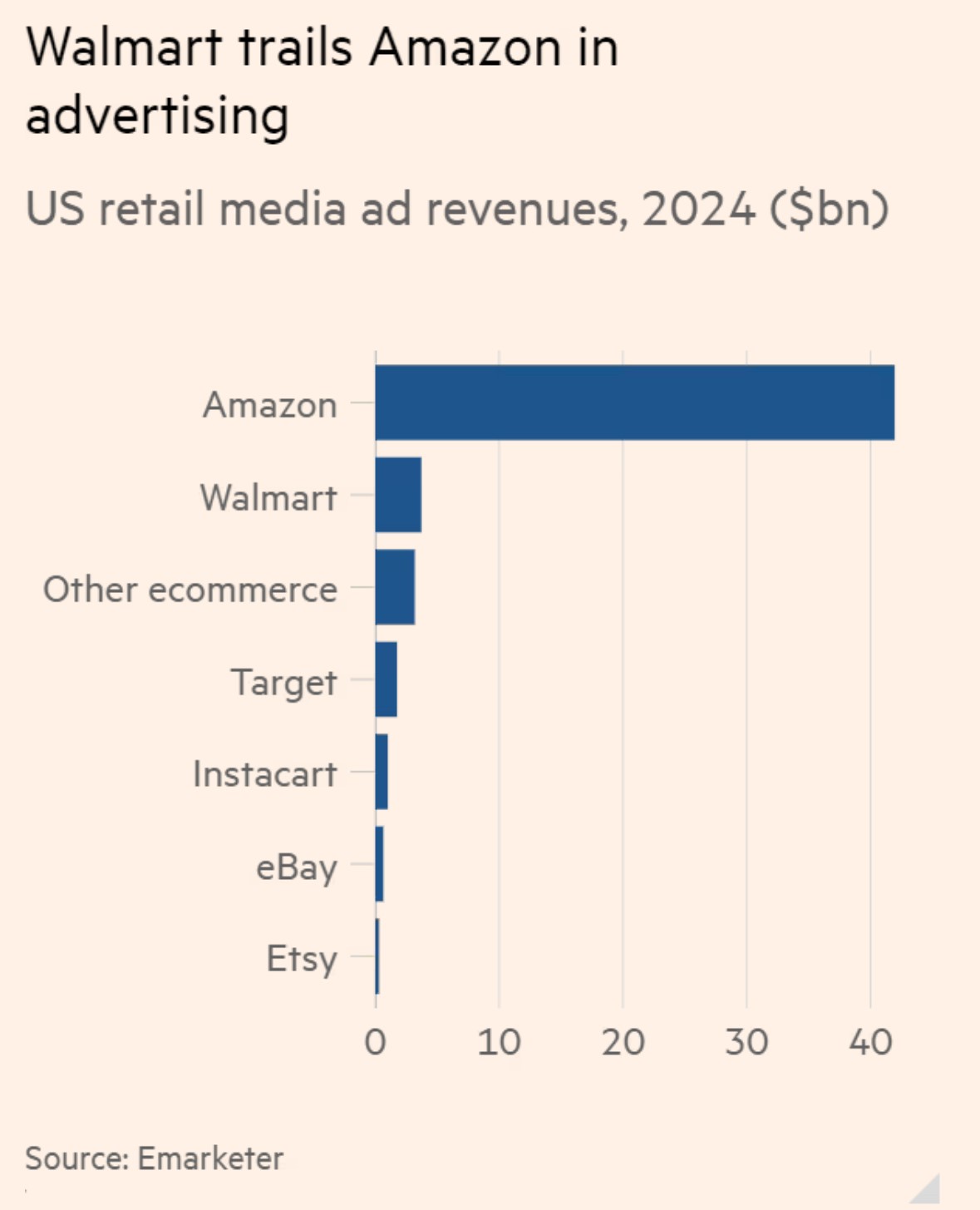
- According to eMarketer (2025):
- Amazon Adsdominates the US retail media market witha share of around79.7 per cent.
- Walmart Connectis the second-largest player witha market share of around8%
- The third player,Target Roundel, lags far behind with a market share of around1.5%.
- Size of the US retail media market
According toeMarketer:
- Average retail advertising spend in the United States reached approximately$58.8 billion in 2025 (Walmart therefore spent $4.7 billion on advertising in 2025)
- Growth to$69.3 billion is forecastfor 2026.
https://www.emarketer.com/content/retail-media-ad-spending-forecast-trends-h2-2025
Let me give another example, taken from *The Coming Wave: Artificial Intelligence and Power in the 21st Century* by Mustafa Suleyman, Garzanti, 2024:
…”Consider the influence of an expanding empire such as the Korean Samsung Group. Founded as a trader in noodles and other food products almost a century ago, after the Korean War it transformed itself into a conglomerate of companies.
Samsung was one of the driving forces behind the country’s economic growth in the 1960s and 1970s, not only as a giant in the diversified manufacturing sector, but also as a major player in banking and insurance. Samsung was the driving force behind the Korean economic miracle, thus becoming the leading chaebol – a term referring to a small group of companies that control the country.
Smartphones, semiconductors and televisions are Samsung’s specialities, to which must be added ferry services, life insurance and theme parks. A career at Samsung is considered highly prestigious. The group’s turnover accounts for up to 20 per cent of the South Korean economy. For South Koreans today, Samsung is almost a parallel government, a constant presence in people’s lives”…

Conclusion:
- For decades I have been hearing complaints from suppliers about their contributions to large-scale retailers. Meanwhile, these contributions have risen dramatically, despite some minor friction, even recently.
- Esselunga had its own advertising revenue plan, which largely coincided with the collection of promotional contributions. The tools used to raise more than €379 million in 2003 included, for example: a radio programme, digital signage and in-store advertising spaces. In addition, there were promotions in leaflets, via the Fidaty scheme (e.g. shopping vouchers) or in Esselunga’s magazine. We had also launched a promotional programme focused on ‘Esselunga at Home’.
- The most important thing, however, is that large companies such as Walmart, Amazon and Lidl have grown exponentially and are market leaders in sectors that are neither food nor non-food: Amazon and Walmart in advertising; Amazon again in e-commerce,but also in the procurement of alternative energy sources; and Lidl in artificial intelligence and cloud computing.
And it is a shame that no Italian company has had the scale – but above all the vision – to approach the world in the way these giants have.
In Italy, everyone has thought: e-commerce must be self-sustaining. This was the case for Esselunga at home whilst it had no rivals, but Amazon and Walmart disprove this view: e-commerce is also sustained by other, more profitable sources of revenue.
N.B.: And it’s not a question of ‘youth’: Lidl’s founder and leader, Dieter Schwarz, is nearly 90 years old. Thanks to Damiano Paternò.