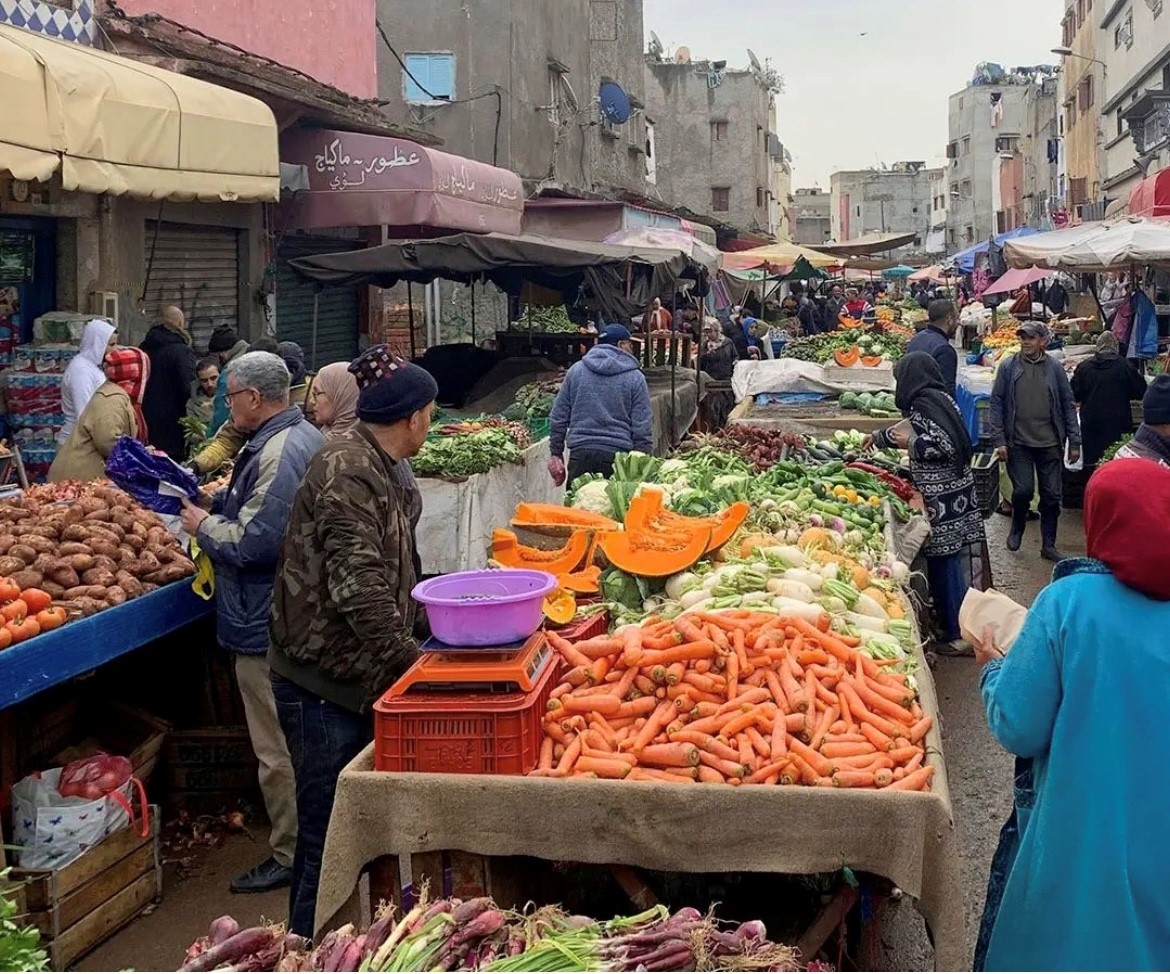
Written on 7 June 2020, updated on 23 February 2023, above: market in Morocco
Original title: “Covid paradoxes: agricultural prices fall, hunger rises”
FAO Food Price Index at a 17-month low, but food prices rise at the retail level
Sissi Bellomo, *Il Sole 24Ore* , 5 June 2020
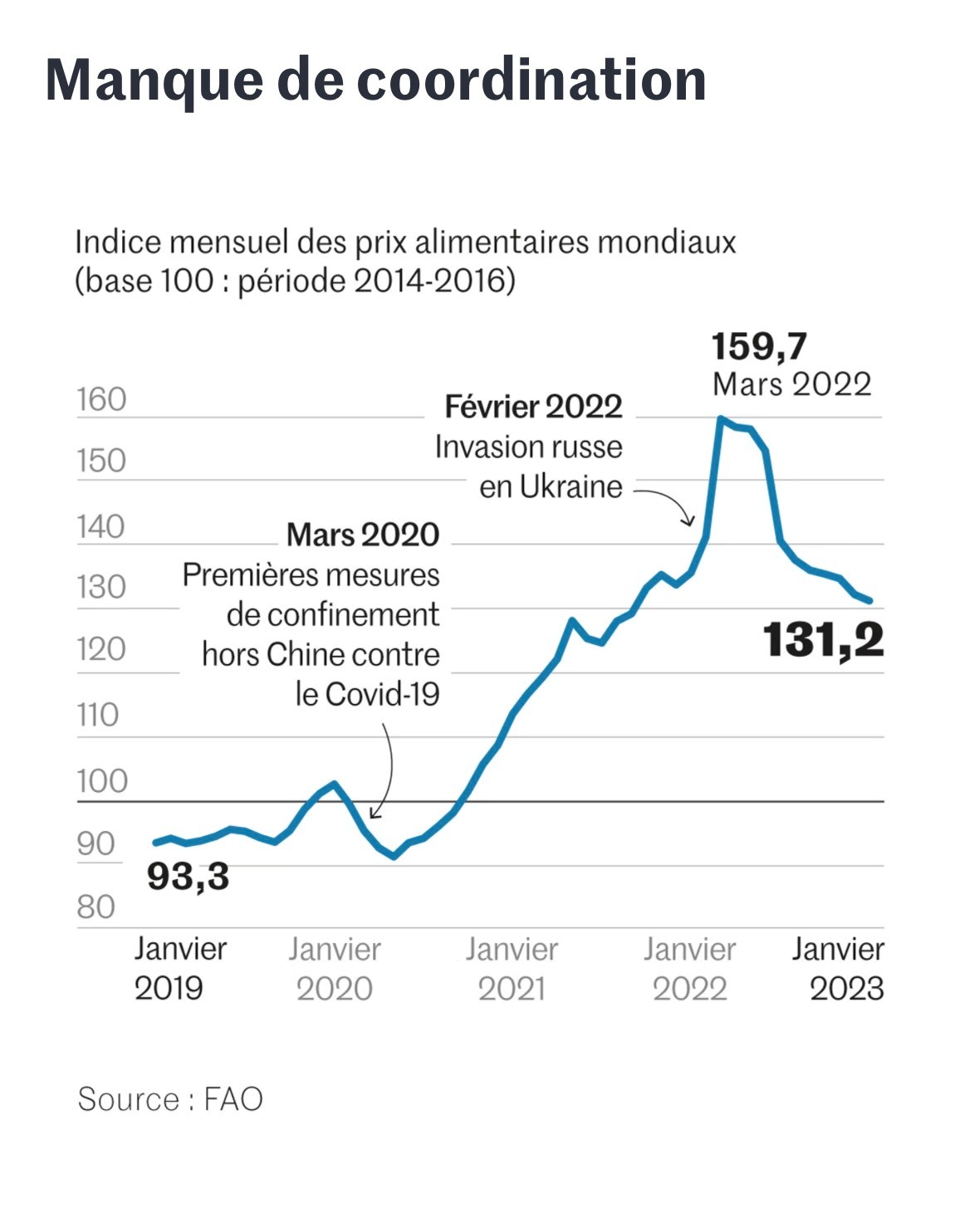
Below: the FAO price index cited by *Il Sole 24 Ore* andtaken from *Le Monde*, 23 February 2023.
It clearly shows how prices began to rise in the summer of 2020.
Below is the article from 2020
Food is abundant and increasingly affordable internationally, yet the cost of the shopping basket is rising and hunger threatens to affect millions more people around the world. It is yet another paradox of the coronavirus era, which has disrupted not only our lifestyles but the entire global economic system, creating imbalances and inefficiencies never before experienced.
The FAO’s Food Price Index, which reflects food prices, is puzzling at first glance: in May – according to the latest update, published yesterday – it fell again, for the fourth consecutive month, and at 162.5 points it is at its lowest level since December 2018, down 1.9 per cent from April and 11.2 per cent from January, when the virus had not yet spread beyond China’s borders. The pandemic has disrupted supply chains and threatens to leave crops to rot due to a shortage of farm labourers, yet the FAO index shows prices continuing to fall for cereals as well as dairy products, for meat as well as vegetable oils. Only sugar has risen on a month-on-month basis, but in April it was at a 13-year low.
The legendary housewife from Voghera would think she was looking at a faulty thermometer. Food prices are the only inflation component that has risen everywhere during the pandemic. In the US, it even recorded its sharpest rise since 1974 in April (2.6 per cent month-on-month, against an overall fall in consumer prices of 0.8 per cent). This trend is not limited to developed economies. And in the world’s poorest regions, it risks leading to a humanitarian tragedy.
According to the World Food Programme (WFP), the coronavirus crisis could double the number of people facing food insecurity to 265 million. In theory, there is no shortage of food, but for many it is difficult to access, notes Martien van Nieuwkoop, Head of Agriculture and Food at the World Bank: ‘We are seeing hunger rise in a world where there is abundance, and agricultural markets are well-stocked and relatively stable’. The organisation fears that the post-Covid crisis could push 60 million people into extreme poverty.
In May, the FAO itself launched an appeal to raise $350 million to step up the fight against hunger: ‘In countries already severely affected by hunger, people are finding it increasingly difficult to obtain food as incomes plummet and food prices rise.’
It is the nature of the Food Price Index that explains this apparent contradiction. The complex methodology used to calculate the index takes into account 73 price series relating to 23 commodities, but these are still international figures, which fail to reflect what happens further down the supply chain: on the shelves of our supermarkets or in the dusty markets of Africa. And Covid-19 has triggered phenomena that are complex to decipher, let alone tackle.
Retail prices are rising mainly due to logistical chaos and labour shortages in the fields. But agricultural products at source are affected by numerous downward pressures, also triggered by the coronavirus, many of which are linked to energy. The slump in petrol and diesel consumption has wiped out a significant portion of the demand for maize, sugarcane and vegetable oils, which are used for biofuels. In the US, a third of the maize harvest is usually used to produce ethanol, but in April this use fell by 40 per cent, according to the USDA. The use of cereals and soya for animal feed has also fallen: the closure of restaurants has hit meat sales, and many abattoirs – particularly in the US – have suspended operations following outbreaks of infection. The collapse in oil and gas prices has also reduced production costs in agriculture: fertilisers, for example, are cheaper.
The pandemic had also triggered protectionist policies in some exporting countries, which feared food shortages. But these measures have now been lifted, removing a factor that could have caused price pressures and exacerbated the risk of food crises.
Of course, the situation regarding commodities was exacerbated between 2021 and 2023 by the war and climate change, with the index continuing to rise before stabilising.

Read also:
1. Food, Covid-19, migrants and Europe
2. COVID: poor countries? Getting poorer still. The case of the textile industry
3. The global virus has exacerbated inequalities
4. Commodity prices have not stabilised in 2022, partly due to the climate.
5. Why we must not give in to Russian grain imperialism or back down on Ukraine