Drafted on 29 April 2023, although the price surge of leading brands starts during Covid, in 2020.
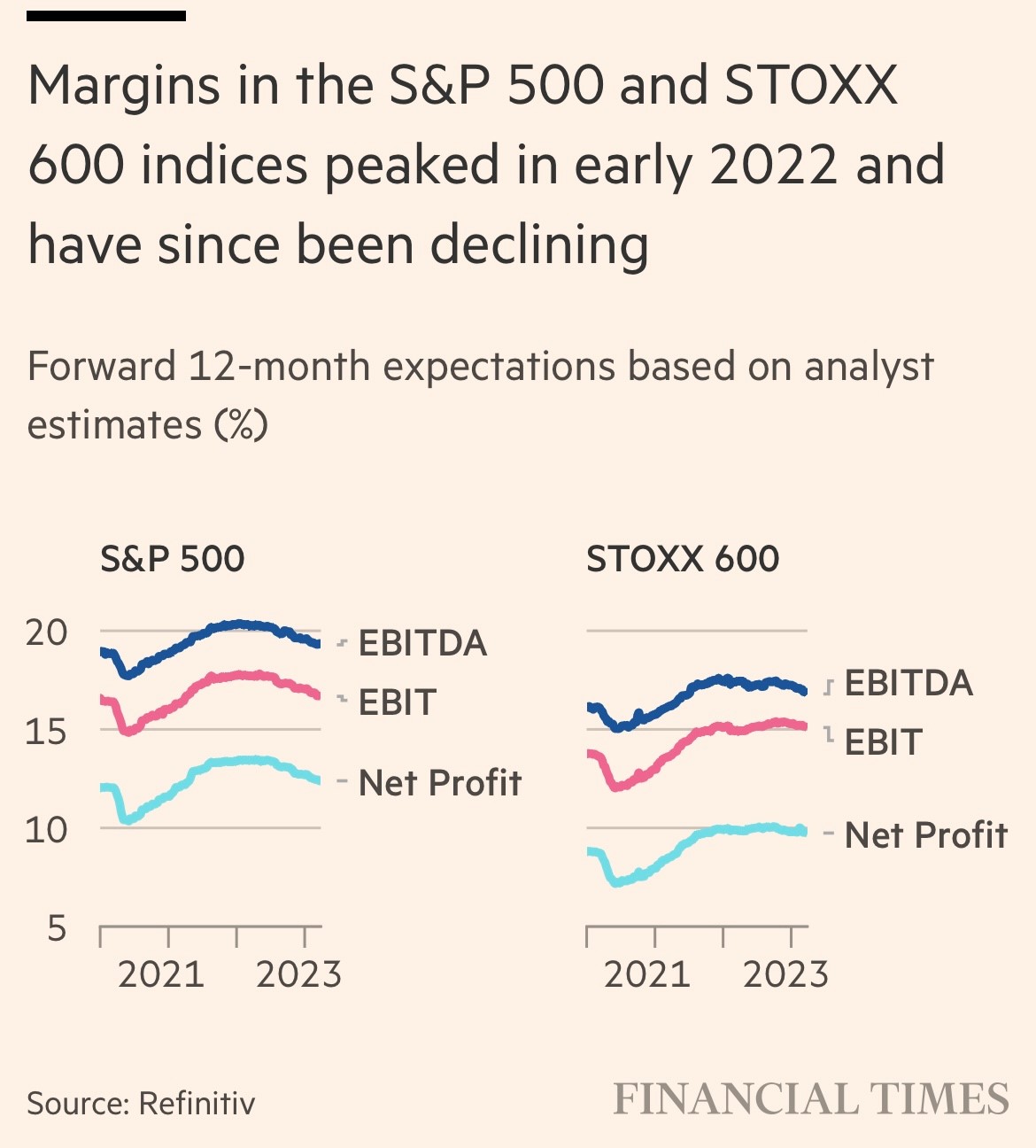
This can be clearly seen in the Financial Times margin charts, below, in the first image.
Updated on 2 April 2026.
This article is in the social section because inflation is a phenomenon that affects the less well-off social classes the most. And although it is falling, it is still very high: in Italy, grocery (large consumer packaged goods) was 9.5 % in 2023.
It should be noted that since the last update – October 2023 – and today (November 2024 was mentioned) there have been two confirmed cases of skyrocketing profits of FMCG companies: that of Pepsi and Nestlé.
Then there are the accusations of authoritative sources such as the Financial Times, which wrote in August 2024 that consumer goods companies have been at the centre of the inflationary wave that has swept through the US over the past three years.
But let’s start at the beginning: first there was shrinkinflation. Now there is greedinflation, a difficult term to translate because it is composed of greed and inflation.
In Italy we would speak of speculation.
What does greedinflationconsist of ?
In the raising of margins to make profits, more than the raising of costs due to inflation.
This is the case with Procter & Gamble: “Procter & Gamble has lifted profit margins for the first time in two years after the world’s largest maker of household goods pushed up prices for consumers in recent months at a faster pace than its own expenses rose.
The lifting of listed companies’ margins, as seen below (according to theUniversity of Massachusetts), occurred from 2020 (with the start of Covid-19) to 2022 and is hardly reportable to antitrust authorities now.
Sources claiming this has happened are now many (the Post, here, reports Bloomberg).
There is not only the Coop, Prometeia or the ECB.
But “consumer groups are optimistic after the price increase”.
Among those who say all is well are Nestlé, Pepsico, Kimberly Clark, Coca-Cola, Procter & Gamble.
And even McDonald’s , which – like the other companies – has good reason to be, just read the article below.
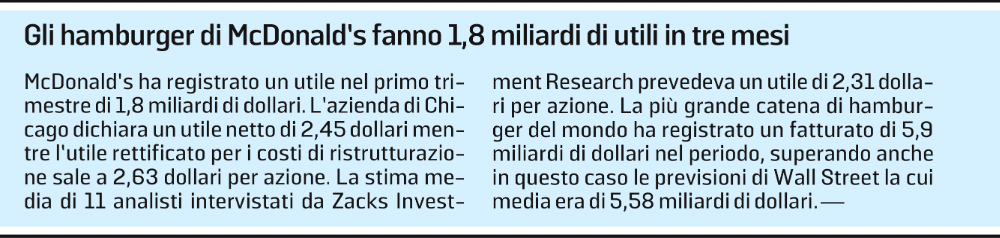
All optimistic?
Good.
But if you read the French press, for example, you find :
- the headline I have taken ‘Why industry margins doping inflation’ (Le Monde).
- the names of the producers accused on the front page. And it’s not just FMCG producers.
There are : STMicroelectronis, Stellantis , EssilorLuxottica, Renault, Nestlé again, but also L’Oréal (net result at 24% , sales at 18%). And the head of Unilever says that the group is not “profiting” from inflation but does not clarify how much its costs have risen in relation to its margins (read about it : Price doping : accusations against Algida (Unilever) of July 2023).
It should be noted that the entire oil sector, already heavily subsidised, has been favoured by the war. This is the case, for example, with Exxon.
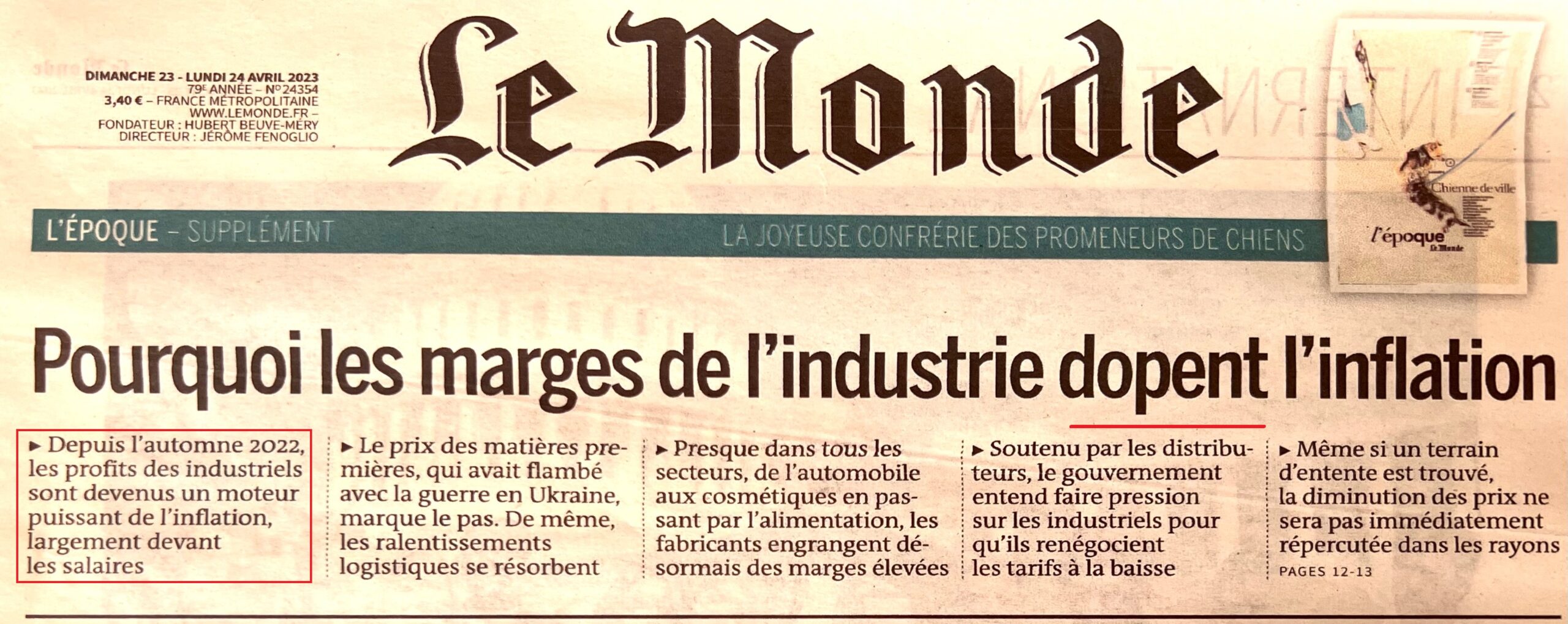
French industry’s margins have become the “engine of inflation” from autumn 2022 onwards.
The government – which had already intervened earlier, trying to steer the market – is demanding new contract negotiations(renégociations) with the French GDO this summer.
The concern in France is great because ” in the first quarter, volume purchases in the large-scale retail sector fell to -9%”.
And in Italy?
Volumes continue to fall – -5.1%, year ending February 2023. We are technically in recession but the government seems not to be aware of this.
Just as it doesn’t know about the deflation, the water crisis (which threatens agriculture) or the inflation caused by greed.
It deals with synthetic meat and insects, following the moods of the lobbies ( Coldiretti, Cremonini, McDonald’s) and distracting public opinion from the real problems.
Mario Sassi writes ‘Rising turnovers are so convenient for everyone. The government has little room for manoeuvre’.
On the first concept I agree, even if the ‘triumphalism’ of Confindustria on Italian GDP growth (also stated elsewhere) is annoying.
On the second , I believe instead that the opportunities to control and influence by the government were there, during Covid-19, but they were ‘lost along the way’ (I enunciate the possible means: price observatory at the Ministry of Agriculture with greater coordination and powers to the authorities in charge. But perhaps, in addition to the French examples – which I know well – there are others).
Successive governments in Italy in recent years have not considered the agriculture-processing-distribution sectors as strategic. And, for the moment, I do not see a reversal.
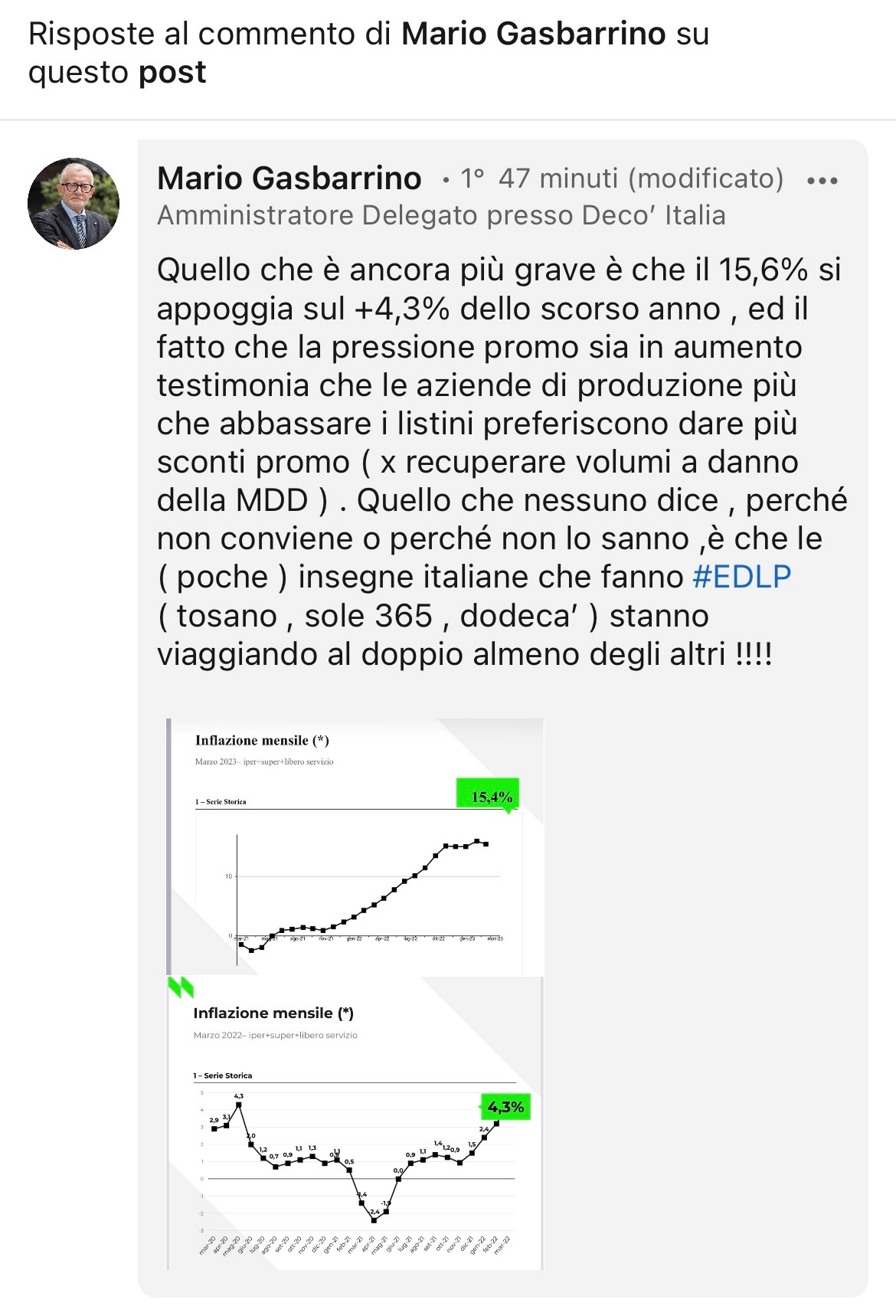
The newspapers talk about these issues from time to time and the producers, instead of lowering their price lists (to the distribution), ‘do more promotions’ ( giving a windfall of promotional contributions to the GD and – indirectly – to consumers) in a context of inflation – over two years – of 20% (see Mario Gasbarrino ‘s post (*), below).
And to me personally, this affair reminds me of the advent of the euro, when I was at Esselunga: the suppliers, in that case, were anticipating the inflation (real or presumed), which should have manifested itself with the advent of the new currency.
Some suppliers were so ‘careless’ as to put it in black and white… and I had to report it to Centromarca (Confindustria).
In this case, nothing was anticipated but one ‘followed the wave’. And turning back becomes impossible: although inflation in Europe fell below 2% per year in September, prices have not fallen. Stable for fifteen years, the price of eggs and pasta has exploded by more than 20% and will never return to its 2020 level.
(*) MDD : private label, EDLP : Everyday Low Prices, NO promotions.
And finally: Dear prices, towards sweeping inspections by the tax police against speculation (a bit of a show to show that ‘something is being done’…).
Read also these updates:
Istat : households’ purchasing power falls, companies’ profit rates rise
US FTC (antitrust) charges: GD exploited its power during Covid-19 pandemic
Consumer goods companies: at the centre of the inflationary wave that has been sweeping the US over the past three years (July 2004). And the loss of purchasing power of
americans was one of the determining factors in Trump’s election.