Compiled 7 March, updated 26 March 2026
Foreword:
this is not a ‘summary’, these are Massimo Giordani’s notes on the subject, on which I have grafted my own vision, in view of the event held in Bologna, in the former Fico- Eataly premises on 3 March . Read what Oscar Farinetti had to say about e-commerce.
On these topics you can watch the video and read some articles.
My thoughts will be completed on 18 March, in Parma.
THE FUTURE WE IMAGINED
E-commerce food today
3 March, Grand Tour Italia
Via Paolo Canali 8 – BOLOGNA
Foreword:
- five years ago with Mario Gasbarrino and Cristina Lazzati I said ‘Dwarfism is a condemnation’ . And since then it seems to me that nothing has changed in the Italian GD.
Let me explain myself better :
e-commerce in this country has grown from 2012 to today (2025) by 15.4% (annual average), from €9.5 billion to €62.3 billion, but I do not see any ‘big players’. Apart from Amazon and perhaps Esselunga.
Neither of them, however, is ‘complete’: the first remains strong in non-food, the other has missed the train to become an Italian-style marketplace,
- According to Polimi: e-commerce at 7% – so there has been a slowdown compared to previous years, but the figure on shop closures is striking: – 2.8% in 2025.
- And it is not just a non-food problem: some say there are 3,000 too many shops in Italy (Mario Sassi).
While there is a lack of distribution coverage in many areas (agricultural, mountainous) and a shortage of 20,000 workers.
- Again according to Polimi, products have twice the turnover of services, but since the share of e-commerce is low, there are great OPPORTUNITIES, which have not yet been seized.
- In December 2025, Le Monde headlined ‘AI star of Black Friday in the US’
Black Friday at 4.1%, stable in shops, up 10% on the internet.
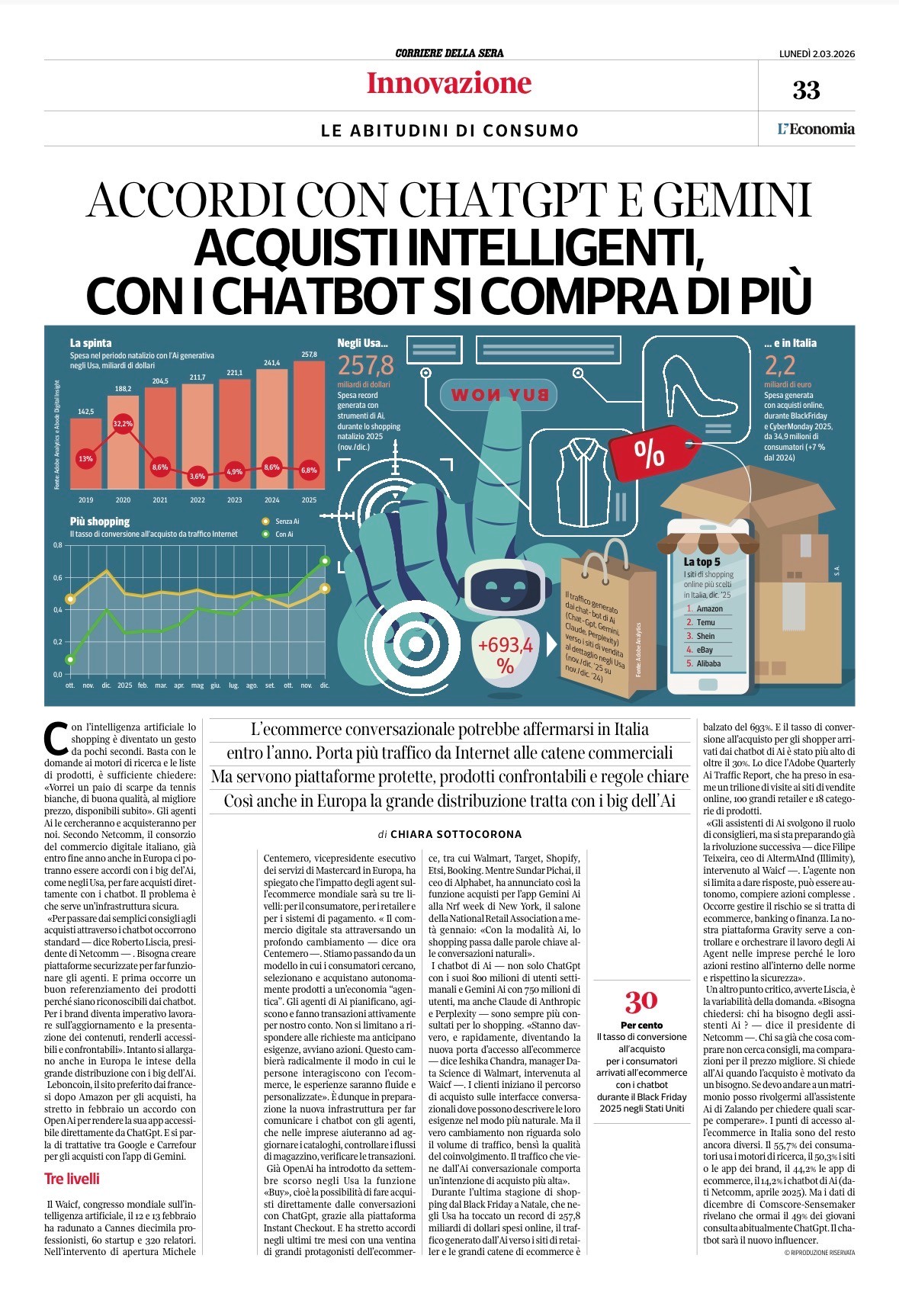
But the most interesting statistic is another: according to Adobe Analytics, traffic to retail sites from ChatGPT, Gemini, Perplexity… increased by 805% by 2024.
Sites are not only losing traffic but risk being challenged by ‘autonomous agents’ who will assess how sites can improve their offerings, perhaps by comparing two products based on our purchase history.
Obviously everyone will think ‘this is the non-food world’… but I sincerely believe that the food world will get there too, sooner or later, at least on the grocery side, where one could – for example – compare products or baskets of products, finally bypassing obsolete price surveys like the one by Altroconsumo.
The US Black Friday gave us another interesting statistic: a 30% conversion rate to purchase for consumers who came to e-commerce with chatbots during Black Friday 2025 in the US.
I demand
According to various industry analyses (Politecnico di Milano, McKinsey, BCG), the real issue today is no longer ‘opening’ e-commerce, but making it sustainable: fullfillment costs, promotional pressure, increasingly high service expectations.
If you had to indicate the ‘second threshold’ to overcome for food e-commerce in Italy, what would it be?
Answer
When we talk about food e-commerce, the first step was almost inevitable: proving that it could be done.
We learnt how to take online orders, prepare complex shopping, deliver them on time, ensure minimum quality, handle peaks in demand – especially during the pandemic.
That threshold, to a large extent, has been crossed.
The second threshold, however, is much more difficult and decisive:
making e-commerce structurally sustainable within the food retail model.
I remember that Esselunga’s operating result at home, in 2013, was 7.9 per cent (per 100 million turnover, approximately). Then, probably, with the advent of Amazon and other operators, margins were lost. Also because nobody thought of a subscription system, like those of Amazon and Walmart.
The result was nevertheless exceptional when you consider that Esselunga did not have, at least at the time, an integrated model linking supermarket logistics, e-commerce logistics, the fidaty database, promotions, payments, etc.
It is not just a question of lowering delivery costs or optimising logistics.
It is a question of rethinking the overall model with which we do retail.
I see it on three levels…
1. Fulfillment – how we organise the system
…
The problem is that there is still no truly scalable standard for Italian grocery.
Some models work well in some cities and collapse in others.
Others work for some assortments but not for all.
This means that food e-commerce, from an operational point of view, is still at a stage of model research rather than consolidation.
If online succeeds in doing this, it stops being a digital copy of the supermarket and becomes a truly superior service.
2. Promotions and pricing – how we finance the channel
In many cases, food e-commerce has grown – ONLY – thanks to discounts
3. Value for the customer – why choose online
You have to offer a different and better experience, on at least three dimensions:
- Smart personalisation
A shopping cart that understands the habits of the family, suggests consistent products, reduces errors and waste. - Useful, non-invasive advice
Recipes, sustainable alternatives, better quality or healthier products – not just commercial push. - Real time savings
Not just avoiding the queue, but simplifying complex decisions: what to buy, why, in what quantity.
E-commerce should not be a nuisance but should be seen as an opportunity, to be developed with passion
Below: 49% of young people habitually consult ChatGpt for their purchases. From Bain’s data it is clear how chatbots, for Generation Z, have now taken over.
The question
If we look at European benchmarks, in markets such as the UK and France online grocery is now worth between 10 and 15% of the total, while in Italy we are around 6-7% (Eurostat, IGD, B2C eCommerce Observatory – Politecnico di Milano).
From your observatory, do you feel today that the Italian delay is mainly a question of channel scale or that the real gap has shifted to how e-commerce is done: quality of service, economic sustainability of the last mile, intelligent use of customer data?
…
1. Operational maturity
It is not a ‘parallel channel’, it is one of the normal ways of doing retail. Here I am reminded of the example of Casino’s owner, Guichard, who was persuaded to do hypermarkets but when he entered them he skipped the non-food aisles because he didn’t like them!
And he didn’t like them not because non-food was losing money but it was a cultural issue.
Non-food, in Esselunga, gave 1/3 of the RO but ‘didn’t like it’.
Fresh, they were considered – rightly – fundamental but, depending on the year, they were losing.
How could e-commerce – to be considered as an INVESTMENT, though – cross-over with home delivery to bring in new customers, in an ageing country that will have large portions of its territory NOT covered by GD and DO…
These are investments for the future where the silver economy is already dominating.
- Last mile and cost of service
until we find more stable and efficient logistics models, e-commerce food will remain more of a laboratory than a pillar of business.
- Use of customer data – herein lies the real lag
Needless to entrench oneself behind European privacy ties, the commercial offer on one’s customers, those who have given their consent can be customised as Ahold Delhaize has done:
Ahold Delhaize built a proprietary digital platform – bol.com in the Netherlands and Peapod Digital Labs in the US – operationally separate from the management of the physical shops, but integrated in the data. In practice, they have created an in-house technology team that develops algorithms for recommendation, assortment management and customisation, without depending on third-party platforms such as Amazon or Shopify.
The key point is not that they have done everything themselves: they have also acquired start-ups and made partnerships, but always maintaining ownership of the customer data and control over the algorithm.
For an Italian retailer, replicating this essentially means three things: investing in a proprietary data platform (even in the cloud, you don’t need a huge structure), building or acquiring in-house data science skills, and stopping treating e-commerce as a secondary IT project – it has to be considered a strategic business unit in its own right.
QuestionIII
In recent months, also in the international debate, the focus has been shifting away from ‘classic’ e-commerce towards commerce increasingly mediated by artificial intelligence: recommendation engines that anticipate needs, assistants that build the shopping cart, up to the first agentic commerce models that act in the place of the consumer.
From your point of view, this shifts the centre of gravity of power: no longer just who controls the logistics or the platform, but who controls the algorithm that suggests what to buy.
Do you see here a great opportunity for food retail or the risk of a new disintermediation, in which the relationship with the customer increasingly passes through external technological layers?
1) Own – or at least co-design – your own intelligence layer
How not to cede the steering wheel of AI to third parties?
The practical answer is not to do everything in-house, but not to outsource key decisions. A retailer can use third-party technologies (Google, Microsoft, specialised start-ups) for the infrastructure, but must retain control over three specific things: customer data, recommendation rules (what to suggest and why), and the direct relationship with the end consumer.
A concrete example: you can use an external AI platform for logistics or stock forecasting, but you should never let an external algorithm decide what appears in the customer’s shopping cart without the retailer having a say. That is where the relationship and the margin is at stake.
Whoever controls the intelligence that suggests products actually controls the relationship with the customer.
2) Using AI to improve the customer’s life, not just to sell more
There is a moral and strategic distinction here.
AI can be used in a predatory way – pushing only what yields the most to the retailer.
Or it can be used in a useful and responsible way.
For example, it could:
- suggest recipes consistent with what I already have in my fridge, reducing waste;
- help me plan my weekly shopping in a healthier and more efficient way;
- advise me on better alternatives in terms of quality or sustainability;
- adapt the assortment to the real habits of families in the neighbourhood.
In this case, AI is not an aggressive sales engine, but a daily ally of the consumer.
And when the customer perceives this, trust grows – and with it loyalty to the retailer.
3) Making AI transparent and trustworthy
Retailers cannot totally delegate algorithms to external platforms.
They must develop, or at least co-develop, their own recommendation systems:
- that know their customers,
- that reflect their values,
- that take into account the local context, product quality, supply chains.
It does not mean doing everything in house, but not ceding the steering wheel to third parties.
It means:
- explaining, at least in a simple way, the criteria for recommendations;
- avoiding hidden manipulations;
- showing that the choice is not only driven by margin, but also by quality, health, sustainability.
Without trust, AI becomes suspect.
With trust, it becomes value-added.
Who designs the algorithm and with what values? Can retailers do it?
Technically, today yes, the tools exist and are accessible even without being Amazon. The real crux is not technology, it is strategic will and organisational culture.
We need management to stop seeing IT as a cost and start seeing it as a competitive asset. We need to build, or attract, internal data science skills. It is necessary to accept that results are not seen in the quarter, but are built over the years.
The investment in platforms and IT reminds me of an episode with ESD Italia: two partners came to see our automated warehouse. They came out saying ‘too expensive’. Therein lies the cultural problem of our country.
P.S.: Rewe has just opened an AUTOMATED logistics platform for FRESH products..
And you need, above all, to be clear about your values before you even write a line of code.
Because the algorithm does not invent them: it executes them. If you don’t know what you want to be as a retailer, the algorithm won’t tell you. Someone else will decide it.
You can read about Walmart and the InHome service here. Or here. Read also E-commerce grows 13.1 per cent while sales in physical shops grow 1 .6 per cent.
Mario Gasbarrino added a very important sentence: ‘if you want to commit suicide, don’t do e-commerce’.
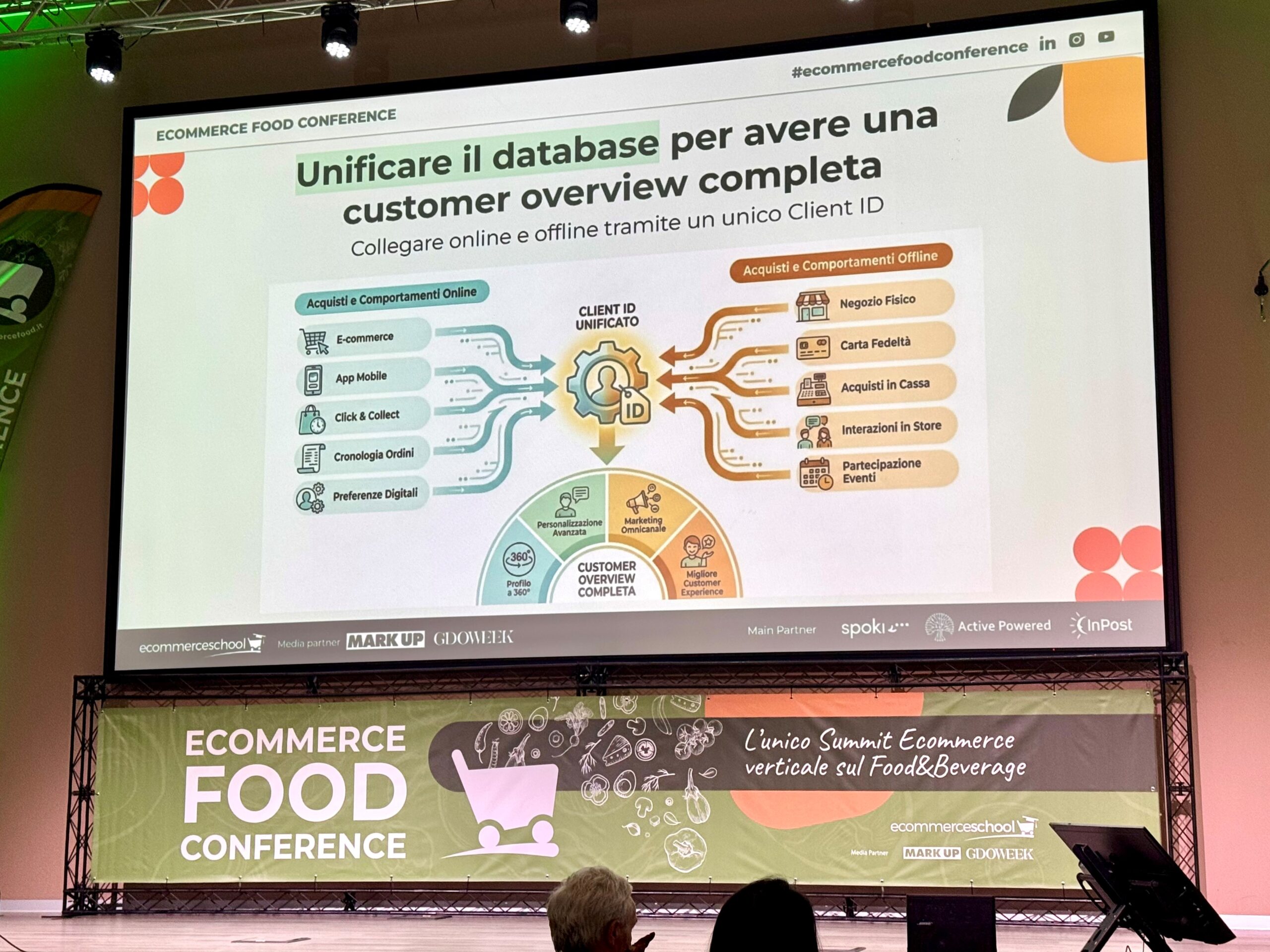
Below: a slide by Marco Biasin that says one fundamental thing: we must unify the database