Compiled 28 August, updated 17 December 2025
1027 shops, 642 of which are direct, will change hands to the former Newlat. The transaction is worth EUR 1 billion. The Gs brand will be relaunched and New Princes gets the green light from the EU Commission for Carrefour Italy (December 2025).
Everything and more has been read on this subject, my ‘technical’ opinion I have already written: much will depend on the skills of the management team. Mario Gasbarrino and I have explained this together in this article.
You can’t improvise distributors and above all it is not always the case that aggregating several realities, with different cultures, brings strength : the acquisition of Newlat reminds me of the vicissitudes of Standa and those of Auchan-Conad
For the former: the judgement on Standa, which had moved from non-food to supermarkets, had never been good since its inception.
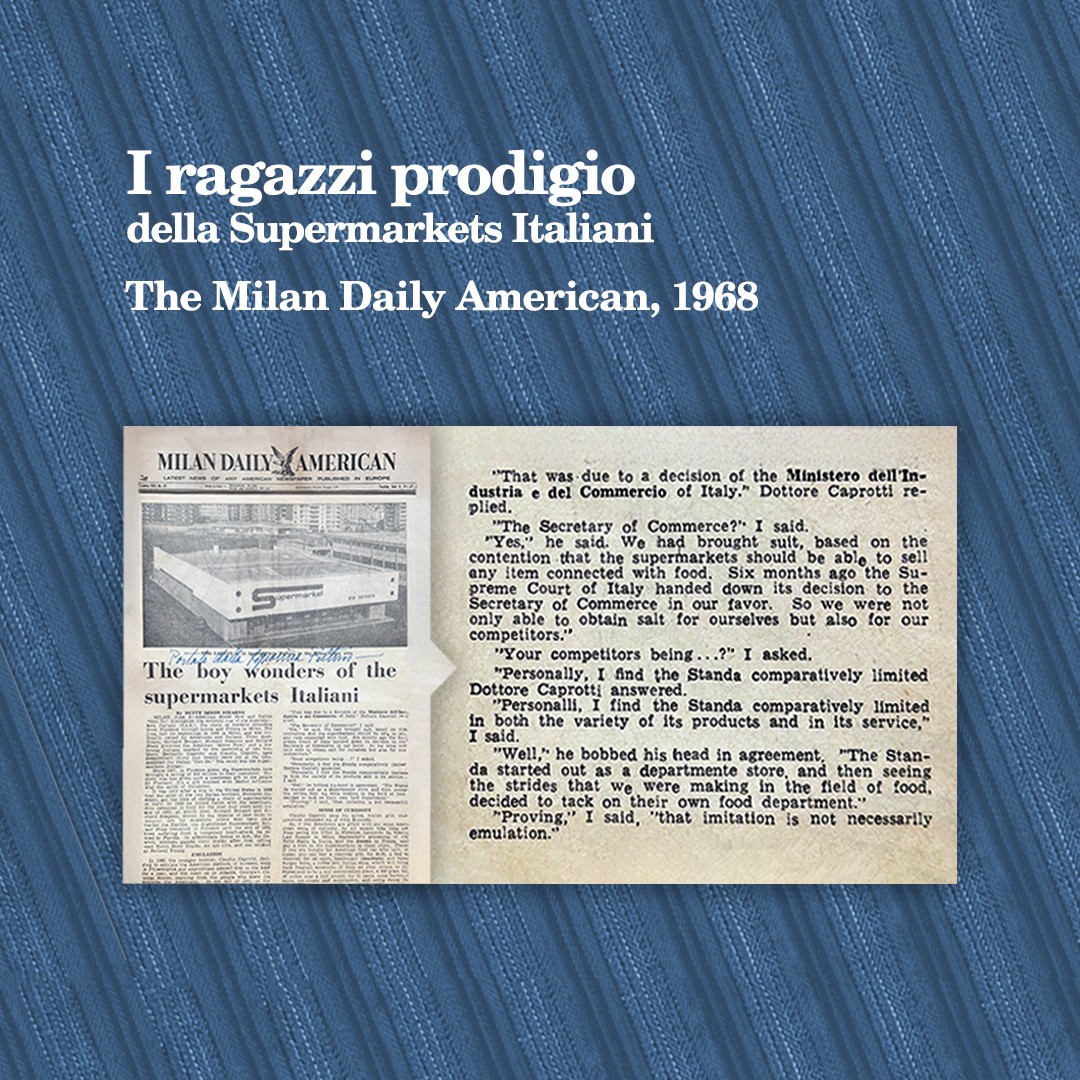
I could write an essay on the subject but I will just quote what Claudio Caprotti said about it in 1968: “Personally I find Standa relatively limited” (both in the variety of its products and in its service),
When I joined Esselunga in 1986, Standa looked like “the poor man’s department store” but if it did not have a clear identity on the other hand it had very high prices, which as a buyer we point out. After being fairly successful, partly because it had no competitors, it went into a phase of clear decline. And that’s when Silvio Berlusconi took over, thinking that ‘different’ trades could be made by aggregating companies with very different logics and cultures. He does this by putting together the still existing group but does not replicate the same success in distribution.
- 1. “Ofelè fa il to mestè” (pastry chef, do your job, in Milanese)
“When [Giulio] Malgara works at Quaker Oats, which owns Chiari & Forti, he will come to see me in Chicago. He is a great friend of Silvio Berlusconi, who at that time is buying Standa and wants to see if he can buy Esselunga and put the two together. Malgara, taking me to dinner at Bice‘s, which had just opened in the city, tries to understand the business intentions of Bernardo Caprotti’s son’ (page 137 of Le Ossa dei Caprotti, Feltrinelli 2023). The operation failed, Berlusconi bought the Brianza supermarkets and Standa was later closed. Not to mention the lesson of the failure of Sears or that of the closure of Dominick’s for manifest incompetence.
- 2. the ‘big retailer’ does not make the best retailer, and the best examples of this are the French retailers Auchan, Casino and Carrefour where, even today – much confusion reigns. Other examples of failed aggregations that I remember are Promodes – Carrefour and Walgreens- Boots.
Many fear a possible effect on the new entity acquired by Mastrolia.
Among the various analyses, I liked this one: From Carrefour to the return of GS: vision or utopia?
“…I was intrigued by the ‘supply chain pact’, as Mastrolia called it, as a new model in relations with producers by the reborn GS. Creating value from the industrial products that Newprincess has in its portfolio, rather than from conflicts over prices and conditions, is certainly suggestive but, here again, it lacks even a hint of how it will manage the conflict of interest with its current large-scale retail customers. He mentions the Luxottica model, which has integrated industrial production with terminal distribution, (Max Mara, to tell the truth, had already done this a decade earlier), but in order not to generate too many conflicts with other customers one must have very strong brands and growing business, otherwise one risks being boycotted. NewPrinces’ food portfolio actually has more than thirty brands, but only a few were strong and moreover in businesses now in decline, such as baby food. Without dwelling too much only on the concrete issues, it is certain that redesigning the rules of engagement with distribution on the basis of value would appeal greatly to our fruit and vegetable supply chain, which is increasingly crushed by price logics. That is why, despite the objective difficulties highlighted, we are rooting for Mastrolia in this area ‘.
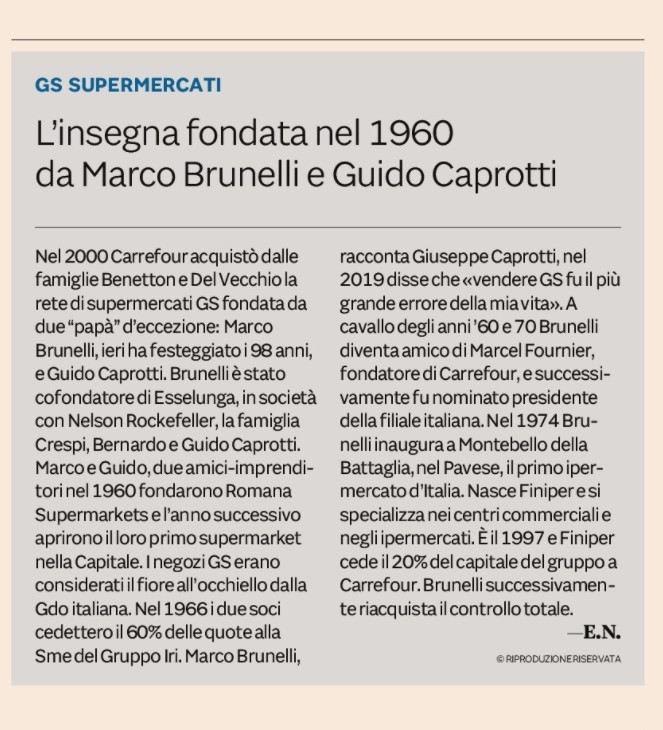
Below: Marco Brunelli thought he had made a big mistake by selling GS to the Italian state because, at the time, before IRI took over, GS was the Esselunga of the South. A decidedly brilliant company (the article is from Il Sole 24 ore of 3 December 2025). You can read more about Guido Caprotti here.
Conclusion:
in essence, the author of the above analysis, Roberto Della Casa, criticises the operation and then, however, cheers for Mastrolia’s purchase of Carrefour.
I’m afraid it doesn’t work that way. Many people on social media had positive emotional reactions to the GS brand – and thus to Mastrolia’s takeover of Carrefour – but few remember how badly managed the company was. I unfortunately do, the advertising gingle ‘at GS you also come cheaper buy more’ had been transformed into ‘at GS you also come cheaper buy more’. GS’s price level at the time was not on a par with Standa’s, but it was close. And that’s just one example, a nice piece could also be written on GS about the ‘mala gestio’ of the group that passed from Marco Brunelli, with his uncle Guido Caprotti, into state hands.
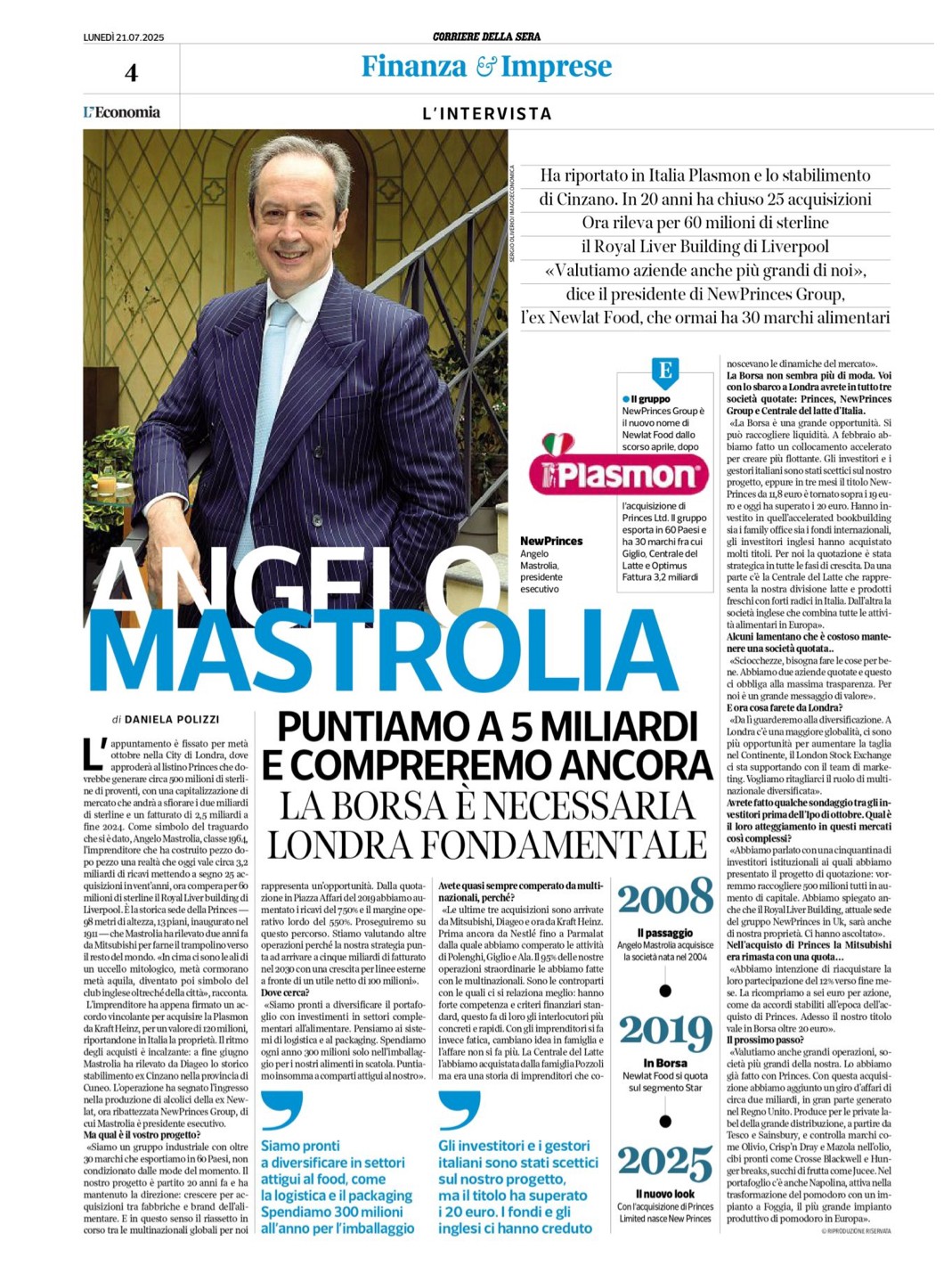
So I prefer Mastrolia in the supplier version of GD, as in this interview a few days before the announcement regarding Carrefour. The difference ‘between cheer and reality’ can also be found in this article.
Read also :
Mastrolia: about the acquisition of Carrefour Italy
NewPrinces’ black week: -17% on the stock market. Princes Group’s discount ipo takes its toll.
Mastrolia (NewPrinces Group): ‘If the net-net works with Lidl, it will also work in Italy’
Carrefour – Centromarca clash: is Mastrolia playing the populist?