Compiled 18 March, updated 21 March 2026
Giuseppe Caprotti: ‘From trolleys to history, the fortune of living more lives’
by Cloe Piccoli
Giuseppe Caprotti
“In my long apprenticeship I was also a worker in a Carrefour in São Paulo. In 2004 the radical break with my father: we had opposing visions, methods and values‘
Updated 18 March 2026 at 11:33 3 minutes read
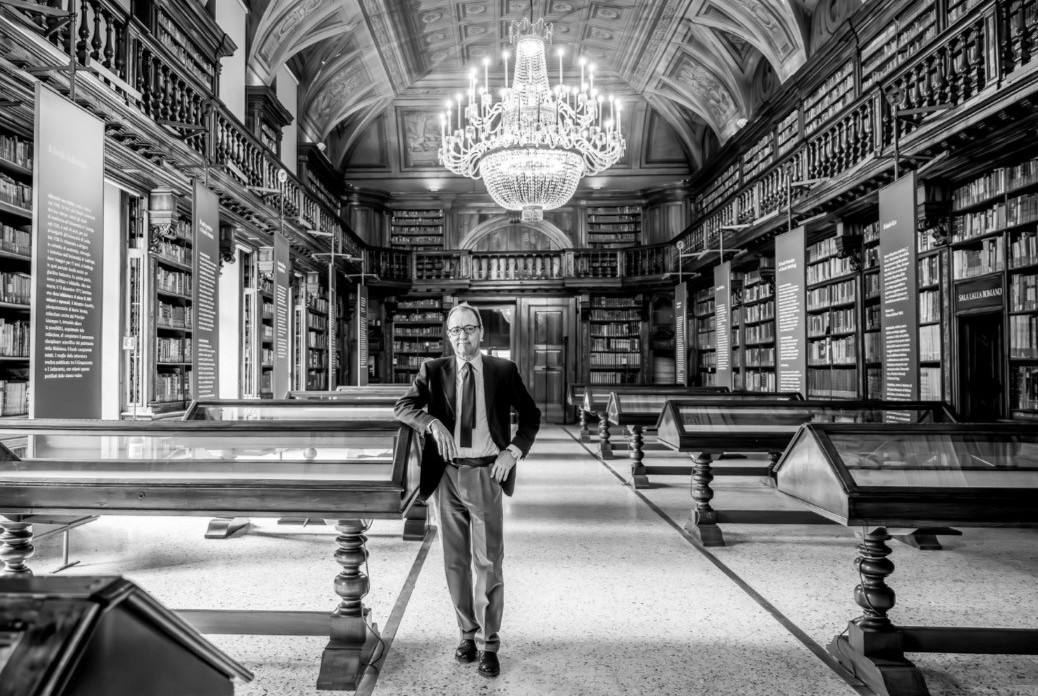
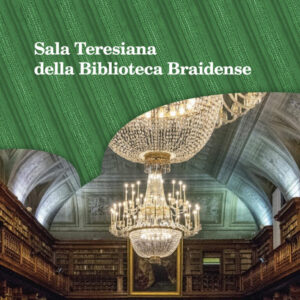
The meeting with Giuseppe Caprotti is at the Braidense library in the Brera Palace. We catch up with him in the Sala Teresiana of this masterpiece by architect Piermarini dating back to 1785, studded with precious bookcases containing volumes with ribs that exude history and culture. Heir to three of Milan’s and Lombardy’s most important industrial dynasties – the Caprotti, Venosta and Quintavalle families – Giuseppe Caprotti is a historian with a degree from the Sorbonne in Paris. One of the aspects of history that most fascinates him is that moment when epochal events, major economic, political and social events intersect with the destinies of families and individuals. Thus, in his book Le Ossa dei Caprotti (Feltrinelli, 2023), the stories of his family intersect with the industrialisation of Lombardy. In the book, epochs and generations distil the textile industry in this part of Italy, and then the birth and rise of Esselunga founded by Bernardo Caprotti, Giuseppe’s father, who worked there for almost twenty years, his last in the role of managing director. The story at Esselunga, has an epilogue worthy of a film, with a radical clash between father and son: Giuseppe is blatantly dismissed from the company he had contributed to building with great passion and with social and cultural projects.
It is 2004 and every end also marks a new beginning. Giuseppe Caprotti has always loved history, books and archives. In his home in Albiate, Brianza, he keeps the archives of the Airoldi di Robbiate family, the counts from whom the Caprotti family bought the villa, and then the archives of his mother Giorgina Venosta, his grandfather Guido Venosta, a fundamental entrepreneurial figure for Airc whom he supported from 1966 together with a young oncologist named Umberto Veronesi, and Carla Venosta Fossati his grandfather’s second wife. Today, he is president of the Guido Venosta Foundation, which develops important cultural, social and environmental projects such as the reforestation of part of the Lambro Valley Park, which, subject to authorisation and indications from the Park itself, would see the planting of a thousand new trees, while he is vice-president of the Società Storica Lombarda with which he supports special history courses in Milan’s high schools. The historian’s precision, love of detail, and passion for all that is art and culture, inspired by his mother Giorgina Venosta who always loved and worked in art, can be found in his books. He is writing the latest one right now.
Let us start at the beginning.
“I was born in Milan and grew up in Albiate in Brianza. At school age we returned to the city to the house in Via Del Lauro in Brera. And then from there I studied abroad, in the United States and France: Political Science and History at the Sorbonne. I graduated in History and then returned to Milan and went to work at Esselunga. It’s 1986. I start from the gavetta. Imagine that for a while I even worked as a worker at Carrefour in Sao Paulo, Brazil,to gain experience ‘.
Of course there is a certain difference between the study of history and large-scale distribution..
“History in my opinion has two great merits: it makes you see the future and the economy. Two aspects that I have seen at Esselunga. But not only that, I have always been interested in sociology [I even took a sociology exam in my path as a ‘historian’], in observing and following society, and large-scale distribution is a privileged observatory on how society evolves , how it moves, how it changes. So it became a passion. I loved selling, being in contact with customers, with people. We were customers too: as a child in the 1960s my mother used to put me in the trolley, we went to the Esselunga in Viale Regina Giovanna’.
Can you tell us about your beginnings at Esselunga?
“I started training in 1986 in Milan, but shortly afterwards in 1988 I went to work for two years in Chicago where I studied American large-scale distribution, I learned what a loyalty card was, how to manage a shelf using modern methods, how to make a superstore. Back then, we had small supermarkets, in Viale Regina Giovanna, Viale Piave, Via Bergamo, Via Cagliero, Via Pezzotti, rooted in the urban fabric with good stories. But at a certain point we realised that we had to enlarge the format‘.
How is it proceeding?
“We are opening superstores: I bring experiences from America, such as wine shops and the sale of fruit and vegetables in bulk. And then from France the cheese and cold cuts counter in front of the delicatessen. And then I introduced home shopping that was done by fax, there was no internet yet, Google was born in 1998′.
What was life like in Milan in those years?
“I worked with my father but then outside of work there was my mother’s large family. With my grandfather Guido Venosta, with whom I always had a special relationship, and his brother Gigi Venosta, a hockey champion. My mother worked in art first at Christie’s and then in the company she opened. It was with her that I started to love art. She was friends with Vico Magistretti, Pierluigi Cerri, Gae Aulenti, Ettore Sottsass, Vittorio Gregotti, Michele De Lucchi, who frequented our house. His first partner after the divorce was Guido Somarè a very special artist, I still have some of his works. With Guido we used to go to Lindos, a town on the island of Rhodes, in the summer. Then my mother married Aldo Bassetti who was president of the Friends of Brera for years, with him I started to love Brera and a few years ago I supported the restoration of the crystal chandeliers in the Sala Teresiana’.
In 2004 the radical break and his exit from Esselunga. What happened?
“Opposite visions of different generations, method, values. One day I received a phone call from the personnel director telling me that my father had called a meeting. It was January. The next day I go into the company, park and see the white guard like a rag. There are four black Mercedes with their engines running. The first three have blatantly escorted my three most trusted employees out. The fourth left empty. I got the message. I never came back’.
What will we read about in your new book?
“I tell another side of the family through two extraordinary explorers: my eponymous ancestor Giuseppe Caprotti, who lived thirty years in Yemen, and my great-uncle Gianni Albertini, a skier and mountaineer who explored the North Pole.”