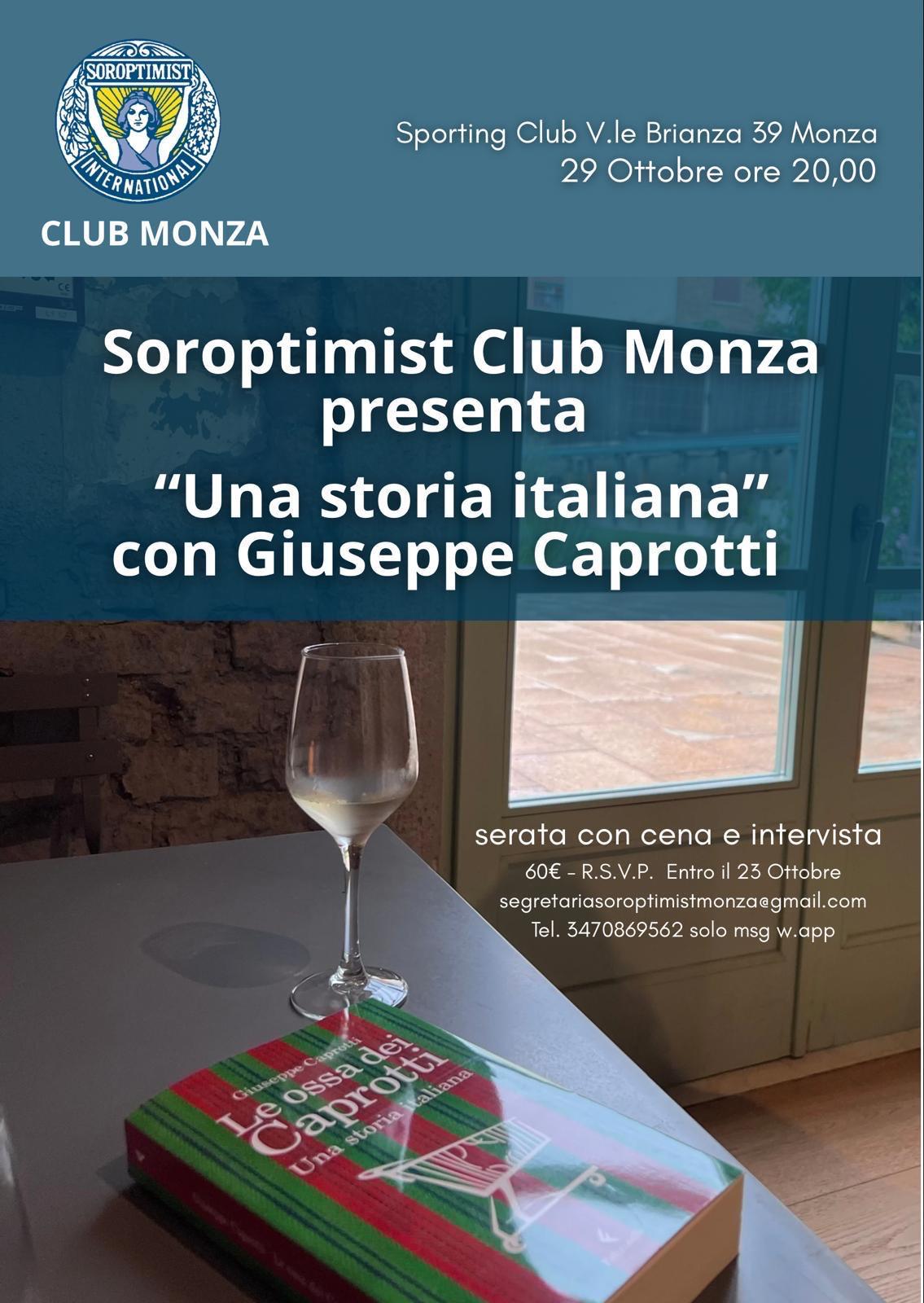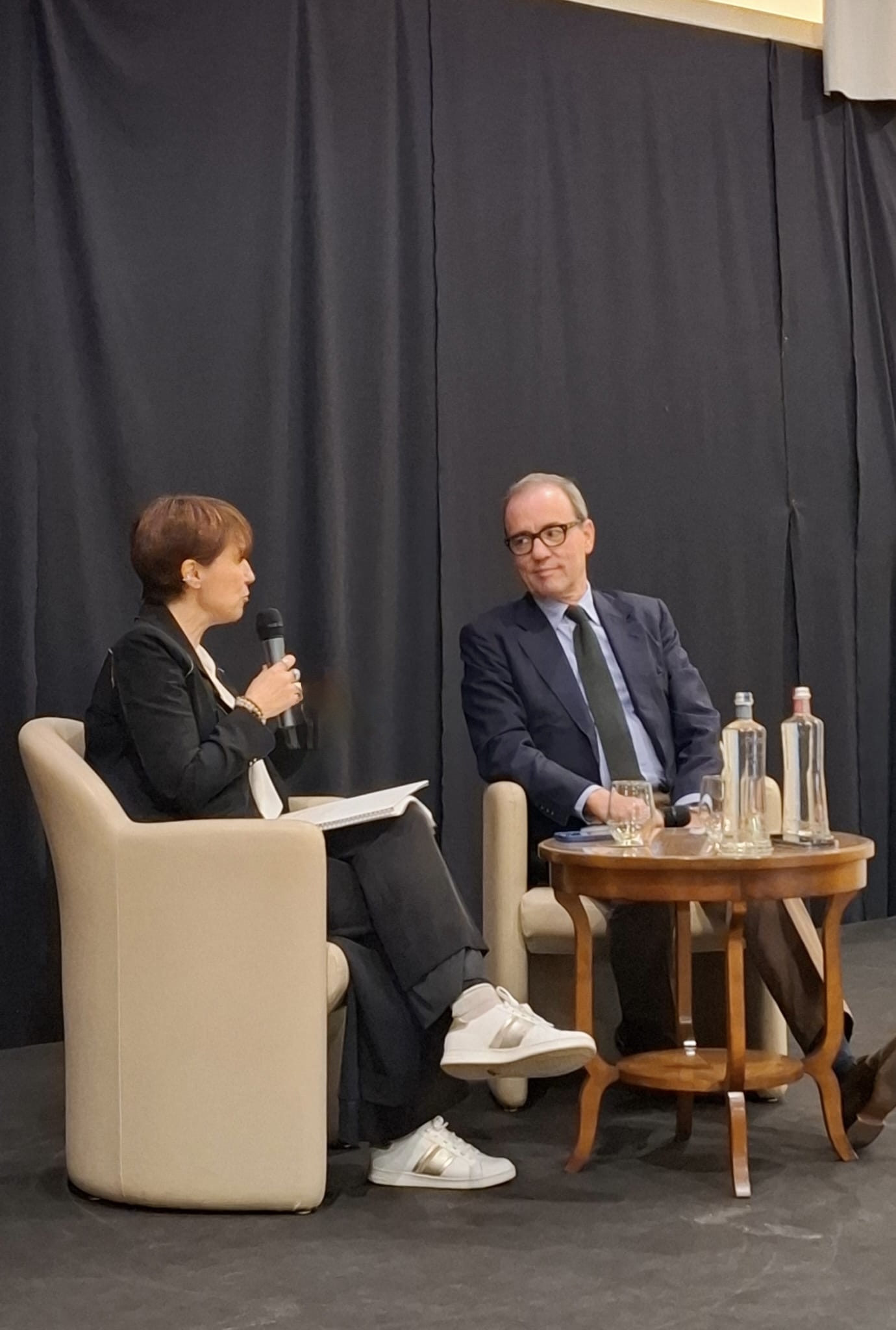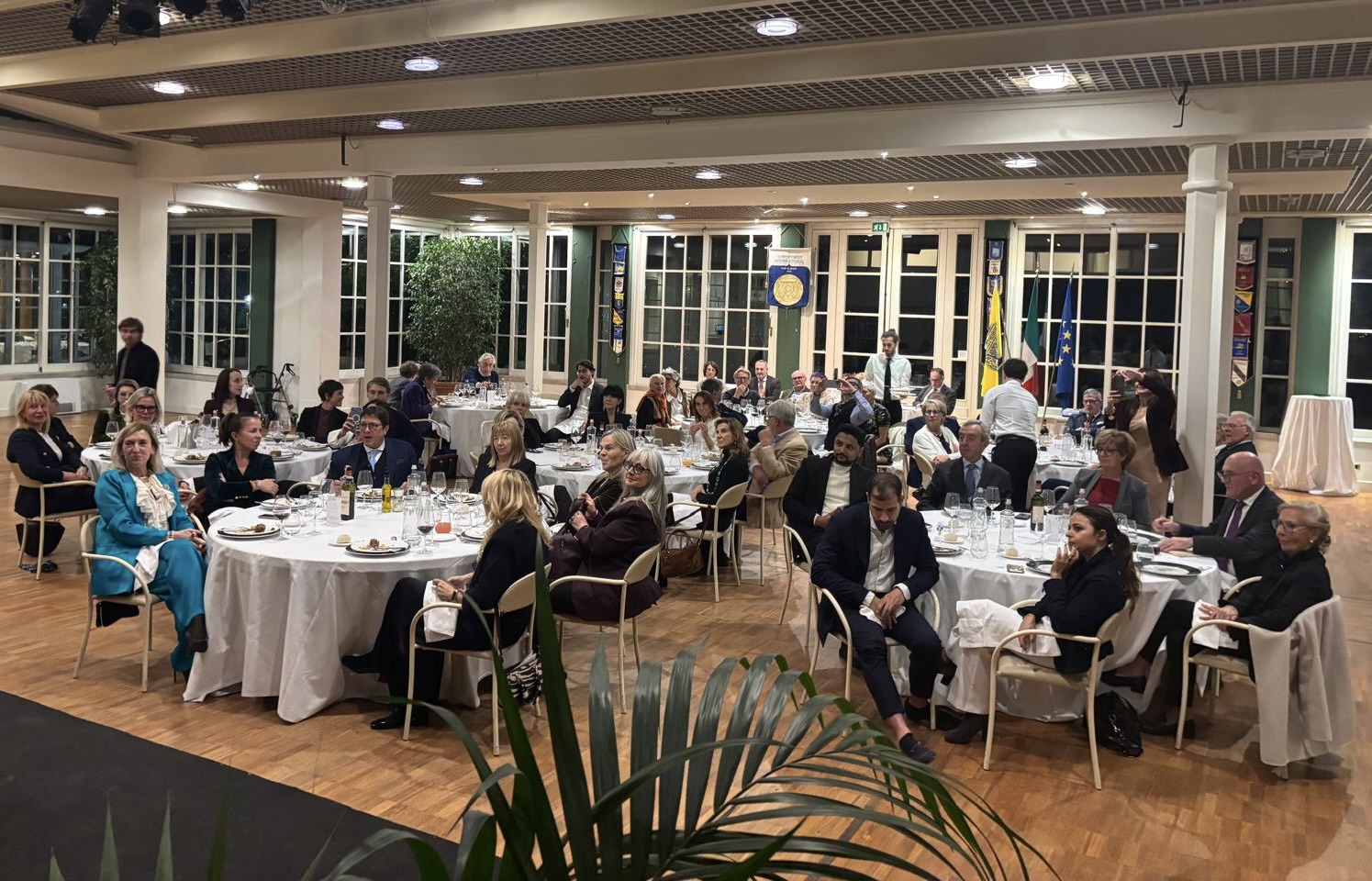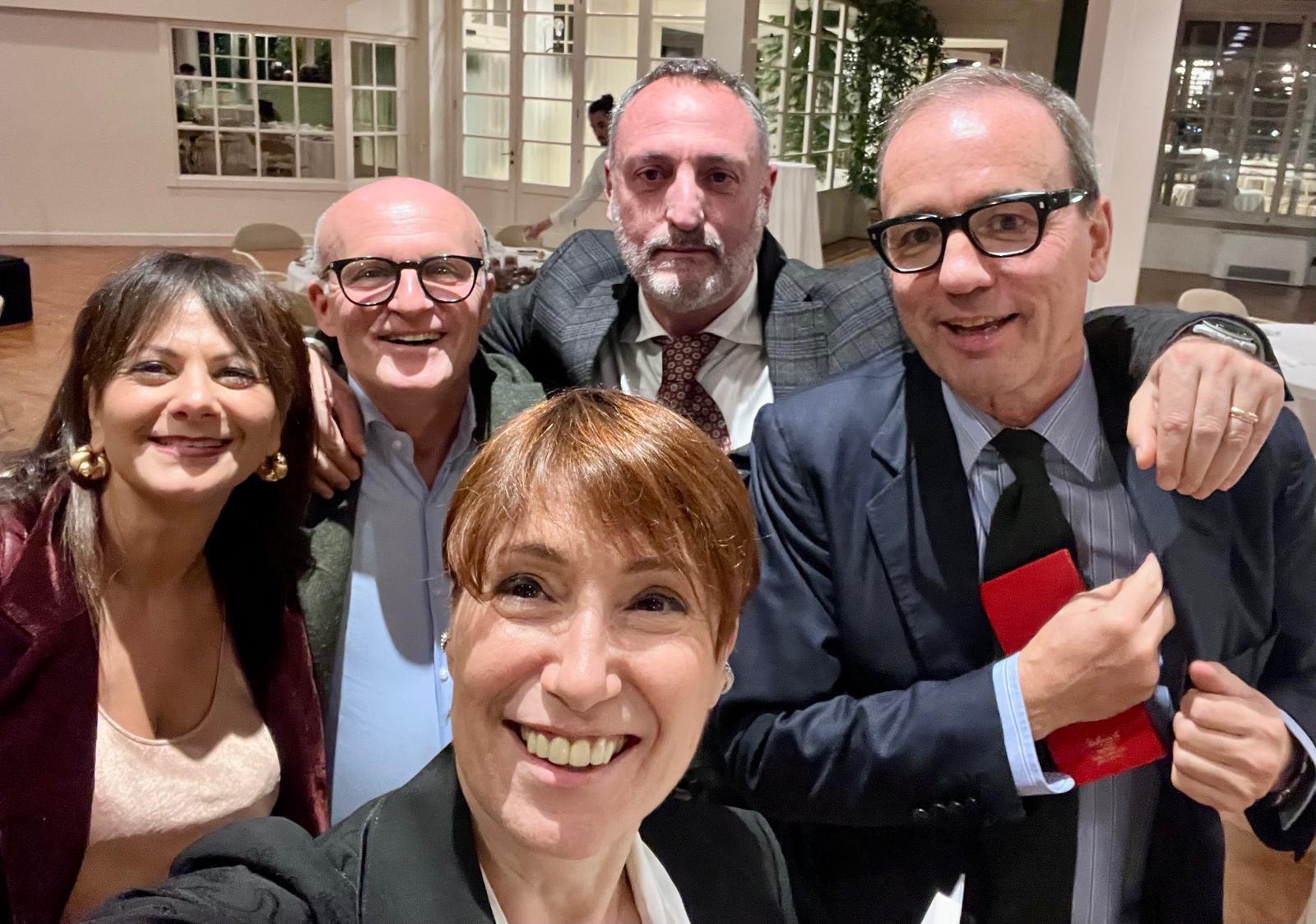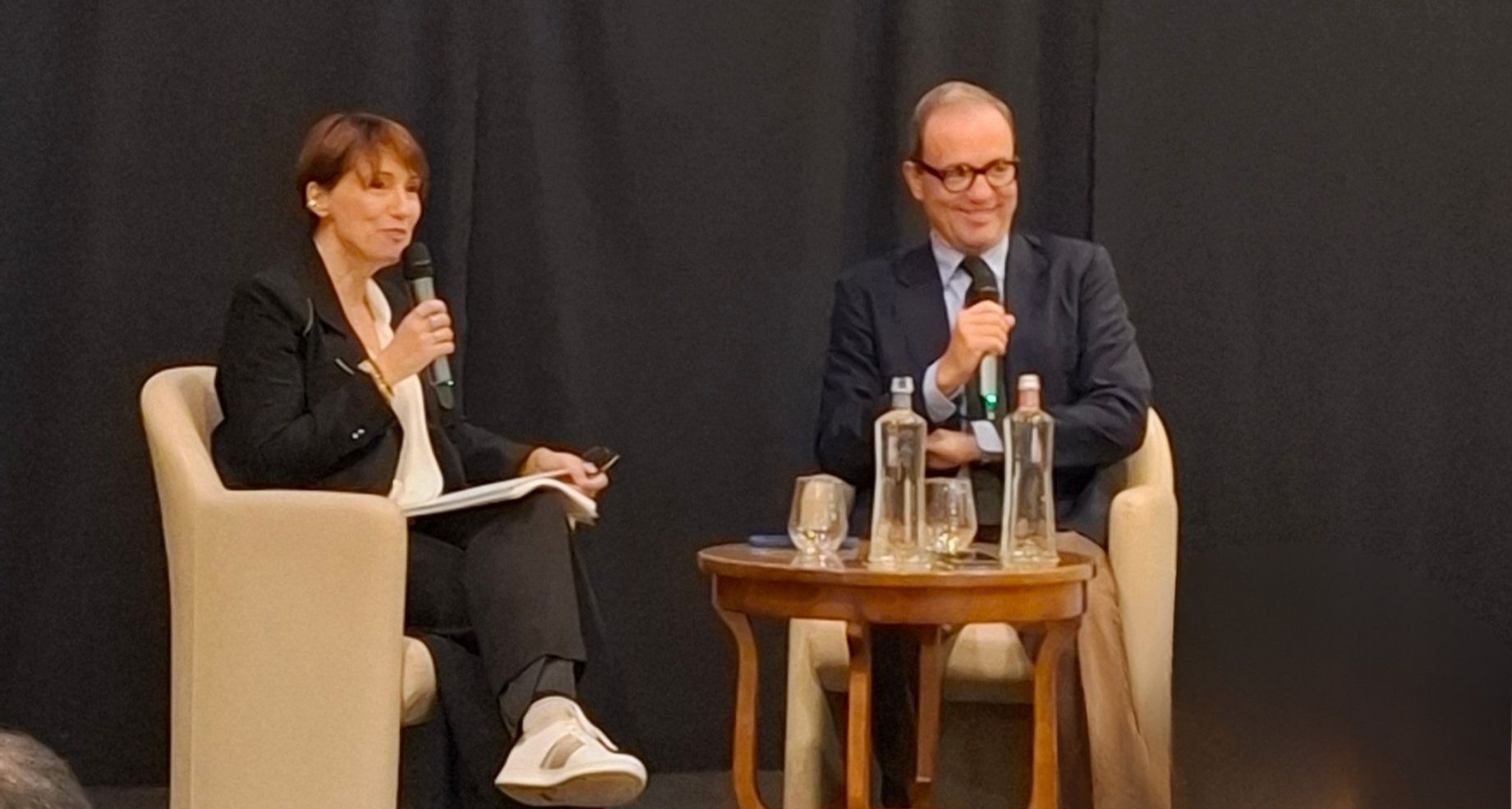
On 29 October 2025, at the Monza Sporting Club, I took part in an evening organised by the Soroptimist Club of Monza.
Together with Sabrina Colantoni, who moderated the meeting, we went over my professional and human experience: from my years at Esselunga to the challenges of innovation, up to my current commitment with the Guido Venosta Foundation. It was an intense and participative occasion to reflect on enterprise, values and social responsibility.
Below is the full transcript of the conversation.
Sabrina Colantoni:
Good evening, Dr. Caprotti. This evening we decided to call each other “tu”. I am a bit excited, I admit, because for me this is a special moment.
I had the privilege of working with you and living that extraordinary experience up close. What you will recount tonight I saw happen.
We also have some former Esselunga colleagues in the audience: Monica di Maggio, Fabio Tosi, Fabio Bellerè.
I would like to start by sharing my first impression when I entered Esselunga: as a customer I had no idea what was behind those supermarkets. I discovered a perfect organisation, with attention to every detail. I was fascinated by that world.
I understood that large-scale distribution, if managed with passion and rigour, can become not only a business model, but also a model of life.
I would start from here: from your beginnings in the company.
When you joined Esselunga, where did you see the first opportunities for change and innovation?
Giuseppe Caprotti:
Thank you all for being here, it is a real pleasure.
As I recount in my book Le Ossa dei Caprotti, joining Esselunga was not easy. I worked two years in the company, then spent two years in America. In 1990 I returned to Italy to take care of the Florentine branch.
And there I discovered something curious: there was a kind of ‘non-democratic centralism’. The Tuscans did not eat Lombard products, but Lombardy imposed its own.
My first ‘revolutionary’ act was to say, ‘Let’s give the customers what they want.’
Not Cremona mustard or Valtellina bisciola, but products consistent with the territory.
In Florence, for example, French cheeses were of no interest to anyone. Hence the idea of moving from a centralised to a decentralised model.
This approach was then extended to other regions, Piedmont and Emilia-Romagna, and represented a real revolution.
The second concerned shelf management, which was introduced with precise industrial accounting.
For the first time, it was possible to know exactly which products were generating profit and which were causing losses. Before, it was not so clear.
Sabrina Colantoni:
Over the years you have promoted: organic, Naturama, non-food, e-commerce, Fidaty… all with great impact. In your opinion, which project has had the biggest impact on Esselunga’s identity and development?
Giuseppe Caprotti:
I would say the creation of the ESD purchasing centre, which was linked precisely to industrial accounting. It managed purchases of around four billion euro: it was a decisive step, which allowed us to negotiate as equals with suppliers. Before then, paradoxically, some distributors were getting better prices than us. With ESD we reversed the trend.
Sabrina Colantoni:
In the 1980s you also introduced social initiatives such as the Food Bank and the Social Report, when there was still no talk of corporate social responsibility.
Where did this focus on people come from?
Giuseppe Caprotti:
From my Catholic roots and the scouts, where I learnt the spirit of service. A film that really struck me was Zeffirelli’s Brother Sun, Sister Moon. That message of simplicity and solidarity stayed with me. There has always been a social approach in me, combined with a vision of the future: even then I was trying to understand what consumers would demand in the years to come. I have always believed that history teaches us to look ahead. I studied sociology, it fascinated me: I spend my days observing how consumption, tastes, behaviour change. It’s almost a hobby, but it’s also the basis for every business decision. Understanding where society is moving is the key to innovation.
Sabrina Colantoni:
Today we talk a lot about ‘people’, transformation, innovation. You have always had a strong focus on employees. What leadership style do you adopt to promote change?
Giuseppe Caprotti:
My model was Publix, an American chain in Florida where employees are also shareholders. Cashiers, butchers, warehouse workers… everyone shares in the capital. This generates belonging. Publix is always among the companies with the highest level of employee welfare. It has been my ‘pole star’.Walmart also involves employees a lot: as soon as you enter the shop, you see the stock value displayed. In Europe, this spirit is rare, but I have tried to bring it to Esselunga.
Sabrina Colantoni:
In your book you talk about the Caprotti family’s origins in textiles. How did the transition to supermarkets come about?
Giuseppe Caprotti:
Yes, our family history has its roots in textiles. After the war, my grandparents obtained access to Marshall Plan funds thanks to the contacts of my grandmother, who was French and had relatives in the United States. It was a decisive moment: those funds allowed the family to develop their industrial activity. Then, in the 1940s and 1950s, came the American inspiration. In 1947, Nelson Rockefeller founded a chain of supermarkets in Venezuela and, shortly afterwards, in Europe. At that time, the Americans were looking for local partners: 51% was American capital, 49% Italian. From that collaboration came the first project that would lead, years later, to the birth of Esselunga.
Sabrina Colantoni:
And your father, how did he fit into this path? What were the strengths of your approach compared to Bernardo Caprotti’s? How well did the two approaches complement each other and were they complementary in the development of Esselunga?
Giuseppe Caprotti:
My father was immediately passionate about large-scale distribution. The complementarity between the two of us lasted until the early 2000s, albeit with many contrasts. We were among the first to introduce the Superstore concept, inspired by the American models I had seen in Chicago. Then, however, times changed. I argued that we needed to reduce floor space and return to city centres, because families were smaller and the market was changing. My father disagreed. In fact, we no longer agreed on almost anything except the initial Superstores.
The real crux was the vision: I believed in the ‘Publix’ model, in a participative and collaborative company, he on the other hand had a ‘I am’ approach.
Sabrina Colantoni:
In fact, after the years of success in the company, there came a difficult period, also marked by court cases and serious reputational damage due to relations with your father.
How did you manage to overcome all that and get back in the game?
Giuseppe Caprotti:
It was a very complicated period. I call it my ‘lockdown’, but it didn’t last two years: it lasted sixteen. There were tough moments – threats, attacks, even fires and chases. It was devastating, not only professionally but also humanly. It was only thanks to my ex-wife [Laura Falchi], who was an incredible anchor, that I was able to hold on.
Sabrina Colantoni:
And after all that, you managed to reinvent yourself.
Today, you are president of the Guido Venosta Foundation, an organisation set up to promote youth education, solidarity and culture.
Can you tell us how this choice came about and what the Guido Venosta Foundation is all about?
Giuseppe Caprotti:
The foundation was born out of a desire to give continuity to those values of solidarity and culture that I had already cultivated at Esselunga. It is a return to our origins, but in a different sphere.
We deal with social, environmental and cultural projects, with a special focus on young people. One of the most beautiful projects, although slowed down by bureaucracy, concerns the reforestation of 25 hectares of land that I have given on loan to the foundation. We would like to create a forest, a green lung, a long-term environmental project. We also have collaborations with schools and associations, such as Spazio Aperto Servizi and the CSD of Monza, to bring young people closer to concrete projects, not just sports or video games, but real educational experiences. In the third sector, however, it is not easy. I consider it a managerial job to all intents and purposes. Many underestimate it, but you need method, competence and seriousness, just like in a company. One of the things my father appreciated about me was the method. He too, in textiles, had learnt the importance of standards, and I brought that principle into the world of distribution.
When I introduced industrial accounting, he was enthusiastic about it: he liked the idea that every decision was supported by numbers. In this, we were similar: we both believed in method, although with different approaches.
Sabrina Colantoni:
Now that we have talked about the history, the company and the values, I will give space to the audience. Is there anyone who would like to ask a question?
Voice from the audience:
Good evening. I am very interested in the topic of e-commerce. You have been a forerunner in this field.
How should retail deal with e-commerce today without losing its identity?
Giuseppe Caprotti:
Complex question!
The main problem is that in Italy we have missed the digital train. The market is now dominated by the big players, such as Amazon. We in Esselunga had started early: we sold books online before Jeff Bezos did, but we did not insist [the online bookstore was dismantled by my father, after 2004]. Today, companies must learn not to ‘delegate their fate’ to external platforms. Producers must try to create their own platform or at least a direct channel to the consumer. To rely completely on marketplaces like Amazon means giving up part of one’s own identity. I understand that it is not easy for small companies, but courage is needed. It is better to invest in your own digital space, even with effort, than to depend on those who can change the rules from one day to the next.
Voice from the audience:
Congratulations, Dr Caprotti. You have shown an entrepreneurial vision far ahead of your time, particularly on the issue of environmental impact.
I would like to ask you: can you explain what you think about so-called greenwashing and whether, in your opinion, it will have a real economic impact?
Giuseppe Caprotti:
Greenwashing is a huge problem. It is a practice that undermines consumer confidence and risks alienating people from environmental issues. It is very much related to the problem of labelling and fake Made in Italy. The European Union has issued rules, but they are often disregarded. The result is that ‘pseudo-Italian’ or ‘pseudo-ecological’ products fill the supermarkets, deceiving customers and damaging those who work seriously. Let me give you an example: in Paris I found an ‘Italian’ oil produced by a company based in Monte Carlo.
You understand that we are at the paradox. The problem is labelling: we need transparency and real traceability. Without them, the market is distorted.
Voice from the public:
We are a group involved in environmental projects on the ground.
We would like to launch new green initiatives and wondered if you could give us some practicaladvice
Giuseppe Caprotti:
You need a clear idea, a precise location and a realistic goal. In my case, I chose to reforest 25 hectares of land. It is a difficult project, because Italian bureaucracy is slow, but it can be done.
Voice from the audience:
I would like to ask something more personal: was there a moment in your career when you thought about stopping and how did you start again?
Giuseppe Caprotti:
I really did stop. During that long difficult period we spoke about earlier, I stopped completely. It was a moment of silence, of isolation. But then, with the end of the judicial affair and Covid, I chose to look ahead. I decided to see the Covid crisis as an opportunity to help. From there my personal rebirth and my work in the Foundation was born.
Voice from the audience:
In your opinion, can small shops in city centres be a solution to revitalise cities and neighbourhoods?
Giuseppe Caprotti:
Unfortunately, I believe that city centres, at least in part, will not recover easily. There are structural problems: too high rents, difficulties for small businesses. That said, the reduced format of supermarkets is certainly a useful response. We had already experimented with it at the time with ‘Esselunga sotto casa’.
Voice from the audience:
If you had to sum up your entrepreneurial vision in one sentence, what would it be?
Giuseppe Caprotti:
I would say: “In a stubborn and contrary direction.” It’s a quote from Fabrizio De André, but it represents well the way I see business. If you have an idea you really believe in, you have to follow it, even if everyone tells you it won’t work. That’s what I did with organic farming, with industrial accounting, with many projects. You need conviction, method and a pinch of courage.
Voice from the audience:
About the book you published, what prompted you to write it?
Giuseppe Caprotti:
I am not a writer, but I have always written – for work, for passion, to put my thoughts in order. I decided to tell my story to restore truth and justice. For years much has been said about me, often in a distorted way. In the book I wanted to clarify how things really went, and above all to remember my family roots: a 340-year-long story, which deserves to be known. It is not only a personal account, but also a tribute to those who came before me. I come from a family that worked hard, first in textiles and then in distribution. They built, innovated, risked. I just picked up that legacy and tried to carry it into the future.
Voice from the audience:
A lighter question to close: the Armando Testa campaign has remained iconic. How did it come about and what was its impact?
Giuseppe Caprotti:
Yes, there are two campaigns. The first is the one with fruit and the second with characters, such as John Lemon. It was born from an idea of my sister Violetta to communicate quality. My father was focused on prices – rightly so – but my sister and I thought it was important to also emphasise quality and brand identity.
Sabrina Colantoni:
Thank you, Giuseppe, for sharing your story with us, with sincerity and passion.
Giuseppe Caprotti:
Thank you. It has been a pleasure to be here.
Sabrina Colantoni:
For those who want to know more: the official website is giuseppecaprotti.it and the book “Le Ossa dei Caprotti”. Good evening everyone!