

Drafted 13 January 2022 , updated 2 October 2025
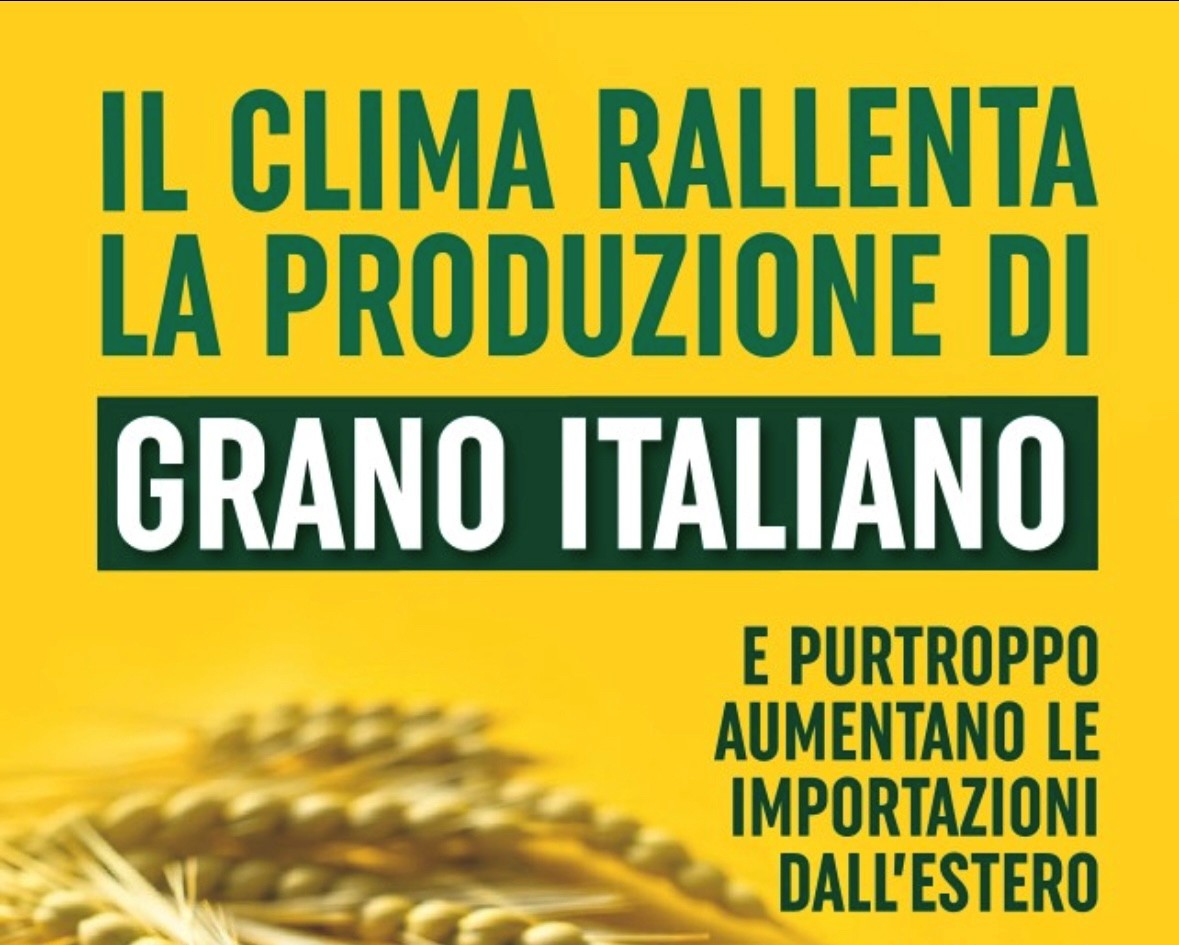
Above : the cover is taken from a Coldiretti post of July 2025, which is also why I did not delete the references to the drought in Italy in 2023 :
1) heat waves and extreme events follow one another.
2) the effects of drought on agriculture are seen in the long term.
Original title :
Commodities will not stabilise in 2022. Disturbing international study
While consumer prices are belatedly starting to rise on the shelves of Italian supermarkets (thanks to the tough negotiations that the large-scale retail trade is conducting with the industry) a truly worrying alarm comes from a recent report published by the Stockholm Environment Institute and reported by authoritative international financial journals, including the Financial Times in a recent article.
Basically, the study warns that the commodity price increases, which stormed the manufacturing market in the second half of 2021, will not come down in 2022; on the contrary, according to it, decades of extreme uncertainty lie ahead.
According to the study, agriculture will be one of the sectors most exposed to climate change in the near future, susceptible to risks from both events attributable to individual extreme weather events and possible long-term changes in climate models.
Lower yields and instability in agricultural planning are expected. A few examples: global sugarcane yields could fall by 59% in the coming decades compared to yields in the period 1980-2010, while Arabica coffee and maize could fall by 45% and 27% respectively, according to estimates in the above-mentioned report (for maize see also this article).
Not only that: news of worrying weather conditions at the times of the various agricultural productions will be interpreted by the market in a pessimistic way and will agitate prices even before the crops. In short, the scenario that is envisaged is anything but rosy and a bit of concern must pervade all of us, in the hope that the negative picture will be exaggerated and that everything can return to a normality that seems to have been lost today at a general level.
We would like to be as ‘reassuring’ as Andrea Meneghini is but:
- In France they call it dérèglement climatique, in Italy the term used is climate extremes (to understand the phenomenon better just see what happens in California or Canada). And, last year, it caused €2 billion in damage to Italian agriculture.
- Worldwide, the damage caused by climate extremes has been quantified by insurers (not only to agriculture) at 175 billion (for an update to 2023 read: Climate: agricultural policies up 6%).
- Forty years of extreme climate – in Italy – have cost us 72.5 billion. The calculation was made by the European Environment Agency, for 20,735 events between 1980 and 2019. The effects, also economic, of climate extremes are now evident. In Europe, only Germany has a heavier budget
- The situation will not improve in Russia, for example, or, to take another example, in the United States.There is no point in deluding ourselves.
- Below are 3 examples of recent price increases taken from the Financial Times mentioned above: coffee (Brazil): 76%, potatoes (Belgium): 180% and peas (Canada): 85%.
- And then there is the pasta sting : wheat has risen by 90% since this summer (2022 ) and the price is slow to fall (2023) also due to the stock effect.
The consequence is that: the hope of a passing inflation recedes (2023)
The global impact will be very heavy:
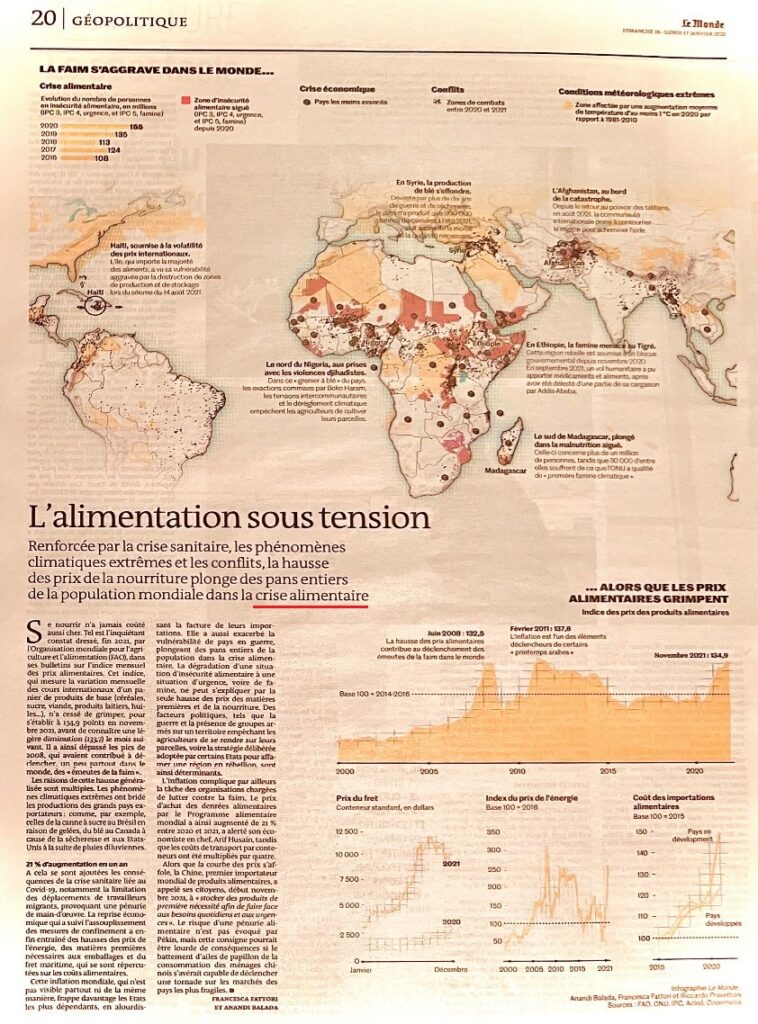
Le Monde, below, estimates that the health crisis, extreme weather phenomena and wars are plunging much of the world into a food crisis (the strongest inflationary spikes, following the FAO monthly price index, were – in the past – in June 2008, February 2011 and November 2021).
This is confirmation of what ‘was already written’ in 2020, at the beginning of the pandemic.
Obviously all this will trigger further migrations, from the ‘Global South’, to richer countries. Read for example : In Bangladesh among environmental refugees: a shantytown in Dhaka to escape the waters. It is one of the countries most affected by global warming: ‘We cannot wait until 2030 for the West to act’.
Forecasts in the IOM report ‘Migration and Climate Change‘ speak of 200 million climate migrants by 2050 and, as we see below, all African countries bordering the Mediterranean have drought problems.
Covid will wipeout 52mnjobs worldwide by 2022 (“in China about 30mn jobs are being wiped out by Covid” source: Inglobando 29 May 2023).
Many farmers, at a loss, are contemplating not sowing any more.On this subject read also Agriculture, in Italy: the decrease of farms continues.
Regarding the impact, in the short term, on Italy for once I agree with Francesco Pugliese, CEO of Conad, because, like him, I believe: “the worst is yet to come” (Milano Finanza)
I also agree with him when he says: ‘We are already living in a war economy’.
I would add that, unfortunately, the Italian state is unable to control prices (and margins) in agriculture, production and large-scale distribution.
On the problems that caused inflation read Food and non-food: shortages and inflation
On hidden inflation – shrinkinflation – downsizing you can read this piece. Or this article about Barilla and Ferrero.
Obviously the war in Ukraine can only make things worse.
On wheat and other agricultural commodities subject to the effects of climate change you can read :
- Wheat never more expensive than after Indian exportfreeze and drought in France (24 May 2022)
- Canada: drought puts grain and seed production in crisis
- Wheat : Europe’s production expected to drop 5% due to drought (10 June 2022)
- Wheat: yields down 25 percent due to drought and high fertiliser prices
- Kenya, climate hits arabica coffee. 6 million jobs at risk.
- Water is not infinite (where we also talk about Italy and specifically Lombardy (and what is happening to the river Po)
- Chile: the capital Santiago rations water.
- Iraq: repeated sandstorms due to desertification
- India: heat waves have doubled since the 1980s-1990s and will become the norm.
- For months, the Horn of Africa has been experiencing one of the worst droughts in recent history, and the situation is now desperate in Ethiopia, Kenya and Somalia: 43,000 people died in Somalia in 2022.
- France rainfall deficit of 45% this spring
- Drought: 50% of agricultural production in northern Italy at risk
- Hot weather: 30% of Made in Italy at risk with the sea in the Po River
- France: wheat fields set on fire due to drought
- “Moutarde de Dijon’ (mustard): no longer to be found due to drought in Canada
- Italian agricultural GDP heavily slashed by drought
- USA: Cotton prices skyrocket due to drought
- The effects of the drought on the economies of major countries such as China, the USA and Southern Europe (including Italy.
- Italy: Olive oil: Italy risks running out of Italian extra virgin olive oil by summer; Oil production at lows across Europe; Olive oil, climate destroys 1/3 of production).
- US farmers facing drought due to climate change reconvert
- USA: inflation aggravated by climate events
- Italy : Rice: production plummets by 30%
- Potatoes, European production at an all-time low
- Citrus fruit production in Europe is expected to fall by 15 per cent
- India : Darjeeling tea also threatened by climate change
- On metals read : Commodities, prices rise: ecological and digital transition slows. The role of China. But while metals are considered – in terms of quantity – to be ‘in surplus’ on world markets, grain prices – as of December 2022 – are still 20% higher than a year ago.
- Honey: beekeepers on alert, water shortage (2023)
- Egypt: water crisis threatens agriculture (producing sugar cane, wheat, maize and sorghum, January 2023) The sea – with salt – is entering the Nile delta, as is happening to the Po river.
- Olive oil (last harvest: – 34%: The Financial Times – February 2023 – reports climate danger, with effect on prices, for (You can read the partial Italian translation here.
- Rice at risk due to drought and Drinking water at risk for 3.5 million people (2023)
- Drought : A2A shuts down the first hydroelectric power plant (2023)
- Fruit and vegetables: 45% price rises from February 2022 due to extreme weather events in Italy (2023)
- Wine: drought emergency threatens Barolo (2023)
- Morocco: wheat threatened by drought (2023)
- Soya and corn without water,Argentina in recession (2023)
- Italy : in the North East rationing has begun, they bring water with tankers (28 March 2023)
- Tunisia: drinking water rationed due to severe drought (2023)
- Italy, hazelnuts : in the last two years the climate crisis has cut one third of production capacity (2023)
- France: half of the departments (50 out of 96) in the grip of drought (2023)
- Rice: in 2022 the lowest production in 20 years (2023)
- Drought, water rationed in 40 municipalities in Piedmont (2023)
- Olive oil: record prices due to drought in Spain (2023)
- Sugar: prices up 59% in one year (2023).
- Food, uncertainty over raw materials dampens price falls (2023).
- Emilia- Romagna Veneto and Lombardy: regions of a country unwilling to face climate change (2023).
- Coldiretti : Italy has lost 80% of its honey due to climate damage (2023)
- Emilia-Romagna: The fruit harvest will be compromised for the next four or five years (due to extreme weather events).
- USA: drought threatens to increase inflation (price of wheat, oats, etc., 1 July 2023).
- Olive oil prices continue to rise with the Spanish drought (13 July 2023).
- India: The government has banned rice exports due to extreme events: rain and flooding (2023).
- Tomatoes: due to climate change Italian production falls and Chinese imports rise (2023).
- Wheat: the Italian harvest will be of poor quality, while Canadian production will be reduced due to drought (2023)
- Orange juice futures hit record highs after storms devastated Florida ‘s crop (2023)
- Potatoes: 25% of the harvest at risk due to climate and pests (2023)
- Extreme weather hits the price of sweets and confectionery, with sharp increases in sugar and cocoa (2023)
- Greece: this summer’s historic floods hit Thessaly, which produces 40% of the country’s cheese – mainly feta – (2023)
- Food: from tomatoes to olive oil, all price rises due to climate change (2023).
- Record prices for orange juice (2023).
- Italian rice at risk (2023).
- AF (13 November 2023) describes the commodity chaos very well.
- Climate change: coffee and chocolate prices at record highs (2024)
- Extreme weather conditions threaten Irish potato production (2024).
- Mutti : tomato campaign at risk due to climate change (2024)
- Rice shortage in Japan as a consequence of global warming and excessive tourism (2024)
- Due to unfavourable weather this year’s soft wheat harvest is at risk (2024)
- Butter up 83% (2024)
- Cocoa up 180% year-on-year (2024)
- Coffee price skyrocketing (2024)
- Corn: prices at risk due to drought (2024)
- Olive oil price from 2019 to 2024 up 112% (2024)
- Milk, Calzolari (Granarolo): “Never seen such high quotations. It is the effect of global warming’ (2025).
- Drought in Brazil causes arabica production to collapse, sending prices soaring (2025)
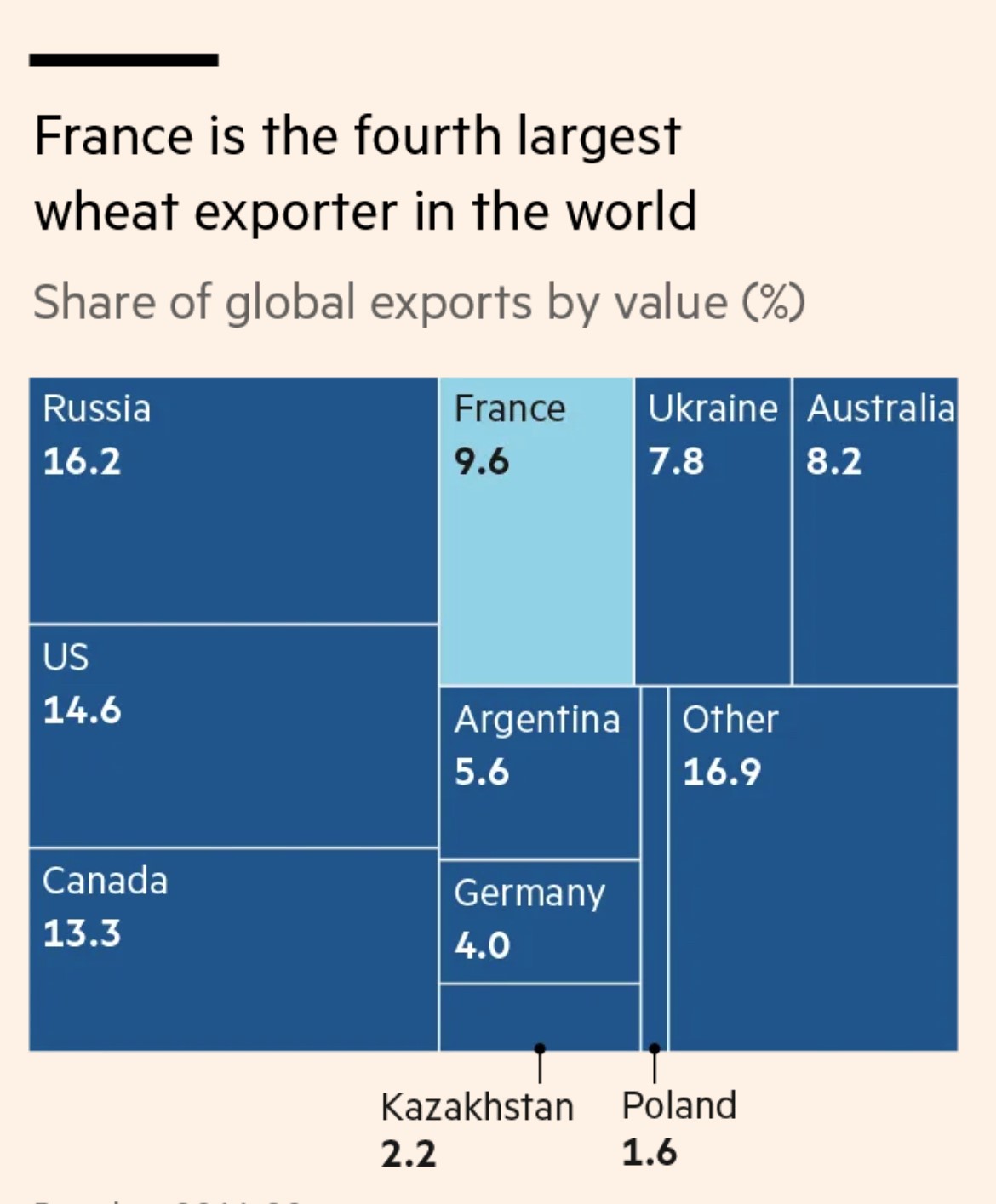
Below: major wheat exporters (Financial Times), although Ukrainian production is estimated to have fallen by 30% by the end of 2024 due to the war.
Conclusion:
that the worst is yet to come can be glimpsed from the November 2022 inflation of over 15%.
Also in November 2022, the US Department of Agriculture predicted that US inflation in 2023 will increase by between 3% and 4% .
In December 2022: consumer prices are not expected to fall to pre-Covid-19 levels
The situation will be aggravated:
- by protectionism, implemented – as of 2020 – by dozens of countries.
- by logistics problems and cost increases in metals.
- by fertiliserprices .
- by the $/€ exchange rate :Legacoop-Prometeia: this is why inflation will remain high in 2023.
- speculation.
I personally foresee a very heavy 2023, but also a very heavy 2024 and 2025, because of what has already been said above about raw materials and the climate issue, which nobody seems to want to tackle.
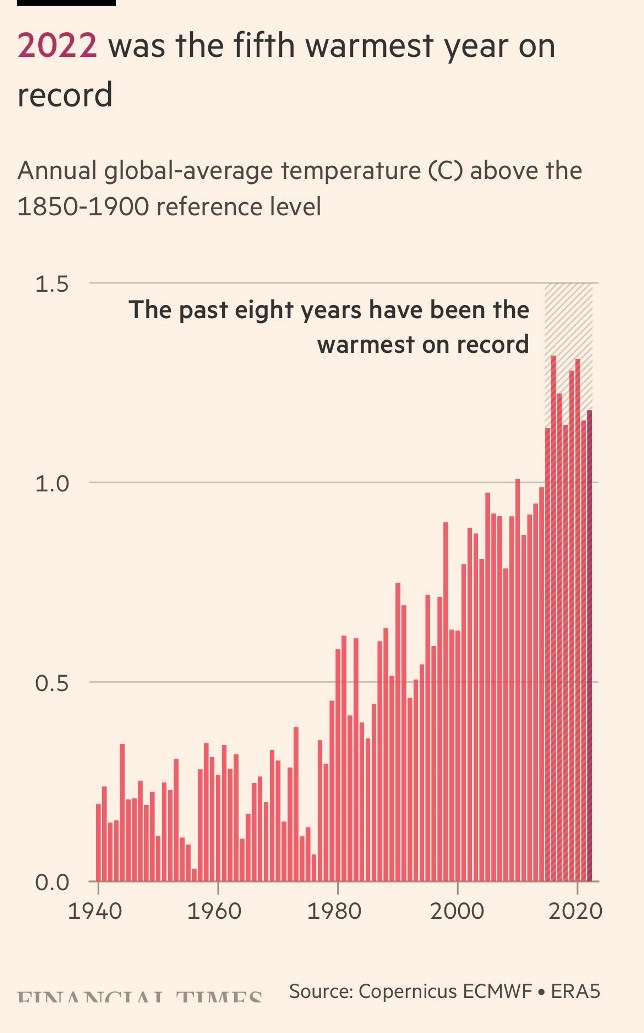
The climate signals, for the beginning of 2023, are not encouraging, in Italy (jobs and water are at risk, even for hydroelectric power) and worldwide (temperatures:1 .2 degrees Celsius compared to pre-industrial levels).
Below : the last 8 years have been the hottest on Earth’s surface (FT 11 January 2023).
P.S. : Le Monde of 22-23 January 2023 notes that ‘Wheat prices are bearish and back to pre-conflict levels in Ukraine ‘
In detail :
- wheat quotations have fallen from 438 €/t (May 2022) to 280-285 € per tonne. And in April 2023 they will fall further.
- forecasts for 2023 are for a record harvest of 763 million tonnes.
but the climate factor is not taken into account in the article. While the Financial Times of 29 January 2023 reports on climate extremes.
And the confirmations come, between April and July 2023, from Asia, Canada, Northern Europe, Spain, France (a major wheat producer), the USA, but also Italy .
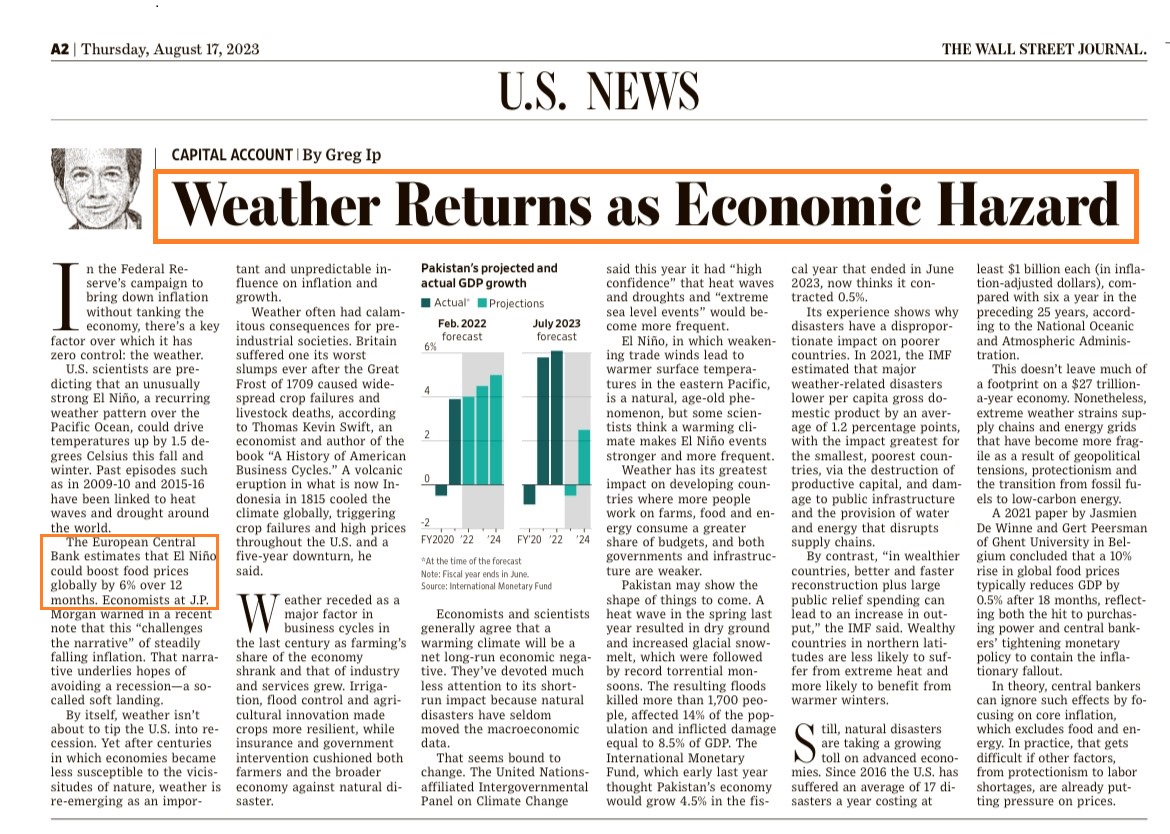
Then there is El Nino, which was the focus of the Wall Street Journal’s reflections in August 2023 on ‘climate risk‘ and the possible increase in food prices (below). And the escalating war in the Black Sea.
For intellectual honesty, let’s complete the picture on wheat: global crops continued to “do well” despite the spate of extreme weather events. The US Department of Agriculture says, for example, that wheat production will reach a record level in 2023-24, and the share of US production affected by the drought has actually declined (not the case for Canada, however). Although the Chinese unknown remains with wheat imports at 20%.
As for prices, however : ” they are now well below the levels of February-June last year, when they rose above $10 per bushel following Russia’s large-scale invasion, but remain a third higher than typical levels in pre-conflict years (FT 10 August 2023). On wheat read also this article.
Of course, when it comes to commodities, as we saw above, there is more than just wheat. Let’s give an example ‘of the opposite sign’: USA: corn, the most produced US crop, is losing about $720 million in revenue per year due to extreme heat.
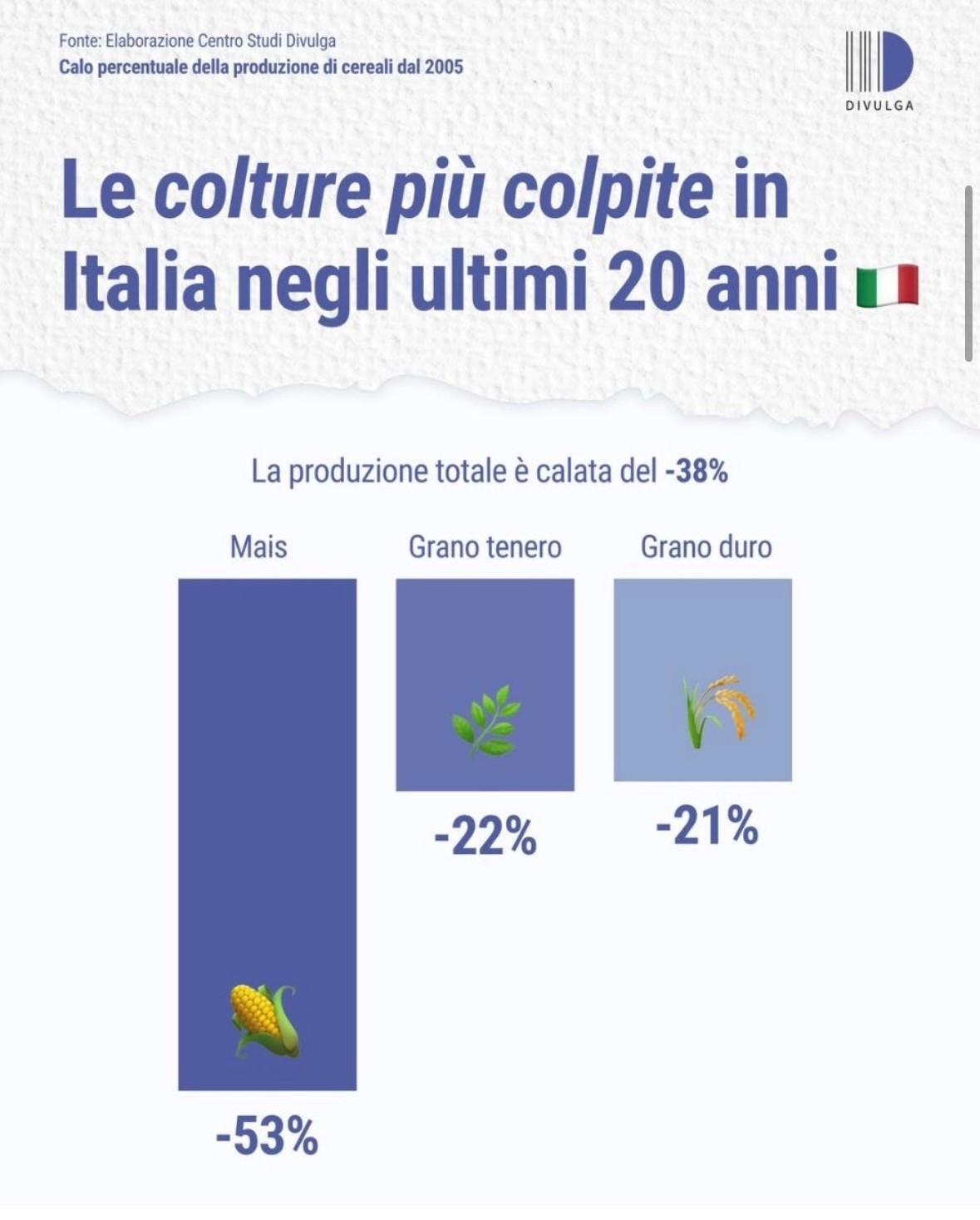
Below: major crop declines in Italy (August 2025).
The coffee situation described by the Financial Times in August 2023 is as follows :
coffee consumption has almost doubled in the last 30 years. Starbucks plans to open one outlet every 9 hours in China in the next two and a half years. If demand continues to rise, consumption should double again by 2050.
But the threat (threat) of climate change means that :
- there is not enough land
- farmers cannot make a profit
- prices are rising
Coffee is in danger of becoming a luxury good, the quality of which will deteriorate.
March 2024 also highlights this situation: Chocolate, cocoa prices quadrupled in one year to EUR 10,000 per tonne: the effects on Ferrero and Nestlé.
Below: Drought, rainfall and heat waves have affected crops and prices of potatoes, lettuce, cocoa, onions, olive oil and coffee – to name a few – in various parts of the world from 2022 onwards.
In 2025, the hazelnut crisis in Italy (AF 29 September 2025, last of 6) was added.


