First draft: February 2017. Updated 2 March 2026.
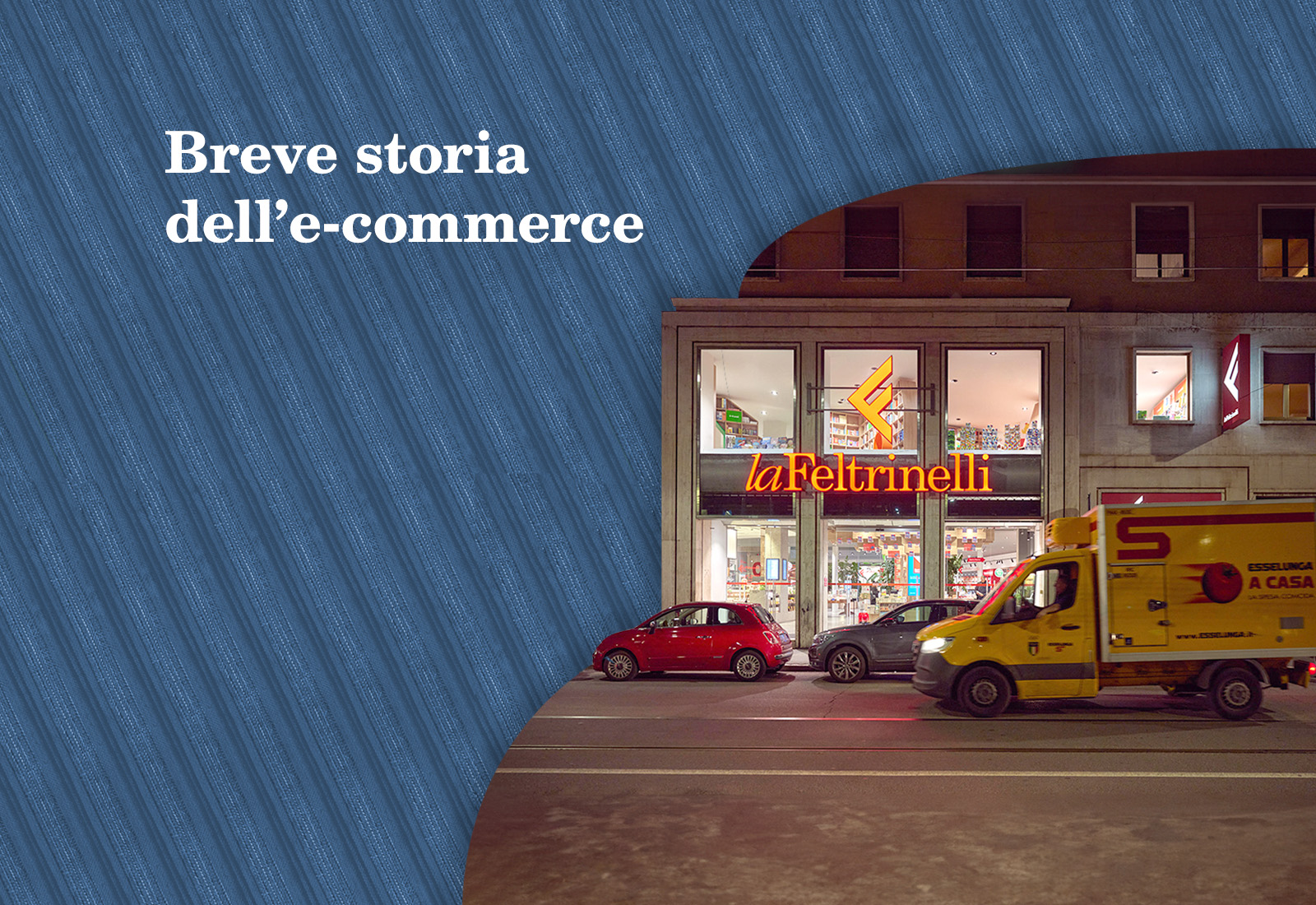
Above : photo taken on 8 November 2023 at the presentation of Le Ossa dei Caprotti at the Feltrinelli in Piazza Piemonte, Milan
When I started working, in 1999, on the Esselunga at home project – the service became operational in 2001 – (read about it in ‘Esselunga opens a shelf on the web’ ) there were no data or companies in Italy to look at in order to understand how we could approach this beautiful adventure.
In the world, the companies that could be considered a reference could be counted on the fingers of one hand:
Google, for instance, had only been founded on 4 September 1998, while the search engine had been launched the year before.
There are still very few references on the web to the recent history of e-commerce in Italy and the world.
I have therefore tried to reconstruct a historical chronology for e-commerce in the food and non-food sectors which, however, does not claim to be exhaustive:
1989 : birth of Peapod USA : food, still existing and belonging to the Stop and Shop chain, of the Ahold group, which merged with Delhaize in 2015.
1995 : birth of Amazon and E- Bay USA : non-food; although Amazon has now invaded the field of traditional supermarkets, with Amazon Fresh but especially by buying Whole Foods.
1996 : birth of Webvan USA: food failed in 2001 (visited by myself and Mr Paolo De Gennis). It was later taken over by Amazon in 2009.
1996 : Iovorrei Italia (SMA- Rinascente group) : food, closed down
1998 : IBS Italia : non-food, still existing.
1998 : LeShop.ch, later bought by Migros (Switzerland), food, still existing. Changed its name to www.Migros.ch.
1998 : Alibaba China: food and non-food, one of the largest players worldwide. In 2001 it starts earning money.
1998 : JD.Com China born on the back of SARS. In Q2 2020 it had $28.7 billion turnover, an increase of 33.8%. JD.Com had 417.4 million buyers (year ending June 2020 on year ending 2019).
1999 : Luisaviaroma Italia : non-food, existing, with interesting current developments (2024).
2000 : Volendo.com Italy (Lombardini Group) : food, closed.
2000 : Ocado (Uk), food. Still in activity
2000 : Auchan France: food , launches the first Drive
2001 : Esselunga Italy , mainly food. The superstore in Monza is used partly as a shop and partly as an e-commerce warehouse, with staff picking in the shop.
2007: AmazonFresh.
2008 : Zalando
2009 : Zalando is bailed out by a €20 million loan from the German food chain Tengelmann ( Plus, Kaiser, etc. signs, former owner of the famous American chain A&P).
These are the years when Esselunga has an operating result at home of between 7, 9 and 10%.
2014 Amazon Prime Now.
2015 Amazon Italy enters the world of food
Amazon has a partnership with Marco Brunelli’s Unes.
Amazon launches Dash Buttons
2016 : Amazon launches the first private label food with fancy branding. Zalando has a turnover of € 3.6 billion in non-food.
2017 Coop Italia, food, launches Easycoop.
2017: Walmart USA, food and non-food, allies with Google. In China it allies with JD.Com.
2017 : Casino (F) forms an alliance with Ocado (UK). The British company will manage the e-commerce of Monoprix, a brand owned by Casino.
Ocado makes agreements with Sobeys (Canada), Ica (Sweden) and Kroger (USA). Kroger acquired 5% of Ocado for $247 million. Ocado will develop 20 logistics centres for Kroger.
2017 Carrefour allies with Fnac Darty and Monoprix buys start-up Epicery.
Carrefour decides to unify the names of its e-commerce divisions: only Carrefour.frwill be used.
2018 Conad tests e-commerce in three different ways in three different regions
2018 Carrefour forms an alliance with Tencent, which has a 31% share of Chinese e-commerce with JD.com.
Carrefour will later sell its Chinese subsidiary to the Suning Group, which is owned by Alibaba.
Carrefour announces partnership with Google for voice assistant named ‘Lea’.
Walmart, Tesco and Carrefour allow their customers to order online via Google Assistant.
Will the new frontier of e-commerce be vocal? Great success for Alexa (Amazon) in the US.
2018 Monoprix and Amazon team up.
Monoprix and Zara claim that 10 per cent of their sales are made through e-commerce.
For Zara, this is a turnover that could exceed €2.5 billion.
2018 Amazon teams up with Best Buy -1 ‘000 shops, 125’000 employees- to market 11 new ‘Fire tv Edition’ TV models with built-in Alexa- Echo voice assistant. In addition to voice control, the devices will be connected to the web to stream programmes from Amazon Video, Netflix or Hulu. They will be sold at Best Buy or on Amazon’s platform, or directly in the chain’s shops, which will serve as showrooms for these high-tech products.
It is estimated that Amazon Prime Now has 100 million customers who spend an average of $2486, five times as much as non-subscribers.
Prime customers shop on Amazon 25 times a year while non-subscribers shop 12 times a year.
Prime Now is the largest club of loyal customers in the world, after Alipay (of Alibaba). Data source: Amazon, Natalie Berg, Miya Knights ed. Hoepli 2019,
2018 : Esselunga at home invoices € 236 million – Italian Supermatkets balance sheet page 3 – a leap of 28% over the previous year but is outclassed by Amazon Italy which, with non-food, now invoices more than € 1.5 billion.
2018 : Starbucks has adopted Samsung‘s voice assistant , Bixby, with a Korean partner.
2019: In France, Casino sells its private-label products on Amazon.fr.
Esselunga is to open two new logistics centres in Italy.
Also in Italy, Amazon has a turnover of €4.5 billion (source: Corriere della Sera, see: Amazon versus Google: beyond e-commerce).
2019 : China : e-commerce is worth 18.6% of physical goods
- In China we are over 28% of all goods, food and non-food, projecting a 60% penetration in three years. Tik Tok has decided to go e-commerce
- Italy in April 2020 is at 3% even though, again according to Nielsen, click and collect (*) volumes tripled in the last two weeks of February (2020). And Bofrost (home frozen food) doubled its turnover.
(*) are more than 5,000 in France and less than 1,000 in Italy, where the GD has, therefore, a great deal of unexpressed potential (read this interesting update on this in 2022).
E-commerce in Italy, in spite of serious structural delays, is growing tremendously.
For e-Commerce in Italy, the progressive growth from 1 January 2020 is 116% (November 2020).
Cap (postcodes) covered, click-and-collect and drive-throughs are growing(although some chains, in the second lockdown, have no slots available for online purchasing and therefore cannot deliver).
Amazon and Esselunga are opening or are opening new logistics centres ( Amazon will open four new logistics centres in Italy in 2021) . And Penny Market (discount) isalso testing home delivery, in Milan and Catania.
Amazon is becoming the leading retailer in Italy, even though it only does e-commerce. And Amazon Fresh lands in Italy: same-day home shopping debuts in Milan. By the end of the year also in Rome.
There are 19 million consumers of consumer goods in Italy.
- 2021 : Nielsen states that, by 2019, the weight of e-commerce has tripled, to 2.4%. The Netcomm figure confirms this ’embryonic’ Italian share (2.5%).
- In France, e-commerce has exceeded 13% market share
And in addition to the doubled e-commerce share during the coronavirus, the agreements are surprising:
Casino -Deliveroo,
Carrefour-Glovo,
Carrefour-Uber Eats,
Carrefour-Google, with a view to a strongdistribution-delivery-technology contamination.

- In the US Shopify- Walmart agreement (for these agreements and also for Amazon France see Le Monde 23 June 2020).
The e-commerce of Kroger, the third largest US retailer, grew by 92%.
Walmart becomes, thanks to its online strategy, the 13th most innovative company in the world and overtakes as market share in US grocery, Amazon (August 2020).
To understand Walmart’s strategy, one only has to look at how it has shifted its investments. Walmart is turning some supercentres (hypermarkets) into e-commerce warehouses.
The results in terms of turnover seem to prove it right as it exceeded $10 billion in one quarterthis year (although the weight, internally, is still under 8%).
Also in the US: at Sprouts Farmers Market, e-commerce sales of food reach 12%.
And Target after record second quarter, with sales driven by ecommerce arrives at 18% for ecommerce.
In California Amazon opens Amazon Fresh, but above all Walmart, by trying to buy Tik Tok USA, shows that it aspires to become a technology company, like Google or Facebook. Amazon grows by 33% as at 30 September 2020. And in the third quarter it posted profits of $6.3 billion.
Ahold- Delhaize acquires Fresh Direct.
2021: E-commerce in the US is worth 20% of retail And in 2021, US e-commerce grew by 14.2%.
- In Germany and Great Britain, Lidl and Aldi enter the sector. And Aldi is also testing home delivery of meals.
- In the UK ,Tesco hires 16,000 people to run it with an expected turnover of €6.1 billion, about twenty times the 2000 turnover.
And also Tesco, at Christmas 2020, turnover is 80% higher than in 2019.
- 2021 in Great Britain grocery e-commerce goes to 17%.
- In Sweden (and worldwide) Ikea ‘s e-commerce now weighs 18% (8 October 2020).
There would be much more to write about Spotify, Netflix and other companies – such as Apple or Tencent (e.g. both have entered the world of music content, see 2019 market shares) that are replacing the physical sale of products with online sales. But I prefer to conclude by talking about 2022, 2023 and internationalisation.
- 2022: Amazon starts to reduce its headcount.
- 2023: E-commerce in Italy is marking time ( read also Continuing the bad moment of the large-scale retail channel) while in the US it continues to grow.
- 2023: Walmart is definitely the most dynamic company, in terms of innovation and marketing. Reconfirmation comes at the end of the year. And e-commerce, in the US, dominates Black Friday with Cyber Monday.
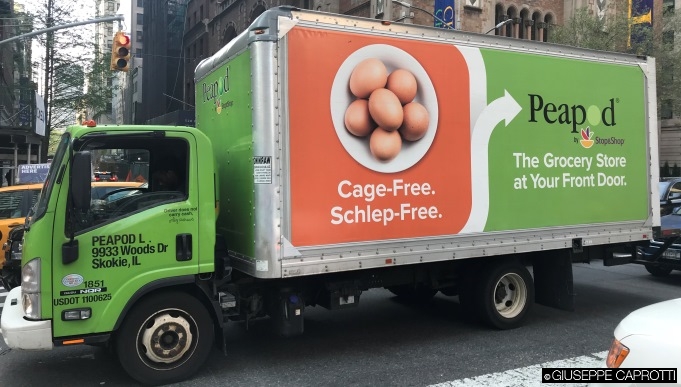
Under a Peapod truck in New York in 2018. The company, an e-commerce pioneer, was founded in 1989. Today it belongs to the Ahold- Delhaize groupthat has developed it so much(Ahold- Delhaize in November 2020 acquired Fresh Direct)
My idea for ‘Esselunga a Casa’ was to create a warehouse in Germany to sell our products to the Italian community.
In short, in my own small way, I thought – very modestly – like Jack Ma, the founder of Alibaba, who in February 1999 told his staff:
But my vision, in Limito di Pioltello, was not shared and :
1 Esselunga at home today seems to be going in the right direction.
Better late than never. Even if Amazon Italia , including non-food, has the absolute leadership of the Italian market.
2 Alibaba (*) capitalises on the stock market for $440 billion (2017) with which it finances its expansion. It is one of the 100 companies whose capitalisation has grown the most during the pandemic (2020, source: Financial Times).
(*) born in 1999 when we started studying e-commerce and then launched Esselunga at home two years later.
Alibaba, among many other things, operates in home catering, has just launched automated supermarkets and after forming an alliance with Auchan bought itself – in October 2020 – control of the chain of hypermarkets and supermarkets they had in common (Sun Art). It is also buying a stake in Dufry (Duty Free).
As at 30 June 2020, the results were: turnover up 34% ($14, 3 bn – these are transacted commissions, as Alibaba has no warehouses and does not deliver goods except directly from third-party suppliers), Ebitda up 30% (to $7, 2 bn) and net income up 124% (Source: Alibaba).
On Alibaba and the Chinese market you can read these articles :
- on its 757 million “active consumers” which, in September 2021, became more than a billion : Beijing gets its hands on Alibaba’s treasure
- on the listing of Ant Financial (Alipay), which received requests for $2.8 trillion.
- on the listing which is then blocked for political reasons and Chinese high tech is subjected to new antitrust rules.
- For an update on Alibaba as of 10 April 2021 read here.
- On Single’s Day 2021 read: Alibaba and JD.com: $139 billion single’s day
- On the political events of late 2021 read : Alibaba : 1.24 billion consumers but the stock has lost more than 42% since the start of the year
- 2023 : In China, it is worth mentioning the Douyin phenomenon, which belongs to the ByteDancegroup, which also controls Tik Tok and the expansion of Pinduodo. The Chinese market is definitely the biggest in the world. But it has been regulated and curbed by Alibaba’s break-up.
- The owner of TikTok, ByteDance: USD 50 billion cash on hand (2023).
Below: Alibaba ‘s debut on Wall Street , in 2014

The idea of internationalisation came to me in Louvain, Belgium, where Delhaize, who was our ally in the Sedd (=European purchasing centre, with Sainsbury, Delhaize and Docks de France, later passed to Auchan) sold Felce Azzurra Paglieri products (and other Italian brands) to the very large community of Italian emigrants there.
Below Giuseppe Caprotti at Delhaize, between Paul Van der Vliet (dir. comm.) and Renaud Cogels (dir. gen.) at the time of the Sedd plant.
We exported some Esselunga-branded products to Belgium (e.g. fresh stuffed pasta).
From Belgium, with Caddy Home, I got the idea about e-commerce, as I wrote in my book Le Ossa dei Caprotti.

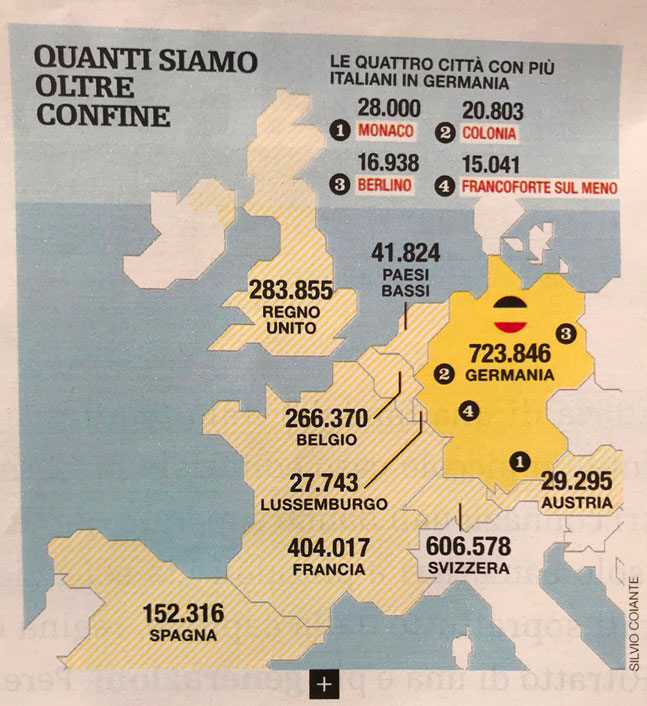
So I inquired and discovered that the highest concentration of expatriate compatriots was in Germany.
This is still the case today: there were more than 2.5 million Italian expatriates in Europe – in 2017 – of which more than 700,000 were in Germany.
And these figures, due to youth unemployment, especially in Southern Italy, are increasing (Source: Il Venerdì di Repubblica 2017 , from Migrantes foundation – see chart below).
The idea was to make a warehouse, stand alone (of packaged food), in Cologne or Frankfurt. Esselunga missed this opportunity but maybe someone else could take this cue. If the Italians don’t, Lidl of Germany will.
And I conclude with a few notes on recent news:
1) concerning the end of the year 2023, where, in the US, e-commerce beat physical retail – food and non-food – and inflation at Christmas, with astonishing growth ( 6.3%). Walmart‘s e-commerce in 2023 exceeded $100 billion and accounted for 15% of its sales.
Kroger, 4th largest US retailer: “Customers who shop both in-store and online spend three to four times more than shoppers who only do so in-store. Personalisation is also driving digital engagement and remains one of the primary ways we offer value to customers beyond low prices.” By 2023, Kroger has increased digitally engaged households by 18 per cent
2) the second concerns non-food e-commerce: in the US, Temu outperforms Shein, which gives the dimension of the speed at which the online world is going in the US, where Chinese companies compete with American ones. And Amazon has decided to fight back. The battle over e-commerce has become political and involves the White House.
3) The third is that in France, e-commerce drives represent €12 billion in turnover.
4) Zara‘s e-commerce is worth €9 billion, or 25% of its turnover.
6) Tik Tok is taking over South East Asia
7) Shein’s European entity records sales growth of 68% in 2023
10) E-commerce drives Christmas spending in the US
11) Delivery in less than ten minutes is revolutionising retail in India.
12) Temu, with questionable methods, is conquering Europe
13) Lidl and TikTok enter the European non-food market
14) Alibaba is investing $7 billion in promoting its Taobao Shangou service. While JD.com is investing $1.4 billion over the next year to expand its food delivery business, as they struggle to become China’s leading ‘everyday app’ for goods and services transactions. The two Chinese giants are facing off in the half-hour delivery segment.
15) Temu tests food sales in Italy
16) In China, e-commerce accounts for more than 60% of total retail sales and now has a geopolitical role in the world.
17) Marketplaces generate more than EUR 247 billion in sales in Europe.
18) Quick commerce, a hybrid of e-commerce and delivery, continues to develop in Great Britain and India.
19) Delivery is gaining considerable weight in quick commerce, but also in the global restaurant business. suffice it to say that the turnover of DoorDash’s marketplace (Deliveroo) is approaching $120 billion.